Detailed Explanation of Key Points on Chestnut Planting and Pruning Techniques
How are chestnuts planted and pruned? Please introduce the following methods for chestnut planting and pruning: Chestnut cultivation techniques 1. Choose a suitable plot: According to the characteristics of chestnuts, the soil pH of the plot must be around 4~7, the plot should be on the middle-lower part of a mountain, with good sunlight, and the soil is best if it is light sandy loam. 2. Planting dens...
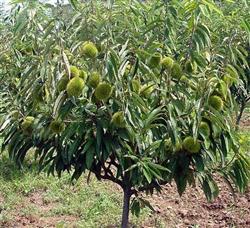
How are chestnuts planted and pruned? Please introduce
Chestnut planting and pruning can refer to the following methods:
Chestnut cultivation techniques
1. Choose a suitable plot: According to the characteristics of chestnuts, the soil pH of the plot must be around 4~7, the plot should be on the middle-lower part of a mountain, with good sunlight, and the soil is best if it is light sandy loam.
2. Planting density: For gentle slopes, 3 m x 4 m is suitable; sloping land can be appropriately sparser, and can be planted at 4 m x 8 m to allow intercropping with crops.
3. Land preparation: For flat land, according to the designed spacing between rows and plants, large holes of 80 cm x 80 cm x 80 cm can be dug. When digging, pile the mature soil above 40 cm on one side and the subsoil below 40 cm on the other side. When backfilling, mix the topsoil with organic fertilizer and phosphate fertilizer and fill it at the bottom of the pit, then fill the subsoil on top. It is best to prepare the land in summer and plant in late autumn and early winter or the following spring.
4. Planting: Based on many years of chestnut planting practice, first plant seedling trees, and after they survive and grow for one year, then graft them; they grow quickly and bear fruit early. Grafted seedlings suffer more from transplant shock after planting. Generally, when grafted seedlings and seedling trees are planted at the same time, after the seedling trees are grafted they have stronger growth vigor and higher yield than grafted seedlings planted in the same year. The planting depth should be slightly deeper than the depth in the nursery by 2~3 cm; it must not be too shallow or too deep. After planting, tread the soil firm, water thoroughly once, and after the water has seeped in, cover with a layer of dry soil on top to retain moisture.
5. Fertilization: Fertilizer and water management is the foundation for high-quality and high-yield chestnuts.
Apply base fertilizer once every year in late autumn and early winter. The base fertilizer should be mainly farmyard manure, with an appropriate amount of phosphate and potassium fertilizer added, and manganese fertilizer added when necessary. For topdressing, nitrogen fertilizer should be mainly used at bud break, and phosphate and potassium fertilizer should be mainly used in June to July.
6. Cultivation and weeding: Throughout the entire growing season, cultivation and weeding should be carried out continuously to keep the soil loose and free of weeds, reduce water evaporation and nutrient consumption, and promote vigorous plant growth.
7. Intercropping: Young orchards and sparsely planted orchards can be intercropped with green manure or crops, which can not only improve soil structure and increase soil fertility, but also increase income. For planted grass, hairy vetch, white clover, crown vetch, etc. can be planted; for crops, short-stalked plants such as soybean, black soybean, peanut, and sweet potato can be planted.
Training and pruning
(1) Training: At present, for chestnut tree shapes, Hebei Province mostly uses the open-center delayed layers form; Shandong and Shaanxi mostly use the open-center form. Practice has proved that the open-center form is easy to form, bears fruit early, and has high yield. Generally the trunk height is 50~60 cm, with three main branches or four main branches. The insertion zone of the main branches should be 20~40 cm, and they should not grow together. The specific method is: when the seedling grows to about 1 m high in June, it can be headed back at 80 cm. About one week after cutting, the buds below the cut can sprout and grow branches about 30~50 cm long, and a small crown can be formed in the same year. If there is not enough time to head back the shoot, it can be cut at 80 cm during winter pruning (trunk determination). In the second year, select and retain three suitably positioned branches as main branches, with main branch height 50~60 cm. By the third year's winter pruning, it can be cut or pinched at 40~50 cm, and from the branches emerging below the cut, select and retain the first lateral branch. The first lateral branch is about 45 cm from the base of the main branch, and the second lateral branch is in the opposite direction from the first lateral branch, about 30 cm from the first lateral branch. In this way, the training task is completed in 3~4 years.
(2) Pruning: Pruning young trees is mainly to expand the crown and accelerate crown formation, cultivate bearing mother branches, and achieve the goal of early fruiting and early high yield. Young trees have the habit of producing 3~4 parallel strong branches, namely three-pronged or four-pronged forks. They can be thinned at a ratio of thin one and leave two, or thin one, or cut one and leave two. In order to control apical dominance, maintain balanced growth vigor among branches and widen the branching angle, the methods of thinning upright branches and keeping slanting ones, thinning upper ones and keeping lower ones, and thinning strong ones and keeping medium ones can be used. For the slender weak branches below the extension branch, except for retaining some as auxiliary nurturing branches, all should be thinned out.
Pruning of perennial branches: According to the requirements of different tree structure forms, for dense branches and water sprouts other than the selected and retained main and lateral scaffold branches, such as those that overlap or are opposite to the main and lateral branches, as well as competing water sprouts sprouting from the lower part, they should be thinned from the base or controlled to ensure normal growth of the main and lateral branches, and attention should be paid to widening the angle of the main and lateral branches.
In order to achieve early high yield, vigorous branches of young trees can be pinched. When vigorous branches grow to 30 cm, they can be pinched to promote branching and also help flower bud formation.
For pruning mature trees, the focus is on adjusting tree structure and balancing tree vigor, promoting the growth of strong bearing mother branches, and solving the problem of poor light in the inner canopy. Diseased and insect-damaged branches, weak old branches, overlapping branches, crossing branches, and large branches that affect the tree shape should be thinned out.
Click to get more chestnut tree planting techniques
Click to get more fruit planting techniques