How to prune a chestnut tree? Teach you the correct pruning method
How to prune a chestnut tree? Please give guidance. A chestnut tree can be pruned by referring to the following methods: 1. Pruning of young trees. The tree forms of chestnut are mainly two types: the natural open-center form and the central-leader layered form. 1. Natural open-center form: This form has no central leader, only 3-4 main branches, and the natural trunk grows outward at an angle. The canopy is short and spreading...
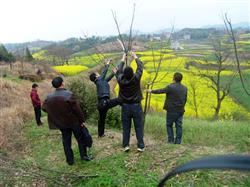
How to prune a chestnut tree? Please give guidance
A chestnut tree can be pruned by referring to the following methods:
I. Pruning of young trees
The tree forms of chestnut are mainly two types: the natural open-center form and the central-leader layered form.
1. Natural open-center form: This form has no central leader, only 3-4 main branches, and the natural trunk grows outward at an angle. The canopy is short, spreading, and open, which facilitates ventilation and light penetration and is suitable for close planting. It is currently the best tree form in use. Its shaping requirements are generally: trunk height 80-100 cm, and 3 main branches evenly distributed around the trunk are selected and retained. The main branches must grow outward at an angle, with an opening angle of 50-60°. Thereafter, from the branches produced on each main branch, 2-3 branches with a certain spacing and strong growth are selected and retained to be trained as secondary main branches. This keeps the canopy sparse and open, with good ventilation and light penetration, and enables three-dimensional fruiting.
2. Central-leader layered form: This form has a central leader, with 5-7 main branches, in layers
2-3 layers. The spacing between layers is 1.2-1.5 m, with 1-2 main branches in the second layer and 1 in the third layer. Each main branch retains 2-3 secondary main branches. Pinching is generally done when the new shoot has grown to about 30 cm, by removing the tender tip 3-5 cm long. After pinching, the 3-5 buds at the tip of the new shoot sprout and grow again, or a single bud sprouts and extends along a single axis. A ring scar forms at the pinching point, and the 3-5 buds below the ring scar are the center of nutrient distribution before the second new shoot sprouts and grows, and can form several large buds; in early-fruiting varieties they can even form flower buds. After repeated pinching, the 3-5 buds below the ring scar of branches at all levels have the same characteristics. According to surveys: the proportion of 2nd-4th order branches forming fruiting mother branches is 35%-56%, and even 90%. This makes winter pruning convenient. For shaping needs, cuts can be made to any 1st-order branch without affecting the next year's fruiting and canopy growth. After mid-August, pinching is generally not done.
During winter pruning, pruning the extension branches of the main branches is very important. The open-center form generally has 3-5 main branches. Each main branch should maintain a certain spacing, and try to avoid the 3-5 vigorous shoots produced at the tip all being used as scaffold branches at the same time. As the tree grows, the branches increase year by year. The selected and retained main branches should grow in an outward-slanting direction, not overlap, and be staggered and spread apart, which is favorable for ventilation and light penetration. The selected main branches should be headed back at a plump bud 40-50 cm along the branch to promote branching of the main branch. Due to apical dominance, the first bud below the cut produces a strong leader shoot, extending outward to expand the canopy. When the angle of several vigorous shoots at the tip of the main branch is too small, the middle vigorous shoot can be thinned out, so as to extend outward and expand the canopy.
During the pruning of young trees, because the amount of pruned branches is large, the latent buds on the trunk often sprout into water sprouts, which grow vigorously and upright. Water sprouts that affect the main branches and disrupt the tree form should be thinned out in time. Water sprouts growing in bare positions can be repeatedly pinched in summer to promote branching and transform them into fruiting branches.
Apart from the main branches of the tree and the side branches of the main branches that play a scaffold role, all other branches can be treated as auxiliary nurturing branches.
II. Pruning of fruiting trees
1. Pruning of fruiting mother branches: Most of the robust 1-year-old branches on the outer part of the canopy are excellent fruiting mother branches and should be retained; when they are too dense and overlapping, the weaker ones among them should be thinned out. For fruiting mother branches that grow too vigorously, 1-2 other branches should be selected and retained below them to be trained into new fruiting mother branches. When a mother branch tends to weaken due to fruiting year after year, it should be renewed by cutting back, and a new fruiting mother branch should be trained below it as a replacement. Thin, weak branches occurring near weak fruiting mother branches should be thinned out early so that nutrients are concentrated to supply the mother branch and turn it from weak to strong. Trees with weakened vigor often have many weak branches and few fruiting mother branches, so part of the weak branches should be thinned out to promote the formation of new fruiting mother branches. For ordinary weak branches or male flower branches, heading back or renewal pruning can be used to promote the bud at the cut or the branch below the cut to transform into a new fruiting mother branch.
2. Pruning of male flower branches: Because the bearing of male inflorescences creates blind nodes, which pushes the fruiting position outward, male flower branches over 10 cm long should be cut back leaving 2 buds at the base; short, thick male flower branches not exceeding 10 cm or with plump terminal buds can produce fruiting branches the following year and need not be pruned.
3. Pruning of vegetative branches: For vegetative branches over 30 cm long, because the buds in their middle and lower parts only produce weak shoots or do not sprout, the fruiting position often moves outward, so they should be cut back leaving 2 buds at the base to promote new fruiting mother branches; robust vegetative branches under 20 cm long can be left unpruned.
4. Pruning of fruiting branches after harvest: If the tail branch is robust and the buds are plump and full, treat it according to the above method for fruiting mother branches. If the tail branch is thin and weak and the buds are not plump and full, treat it as follows: if a new fruiting mother branch has already formed on the lower part of the fruiting branch, it should be left as the new fruiting mother branch, and the fruiting mother branch above it together with the old mother branch should be cut off; if the lower part is a vegetative branch, it can likewise be cut according to the method for vegetative branches; if the lower part has neither a fruiting mother branch nor a vegetative branch, then one fruiting branch close to the scaffold branch can be retained and cut back leaving 2 buds at its base.
5. Control and use of vigorous growing branches: For vigorous growing branches that are not too vigorous, leave them unpruned. The following year they can form flower buds; for strong, vigorous growing branches over 30 cm long, pinch them in summer first and then head them back in winter to promote branching, and the following year remove the strong and retain the weak, remove the upright and retain the slanting; for water sprouts occurring at the base of the main branches of weak trees, they should be retained as renewal branches.
The above are the general methods of winter pruning. Summer pruning uses two measures. First, bud removal: when buds sprout, keep 4-5 large buds on strong branches and remove the remaining sprouts, so as to promote fruiting branches and increase male flowers. Second, male flower removal: when the male inflorescences are less than 2 cm, except for retaining the first 4-5 male inflorescences at the very tip of the fruiting branch, remove all the rest.
Click to get more chestnut tree planting techniques
Click to get more fruit planting techniques