What are the control methods for the peach pyralid moth on Chinese chestnut?
How do you control the peach pyralid moth on Chinese chestnut? Please give guidance. The peach pyralid moth belongs to the order Lepidoptera, family Pyralidae. The larvae bore into and feed on the chestnut kernels, filling the seeds with frass and making them unfit to eat, and causing fruit drop, greatly affecting yield and quality. Its hosts also include peach, plum, and pear fruits, sunflower heads, corn stalks, and so on. Morphology...
How do you control the peach pyralid moth on Chinese chestnut? Please give guidance.
The peach pyralid moth belongs to the order Lepidoptera, family Pyralidae. The larvae bore into and feed on the chestnut kernels, filling the seeds with frass and making them unfit to eat, and causing fruit drop, greatly affecting yield and quality. Its hosts also include peach, plum, and pear fruits, sunflower heads, corn stalks, and so on.
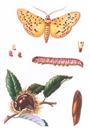
Morphology: The adult is about 10 mm long, with yellow wings bearing many black spots. The mature larva is about 30 mm long, with a dark brown head and a dark reddish-brown thorax and abdomen, and a pale green ventral surface. The mesothorax, metathorax, and the 1st to 8th abdominal segments each bear 8 brown circular setal patches. The anal plate on the last abdominal segment is grayish-brown.
Occurrence pattern: In Zhejiang there are 5 generations per year. It overwinters as mature larvae in cracks in the loose bark of fruit trees, tree holes, terrace edges, fruit stacking yards, and cracks in warehouse walls. Pupation begins in April of the following year. The 1st-generation larvae mainly damage peach fruits, with a few damaging plum, pear, and other fruits; most of the 2nd-generation larvae still damage peach fruits, while some move to corn and other crops to cause damage; subsequent generations mainly damage Chinese chestnut, corn, sunflower, and so on.
Control methods: (1) In winter, clear away fallen fruit on the ground in the orchard, finish this before April, and scrape off the old loose bark on the branches and trunks and dispose of it in a centralized way, so as to eliminate overwintering larvae. (2) Pick up fallen fruit, remove infested fruit, and destroy them. (3) Chemical control. Time the spraying to coincide with the peak emergence of adults of the 3rd and 4th generations (late July and late August), focusing the spray on the chestnut burs. Effective agents include 30% fenitrothion emulsifiable concentrate at 600 times dilution, which is effective against eggs, larvae of all instars, and adults; spraying this agent 20 days before harvest is relatively safe. In addition, 40% dimethoate emulsifiable concentrate at 800-1000 times dilution, 2.5% deltamethrin at 4000 times dilution, and 80% dichlorvos emulsifiable concentrate at 1500 times dilution are also effective. Because the peach pyralid moth has many hosts, control work must be done not only on Chinese chestnut but also on nearby peach trees, plum trees, sunflowers, and other crops, so that the damage by the peach pyralid moth can be controlled.
Click to get more Chinese chestnut tree cultivation techniques
Click to get more fruit cultivation techniques