What is the best time to graft chestnut trees?
When is the best time to graft chestnut trees? Please provide the method. Chestnut grafting is generally carried out in spring, but because spring often brings adverse weather such as low temperatures and heavy rain, along with human technical factors, the survival rate of spring grafting is not high. From 2003 to 2005, the author carried out grafting trials in summer, and the survival situations were respectively...
When is the best time to graft chestnut trees? Please provide the method
Chestnut grafting is generally carried out in spring, but because spring often brings adverse weather such as low temperatures and heavy rain, along with human technical factors, the survival rate of spring grafting is not high. From 2003 to 2005, the author carried out grafting trials in summer, and the survival rates were respectively: 79% in 2003, 76% in 2004, and 82% in 2005. After the grafts survived, the branches and shoots grew vigorously, the crown formed quickly, and fruiting occurred early, so summer grafting achieved good results. The key technical points are summarized below for the reference of chestnut producers.
I. Grafting time: Carry it out from late May to early June, over a period of about 15 days.
II. Scion selection and rootstock pruning: Select nutrient branches from the sunny spring shoot sections on the outer middle-upper part of robust mother trees that have borne fruit for many years with high and stable yield and excellent quality. They are required to be well developed, with prominent and relatively plump buds, branch length between 25-30 cm, and branch diameter between 0.8-1.2 cm. Use the scions as soon as they are collected; they must not be kept for long. Cut off from the base the densely growing and improperly positioned branches on the rootstock, leaving branches of basically uniform size that grow obliquely in four directions, with 4 branches at a branching angle of 45-50 degrees. The lowest branch should be 30-40 cm above the ground, and each branch should be cut back to a length of 40-50 cm. All leaves on the rootstock should be retained. Below the cut of each grafted branch, keep only 1-2 small branches as auxiliary nurturing branches, and cut off all the other small branches from the base.
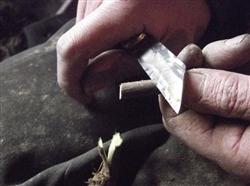
III. Main technical steps of grafting: For cutting the graft bud, cut off the leaves of the scion from the base, leaving the leaf stalks, but do not wipe them off by hand, so as to avoid leaving leaf scars and causing wounds on the scion. Then cut off both ends of the scion, leaving 3-4 relatively plump buds in the middle for single-bud cutting. Cut the graft bud into a decapitated bud and graft it using the single-bud cut grafting method. The cut graft bud should be grafted immediately; it must not be left for long, and it does not need to be soaked in clean water. For plastic film wrapping, choose plastic film with a specification of 3 mm, moderate in thickness, good in toughness, convenient to handle, not easy to tear, and able to tie firmly. When wrapping, take care to expose the bud eye.
IV. Post-grafting management: After grafting, inspect once every 3-5 days and remove the sprouts growing from the rootstock as early as possible. When the graft bud sprouts, cut off the auxiliary nurturing branches from the base and do a good job of managing the new shoots. Notes for new shoot management: 1) When the new shoots are about 15-20 cm long, pinch off the growing tips to promote branching. 2) Because summer shoots have sufficient nutrients, with long shoots and large luxuriant leaves, strong winds and heavy rain can easily break the new shoots, so small sticks should be used to tie and secure the new shoots. 3) When multiple new shoots sprout, remove the weak and keep the strong, remove the oblique and keep the straight, to accelerate healing of the graft union. 4) Prevent and control pests and diseases such as inchworms, flea beetles, and powdery mildew that harm the new shoots. 5) To supplement plant nutrition and help strengthen the shoots, topdress 1-2 times, applying 100 g urea plus 150 g compound fertilizer and 2.5 kg organic fertilizer per plant, applied in a shallow ring-shaped ditch after rain. The first topdressing is during the period when the new shoots turn green, and the second is during the sprouting period of the secondary new shoots. 6) For unbinding, it is advisable to remove the tied plastic film about 10 days before sprouting in the spring of the second year. At the same time, continue to remove the suckers growing from the rootstock.
Click to get more chestnut tree cultivation techniques
Click to get more fruit cultivation techniques