What are the scientific fertilization methods for chestnut trees?
How do you fertilize chestnut trees scientifically? Please give a detailed introduction. Chestnut, like other fruit trees, has the same fertilizer requirements, except that in addition to the three major elements of nitrogen, phosphorus and potassium, it is especially sensitive to the secondary element magnesium and the trace elements manganese and boron. If these are lacking or insufficient, serious physiological disorders occur that affect growth and development. According to measurements...
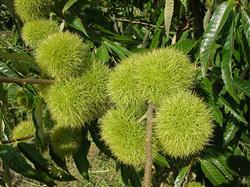
How do you fertilize chestnut trees scientifically? Please give a detailed introduction
In terms of fertilizer requirements, chestnut is like other fruit trees, except that in addition to the three major elements nitrogen, phosphorus and potassium, it is especially sensitive to the secondary element magnesium and the trace elements manganese and boron. If these are lacking or insufficient, serious physiological disorders occur that affect growth and development. According to measurements, chestnut is a fruit tree with a high manganese requirement; the leaves of normally growing trees contain 1000-2500 mg/kg manganese. If the level falls below 1000 mg/kg, leaf yellowing appears and growth is inhibited. If magnesium is deficient or the supply is insufficient, yellowing appears between the leaf veins, and the faded areas gradually turn brown and die. Because boron is an important element that promotes pollen germination, pollen tube growth and ovary development, boron deficiency in the soil leads to empty burrs. According to surveys, chestnut orchards with a soil available boron content of 0.56-0.87 mg/kg bear normally, with an empty burr rate of only 3%-6.9%; orchards with a content of 0.2-0.4 mg/kg have very low yields, with the empty burr rate reaching as high as 44%-81%. Duan Xugen of Meiyuan Village, Dongling Township, Jianchuan County, when planting chestnuts, mixed 100 g of borax into the base fertilizer for each tree, and after planting sprayed 350-times borax water once each June; the trees flowered and bore fruit in the third year, two years earlier than those not given boron fertilizer or boron sprays.
The demand for nitrogen, phosphorus and potassium is large, and the absorption periods differ. Nitrogen absorption is large and lasts a long time, continuing from bud break until before fruit harvest, with the greatest absorption during the rapid fruit swelling stage, and gradually decreasing only after harvest. Phosphorus absorption is relatively stable from after flowering until before harvest, but the amount absorbed is small, and the absorption period is also shorter than that of nitrogen and potassium. However, phosphorus is extremely important to the fruiting performance and yield of chestnut. According to measurements, in high-yield orchards of trees in full bearing age, the soil available phosphorus content reaches as high as 20.18-27.00 mg/kg, and the phosphorus content in new shoots reaches 2420 mg/kg; in low-yield orchards, the soil phosphorus content is only 1-9 mg/kg, and the phosphorus content in new shoots is as low as 1360 mg/kg, showing how great a role phosphorus plays in yield. Phosphorus is an important substance that promotes flower bud differentiation, fruit development, seed maturity and improved quality. Potassium is absorbed in small amounts starting before flowering, gradually increases after flowering, is absorbed most during the fruit enlargement stage, and drops sharply again after harvest. This proves that in the annual growth cycle, from male flower differentiation in early spring to flowering and fruit set, nitrogen is needed most, followed by potassium, with less phosphorus; from after flowering to the fruit swelling stage, phosphorus is needed most, followed by nitrogen and potassium; from the fruit enlargement stage to harvest, potassium is needed most, followed by nitrogen, with less phosphorus.
Key points of fertilization
Young trees: For young trees under 7 years old, follow the principle of "apply frequently and lightly, many times with small amounts, less first and more later, light first and concentrated later." The interval between fertilizations should be short, the concentration light, the number of applications many, and the amount of fertilizer small, reducing the frequency and increasing the concentration and amount as the tree age increases. Generally, for 1-3 year old trees, from early February to the end of May, apply a quick-acting nitrogen fertilizer once every 40-45 days, each time applying 15-20 kg of decomposed clear human and animal manure or 20-30 g of urea per tree, to promote the sprouting and growth of branches and leaves. From early June to the end of August, apply a complete nitrogen-phosphorus-potassium fertilizer once every 40-45 days, each time applying 30-40 g of ternary compound fertilizer per tree, to promote the development, maturity and filling out of shoots. For 4-7 year old trees, topdress once every two months from February to August, still mainly with nitrogen in the early stage, followed by potassium, then phosphorus, and applying nitrogen-phosphorus-potassium ternary compound fertilizer in the middle and late stages, but the fertilizer amount should increase in step with the tree age year by year. The suitable annual application ratio of nitrogen, phosphorus and potassium is 1:0.7:0.8. Spray 300-350-times borax water once each in April and June every year to promote earlier bearing. After entering the 4th year of growth, apply base fertilizer by expanding the planting hole with a full ring ditch or half ring ditch.
Mature trees: Bearing mature trees should be fertilized three times a year, with the annual nitrogen-phosphorus-potassium ratio at about 1:0.85:0.9.
① Pre-flowering fertilizer: In March, after sprouting and before flowering, apply together with spring irrigation, applying 100-120 kg of decomposed clear human and animal manure or 350-400 g of urea per tree, to promote leaf emergence and shoot growth, flowering and fruiting, and to increase fruit set rate and yield.
② Fruit-swelling fertilizer: Apply during the rapid fruit swelling stage, applying 800-1000 g of nitrogen-phosphorus-potassium ternary compound fertilizer per tree, to promote fruit development and improve quality.
③ Base fertilizer is the basic fertilizer that supplies the chestnut tree's growth and development throughout the year. It requires complete elements, a coordinated ratio, a large amount, high concentration, and timely application. The fertilizer can be barnyard manure, compost, soil and miscellaneous fertilizers, composted and processed garbage fertilizer, sugar mud, green manure, or cake fertilizer. In red or yellow soil low in available phosphorus and boron, add an appropriate amount of chemical phosphate fertilizer and borax. Generally, for trees of moderate vigor, medium fertility and relatively heavy bearing, apply 80-100 kg of decomposed barnyard manure, 3-4 kg of superphosphate, and 100 g of borax per tree. Applying in September-October after fruit harvest is best. Use half ring ditches, radial ditches, fan-shaped pits and strip ditches; for trees whose root systems have already filled the whole orchard, open ditches between rows or broadcast over the whole orchard and turn under.
In addition, whether small or large trees, during the growth period from May to July, when spraying pesticides for pest and disease control, add manganese and magnesium elements for mixed spraying to supplement micronutrients, at concentrations of 3500-times manganese sulfate and 2500-3000-times magnesium sulfate. Borax should be sprayed at full bloom, preferably at 300-350 times.
Click to get more chestnut tree planting techniques
Click to get more fruit planting techniques