How to prevent empty burrs in chestnuts? An introduction to practical prevention methods
How to prevent empty burrs in chestnuts? What methods are available? Please advise. Empty burrs in chestnuts are also called empty husks or empty shells, and growers call them "mute chestnuts." The rate of empty burrs in chestnuts is generally about 15%, and can reach as high as 80%, with some trees having almost entirely empty burrs. Therefore, preventing empty burrs is key to increasing chestnut yield and quality. Reasonable selection...
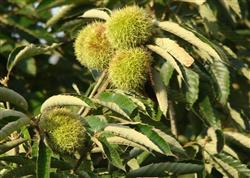
How to prevent empty burrs in chestnuts? What methods are available? Please advise.
Empty burrs in chestnuts are also called empty husks or empty shells, and growers call them "mute chestnuts." The rate of empty burrs in chestnuts is generally about 15%, and can reach as high as 80%, with some trees having almost entirely empty burrs. Therefore, preventing empty burrs is key to increasing chestnut yield and quality.
Reasonable selection and arrangement of pollinizer trees. Chestnuts have a high fruit-setting rate under cross-pollination, while self-pollination often does not set fruit easily. Therefore, when planting, choose excellent varieties with a high fruit-setting rate, and also pay attention to selecting and arranging pollinizer trees. There are many chestnut varieties in various regions, and the pollination combinations also differ. For example, if the main cultivar is Gannong 77-01, the best pollination combinations are Gannong 77-02 and Gannong 77-04 respectively. The number of pollinizer trees arranged should account for about 1/3 of the total number of trees. Practice has proven that reasonably selecting and arranging pollination combinations can greatly increase the fruit-setting rate and increase chestnut yield.
Properly thin out male flowers. Chestnut trees are monoecious with separate male and female flowers; male flower catkins open first, and female flower clusters open later. When the male catkins grow to 2-3 cm, removing 90% of the male flowers not only does not affect the tree's normal pollination, but also results in clean and healthy-looking leaves, a high fruit-setting rate, and increased single-fruit weight. It can also advance maturity by 7-10 days, allowing early harvest and early marketing. Properly removing male flowers from chestnuts is indeed a measure to increase yield and income, and its effect is especially prominent on young trees.
Increase application of boron fertilizer. Chestnuts are very sensitive to boron, especially in boron-deficient soil, where increasing the application of boron fertilizer can effectively reduce the empty burr rate and increase per-tree yield. Specific application methods: First, apply boron at the bud-break stage. In early spring, together with the application of bud-break fertilizer, apply borax into the soil, generally 100-150 grams of borax per tree, and in boron-deficient soil, a somewhat larger amount may be applied. Second, spray boron at the flowering stage. Use 100 grams of borax per 1/15 hectare, mix with 50 kg of water, and spray evenly on the female flowers. For those with a high empty burr rate, the boron spray concentration may be appropriately increased. After boron application and boron spraying, the empty burr rate of chestnuts can be reduced by 20%-30%, and yield can be increased by 3-4 times.
Click to get more chestnut tree cultivation techniques
Click to get more fruit cultivation techniques