How to grow sweet persimmons well? Master these key cultivation techniques
How to grow sweet persimmons well? Please give a detailed introduction. Sweet persimmon is a rare delicacy among persimmons introduced into China from Japan, with more than ten varieties such as Xinshilang, Fuyu, Izu, and Nishimura Wase. It has high nutritional and health value, stores and transports well, has good market quality, and has excellent development prospects. The high-quality and high-yield cultivation techniques are introduced as follows:...
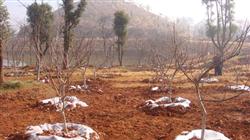
How to grow sweet persimmons well? Please give a detailed introduction
Sweet persimmon is a rare delicacy among persimmons introduced into China from Japan, with more than ten varieties such as Xinshilang, Fuyu, Izu, and Nishimura Wase. It has high nutritional and health value, stores and transports well, has good market quality, and has excellent development prospects. The high-quality and high-yield cultivation techniques are introduced as follows:
I. Orchard establishment and planting
Choose sandy loam with deep soil and a pH of 5.5--7.5; mountain land, flat land, and hilly land are all suitable. Dig a trench 100 cm wide and 80 cm deep, or large holes of 100 cm x 100 cm x 80 cm, and apply 50 kg of decomposed barnyard manure per hole, plus 5 kg of superphosphate and 0.3 kg of potassium chloride as base fertilizer. The best planting time for sweet persimmon is October--November. Generally, it is best to use good-quality strong seedlings grafted onto Wild Persimmon No. 6 rootstock, planting 100--120 plants per 667 sq m, and arranging pollinator varieties in a female-to-male ratio of 12:1.
II. Soil, fertilizer, and water management
At the young tree stage, pay attention to loosening the soil and removing weeds, and apply appropriate topdressing. In a first-year planting orchard, apply the first fertilizer after spring shoots sprout, with 5--10 g of urea and 5 kg of human and livestock manure water per plant, then topdress 1--2 times per month, gradually increasing the amount. In the second year, fertilize once each in March, May, August, and September. In the third year, young trees begin to bear fruit, so potassium fertilizer and a small amount of boron fertilizer should be added. In years 4--5, sweet persimmon enters the high-yield period, and the "three fertilizers" should be applied well. That is, first, pre-flowering fertilizer, applied in March--April, with 100 g of urea, 100 g of potassium sulfate, 50 g of phosphate fertilizer, 5 g of borax, and a small amount of multi-element micro-fertilizer per plant; second, fruit-swelling fertilizer, applied in June--July, with 100 g of urea, 150 g of superphosphate, and 150 g of potassium sulfate per plant; third, post-harvest fertilizer, applied in November--December, mainly organic fertilizer and phosphate fertilizer, to provide sufficient nutrients for high yield the following year.
Persimmon roots are afraid of waterlogging, so during the rainy season, pay attention to clearing ditches and draining water, and strictly prevent waterlogging. And July--September, before the fruit expands, is exactly the dry period, so watering for drought resistance should be done in time.
III. Training and pruning
At planting, cut off the treetop at a seedling height of 0.9--1 m. In the dormant period in winter or early spring of the same year, select 3 branches growing in different directions and at different levels but with the same vertical and horizontal spacing as main branches, with the first main branch 40--50 cm above the ground. Cut off 20% of the branch tip length from both the main branches and the non-main branches on the trunk. Two years after planting, cut off all non-main branches in winter, cut off 20% of the current year's growth from the main branches, and then cut off the thin, weak, crossing, and overlapping branches on the side branches. Finally, at about 50 cm from the branching point on the trunk, select a robust branch extending to the side as the first secondary main branch, and together with the other retained side branches, cut off 20% of the current year's growth. Three years after planting, select and retain the second secondary main branch in the same way, so as to form a dwarfed natural open-center canopy.
Pruning of adult trees is mainly to cultivate robust fruiting mother branches on the main branches and secondary main branches. In winter, shorten fruiting branches and some thin, weak branches, and retract some overly long secondary main branches and old fruiting mother branches. In summer, methods such as twisting branches, pulling branches, and girdling can also be used to cultivate thick and short fruiting mother branches. And replace them in rotation each year. Timely thin out overly dense branches, overlapping branches, thin and weak branches, and water sprouts inside the canopy to ensure good light penetration inside the canopy.
IV. Flower and fruit management
1. Girdling at flowering stage: For trees with excessive vegetative growth, during full flowering, girdle the main branches and secondary main branches to a width of 0.2--0.4 cm and deep to the xylem to increase the fruit-setting rate.
2. Artificial pollination: Young sweet persimmon male plants have fewer male flowers, and artificial pollination can increase the fruit-setting rate by more than 35%.
3. Flower and fruit thinning: For weak trees and heavily flowering trees, thin out weak flowers and overly dense flowers at the flowering stage, and thin out small fruit and deformed fruit at the young fruit stage. After the first physiological fruit drop in July, select and retain robust young fruit at a ratio of 20--25 leaves to one fruit, and remove excess fruit.
4. Bagging to protect fruit: Bagging can make the fruit smooth and uniform and prevent bird damage, sunscald, and fruit cracking, thereby increasing the proportion of high-quality large fruit. Bagging is carried out after fruit thinning. Spray a fungicide once before bagging, then bag with double-layer breathable paper bags. Remove the bags 15 days before the fruit ripens for coloring.
V. Pest and disease control
1. Disease control: The main diseases of sweet persimmon include anthracnose, angular leaf spot, and gray mold. Prevention should be the main approach. Before planting, disinfect the seedlings well, and in winter, do a good job of cleaning the orchard. For anthracnose and angular leaf spot, spray 70% thiophanate-methyl 500x solution for control; for gray mold, spray 50% duomeiqing 1000x solution at the early stage of the disease, and if 50% procymidone 4500x solution is added, the effect is even better.
2. Pest control: To control persimmon fruit borer, in early May, broadcast 0.5 kg of 4% dimethoate-malathion powder on the ground under the canopy to poison overwintering larvae, and spray 20% fenvalerate EC 3000x solution at the early larval stage; for nettle caterpillars, spray 2.5% deltamethrin 3000x solution during the larval occurrence period; for scale insects, spray 40% methidathion 1000x solution during the larval occurrence period.
Click to get more persimmon tree cultivation techniques
Click to get more fruit cultivation techniques