How to prevent and control brown spot disease in Hami melon? Growers must read
How to prevent and control brown spot disease in Hami melon cultivation? Please provide an introduction to the methods. Brown spot disease is a common disease of Hami melon, widely distributed, mostly occurring sporadically, with mild symptoms and no impact on production. In severe cases, the diseased plant rate can reach over 80%, causing some leaves to become diseased and necrotic, affecting yield and quality to a certain extent. Symptoms...
How to prevent and control brown spot disease in Hami melon cultivation? Please provide an introduction to the methods
Brown spot disease is a common disease of Hami melon, widely distributed, mostly occurring sporadically, with mild symptoms and no impact on production. In severe cases, the diseased plant rate can reach over 80%, causing some leaves to become diseased and necrotic, affecting yield and quality to a certain extent.
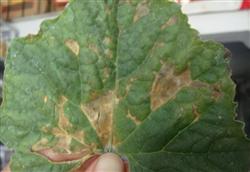
Symptoms: This disease mostly occurs in the middle and late stages of Hami melon growth, infecting only leaves. Initially, small brown spots appear on the leaves, which later develop into nearly circular to irregular brown necrotic spots, with significant size variation. The lesion margins are distinct, often with a yellow-green to light yellow halo. Generally, mold layers on the lesions are not visible; dark gray mold layers, namely the pathogen's conidiophores and conidia, are produced only under continuous rainy or high-humidity conditions.
Pathogen: Cercospora citrullina Cke., called cucurbit Cercospora, belonging to the Deuteromycotina fungi. The pathogen's conidiophores are borne in fascicles, brown, straight or curved, without geniculate nodes, unbranched, with 0-4 septa, flat-topped at the apex, with obvious spore scars, measuring 27.5-90μm × 4.3-5μm. Conidia are colorless, needle-shaped or whip-shaped, straight or curved, with 4-21 septa, measuring 22.5-175μm × 2.8-5μm.
Disease characteristics: The pathogen overwinters in the soil as conidial clusters or mycelium; the pathogen can also overwinter as chlamydospores and sclerotia. When conditions are suitable, conidia are produced and spread by airflow or rain splashes for primary infection; after disease onset, new conidia are formed for repeated infection. Warm and high-humidity conditions favor disease development. The disease onset temperature is 20-30°C, relative humidity above 90%; when the temperature is 25-27°C and humidity is saturated, the disease occurs more severely. High temperature and high humidity in the middle and late growth stages, or more rainy days, or prolonged closed greenhouse conditions, or large day-night temperature differences all favor disease development.
Control methods
(1) Agricultural control.
① Implement crop rotation with non-cucurbit and non-legume crops for more than 2-3 years in severely affected plots to control disease occurrence.
② Strengthen cultivation management, pay attention to ventilation and air permeability, apply fertilizer scientifically, irrigate timely, cultivate strong seedlings, promptly remove diseased plants, thoroughly clear diseased residues after harvest, and reduce field inoculum sources.
(2) Chemical control.
Apply chemical control at the early stage of disease onset. Options include 50% anilazine wettable powder at 500 times dilution, or 50% vinclozolin wettable powder at 1000 times dilution, or 40% flusilazole emulsifiable concentrate at 8000 times dilution, or 6% fenarimol wettable powder at 1500 times dilution, or 70% thiophanate-methyl wettable powder at 600 times dilution, or 80% mancozeb wettable powder at 600 times dilution for spraying. In protected cultivation, use 6.5% dimethirimol dust at 15kg/hm2 for dusting control.
Commonly used fungicides: anilazine, vinclozolin, flusilazole, fenarimol, thiophanate-methyl, mancozeb, dimethirimol.
Click to get more Hami melon cultivation techniques
Click to get more fruit cultivation techniques