What are the symptoms of banana leaf spot disease?
What do the symptoms of banana leaf spot disease look like? Please explain that there are two common types of banana leaf spot disease, namely yellow stripe leaf spot and black stripe leaf spot. In the past two years, they have occurred from time to time in banana plantations. The area of banana leaves damaged often accounts for 20%-40% of the total leaf area, and in severe cases over 80%. Most leaves of diseased plants dry up...
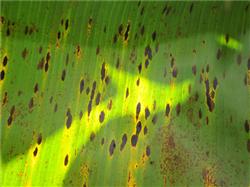
What do the symptoms of banana leaf spot disease look like? Please explain
There are two common types of banana leaf spot disease, namely yellow stripe leaf spot and black stripe leaf spot. In the past two years, they have occurred from time to time in banana plantations. The area of banana leaves damaged often accounts for 20%-40% of the total leaf area, and in severe cases over 80%. Most leaves of diseased plants dry up and die, the plants cannot produce flower stalks and set fruit, or the fruit bunch and fingers become smaller, resulting in a sharp drop in yield and poorer fruit quality, and in severe cases the yield can be reduced by more than 50%.
Symptoms: In the early stage of yellow stripe leaf spot, fine yellow-green lesions appear on the upper surface of the third or fourth young leaf from the top of the plant. The lesions expand longitudinally parallel to the leaf veins, forming yellow-green or yellow stripes. The stripes then expand to form dark patches, which become water-soaked, with the center turning brown or rusty red and surrounded by a yellow halo. Later, the central tissue of the patches or stripes dries up. When the disease is severe, multiple lesions or stripes merge with each other, the surrounding tissue necroses, and large areas of the leaf turn black, dry up and die rapidly. Black stripe leaf spot initially appears between the veins on the lower surface of the third or fourth fully expanded young leaf, as fine chlorotic spots. The spots expand into rusty brown stripes, which then darken and become dark red, brown or black. On severely affected leaves, the lesions or stripes merge, causing large areas of mesophyll tissue to be destroyed, turning black and water-soaked; finally the diseased leaves die rapidly, dry up and droop, hanging upside down on the pseudostem. Leaf spot disease is a fungal disease that is prone to epidemic outbreak under high temperature and high humidity weather conditions, especially after typhoons and rainstorms, when many wounds are caused on the leaves and the disease becomes more severe. It is most commonly seen in banana plantations with dense planting, no removal of suckers, poor soil drainage, weeds growing all around the plantation, inadequate management, excessive application of nitrogen fertilizer, and poor ventilation.
Click to get more banana cultivation techniques
Click to get more fruit cultivation techniques