Symptom Identification and Control Methods of Banana Anthracnose
What is banana anthracnose and how to control it? Please give an introduction. Anthracnose is a common disease in banana-producing areas and also the most important post-harvest disease in banana-producing areas worldwide. On yellow-ripe fruit peel, plum-blossom-spot-like lesions appear, and the lesions rapidly expand into dark brown patches, causing the whole fruit to turn black and rot. When the fruit stalk is affected, it causes the banana fingers to drop...
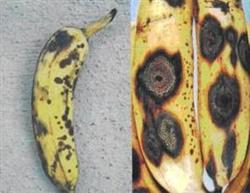
What is banana anthracnose and how to control it? Please give an introduction
Anthracnose is a common disease in banana-producing areas and also the most important post-harvest disease in banana-producing areas worldwide. On yellow-ripe fruit peel, plum-blossom-spot-like lesions appear, and the lesions rapidly expand into dark brown patches, causing the whole fruit to turn black and rot. When the fruit stalk is affected, it causes the banana fingers to drop. When leaves are affected, the lesions are not obvious at first, but later become irregularly elongated, with a gray center bearing many small black dots. When the pseudostem is affected, the top turns black, and in severe cases the stem rots. If the pathogen invades shortly after flowering, the tips of the young fruit turn black and rot. The pathogen is Colletotrichum musae. The initial infection source of the disease in the field comes from diseased banana trees. The conidia on the lesions are spread by wind, rain or insects, and after invasion, the disease most easily occurs first on young and tender tissues. In fruit, it usually exists as a suppressed infection, with the pathogen dormant under the epidermis until the fruit becomes yellow-ripe, when symptoms rapidly appear. Conidia of the pathogen in fruit packaging materials and ripening rooms are also one of the sources of inoculum for this disease during fruit storage and transport. The occurrence of the disease is closely related to temperature, humidity and variety: during periods of high temperature and high humidity in summer and autumn, the disease occurs severely, while in winter with low temperature and dryness, the disease is milder. Among cultivated varieties, Baiyoushen, Heiyoushen and Dongguan Zhongba are relatively resistant; 63-1 and Gaojiao Dundi Lei are relatively susceptible.
Control methods: (1) Clean the banana plantation and collect diseased and dead leaves for burning; apply more fertilizer and strengthen tree vigor. (2) Chemical control. Starting from the flower bud emergence and flowering stage, spray a mixture of 50% carbendazim 500-fold solution + high-lipid film every 10-15 days, for 3-4 consecutive times, which can effectively reduce the damage of anthracnose. After fruit harvest, soak the fruit in 45% thiabendazole or 50% imazalil 500-fold solution for 1-2 minutes, dry it, and place it in a sealed plastic film bag with potassium permanganate solid preservative added, which effectively inhibits the occurrence of anthracnose, prolongs the green fruit stage, and reduces fruit rot during storage and transport. (3) Choose sunny days for timely harvest; during harvest, do not let banana fruit directly contact the ground, avoiding wounds. (4) Fruit packaging and ripening sites and packaging materials must be fumigated and disinfected with 0% formalin solution before each use.
Click to get more banana cultivation techniques
Click to get more fruit cultivation techniques