Detailed Guide to Identifying Symptoms of Banana Root Nematode Disease and Control Methods
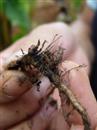
What is banana root nematode disease and how is it controlled? Please provide an introduction. The introduction to banana root nematode disease and control methods is as follows: (1) Symptoms. Root nematodes infect the roots of banana. Affected large roots appear short and swollen, with cracking, and galls sometimes form on small roots. Sometimes they are destroyed before developing into large roots; when swollen, cutting the tissue open reveals brown dotted substances. Because of nematode damage, the roots become infected by pathogenic bacteria, causing root rot and leaving few effective roots. Above ground, the main symptoms are stunted plants, yellow leaves or clustered leaves, loose bunches, loss of green at leaf margins, many dead leaves, and wavy, crinkled leaves. In plants that have emerged from the bud, old leaves look scorched, withering from the leaf margin to the midrib. In severe cases, the fruit bunch cannot bend down normally, and the fruit is thin, small, shriveled and hard; sometimes the symptoms resemble bunchy top disease, except that the petiole has no "green veins".
What is banana root nematode disease and how is it controlled? Please provide an introduction.
The introduction to banana root nematode disease and control methods is as follows:
(1) Symptoms. Root nematodes infect the roots of banana. Affected large roots appear short and swollen, with cracking, and galls sometimes form on small roots. Sometimes they are destroyed before developing into large roots; when swollen, cutting the tissue open reveals brown dotted substances. Because of nematode damage, the roots become infected by pathogenic bacteria, causing root rot and leaving few effective roots. Above ground, the main symptoms are stunted plants, yellow leaves or clustered leaves, loose bunches, loss of green at leaf margins, many dead leaves, and wavy, crinkled leaves. In plants that have emerged from the bud, old leaves look scorched, withering from the leaf margin to the midrib. In severe cases, the fruit bunch cannot bend down normally, and the fruit is thin, small, shriveled and hard; sometimes the symptoms resemble bunchy top disease, except that the petiole has no "green veins".
(2) Pathogen and conditions for disease occurrence. The root nematodes parasitic on banana in China include 13 genera and 31 species, among which spiral nematodes, root-knot nematodes and stunt nematodes are the most widely distributed and cause a certain amount of damage to banana. Root-lesion nematodes and needle nematodes can form very large populations locally, and their damage also deserves attention. Abroad, there is also the more destructive burrowing nematode, so special attention should be paid when introducing banana suckers from abroad.
In China, Fujian Province has more banana nematode damage; plants severely damaged by nematodes have also occurred in Wuchuan County, Suixi County and other places in Guangdong Province. Root nematodes occur mostly in sandy soil banana plantations with extensive management, and are especially serious during drought; nematode damage is rarely seen in clay soil.
(3) Control methods. Use disease-free seedlings for planting: when taking suckers from affected areas for planting, first cut off the sucker roots, soak the corm in hot water at 55°C for 5 minutes to kill the root nematodes, and then plant.
Chemical control: in affected banana plantations, nematicides can be applied regularly for soil disinfection. The chemicals include carbofuran, ethoprophos, aldicarb, isofenphos-methyl, etc., using 2-3 grams of active ingredient per plant, once every 2-3 months, and strengthening fertilizer and water management.
Crop rotation to purify the soil: in severely affected banana plantations, rotate with crops such as sugarcane, soybean and rice, and clear weeds and diseased residual roots. When replanting banana, plow the soil and expose it fully to the sun until it turns white.
Click to get more banana cultivation techniques
Click to get more fruit cultivation techniques