Summer Pruning Methods and Technical Key Points for Kyoho Grapes
How should Kyoho grapes be pruned in summer? Please give an introduction. For Kyoho grapes in summer, the following methods can be used for pruning: 1. Thinning inflorescences and pinching cluster tips. Thinning inflorescences of Kyoho grapes should be determined according to the strength of the new shoots and the size of the plant load. The average weight of a Kyoho cluster is about 400 grams, and the yield target per mu is generally 1600 kg...
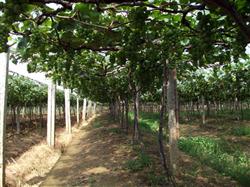
How should Kyoho grapes be pruned in summer? Please give an introduction.
For Kyoho grapes in summer, the following methods can be used for pruning:
1. Thinning inflorescences and pinching cluster tips. Thinning inflorescences of Kyoho grapes should be determined according to the strength of the new shoots and the size of the plant load. The average weight of a Kyoho cluster is about 400 grams, and the yield target per mu is generally 1600 kg. According to the requirements for average cluster weight and yield per mu, if the number of flower clusters is too large, within 15-25 days before flowering, first thin out the weak small inflorescences among the more than 2 inflorescences on 1 fruiting branch, then thin out the inflorescences on weak fruiting branches, so that strong branches retain 1-2 inflorescences, medium branches retain 1 inflorescence, and weak branches retain no inflorescence; extension branches retaining 1 inflorescence is helpful to control excessive growth, and reserve branches retain no inflorescence so that they grow robustly. The number of inflorescences retained before flowering should be about 1/4 more than the expected flow, and after fruit set, remove those clusters with heavy fruit drop.
Pinching the cluster tip should be carried out about 10 days before flowering, not too early and not too late. If done too early, the flower cluster has not yet extended, and it is inaccurate to keep or remove; if too late, nutrients are consumed, which is not conducive to preserving flowers and fruits. Pinching off 1/3 of the total length of the inflorescence has the best effect, and at the same time remove the secondary cluster to ensure the clusters are neat, attractive, and more marketable. If you want to retain the secondary cluster, then the secondary cluster should also be pinched from its tip by about 1/3 of its length.
2. Tying and training new shoots, regulating tree vigor. The base of Kyoho grape new shoots is relatively thin and is easily broken from the base by wind, causing bareness and reduced yield. To prevent this loss and facilitate ventilation, when the new shoots grow to about 30-40 cm, they should be tied to the trellis in time. In this way: (1) For strong vigorous shoots or excessively vigorous branches, twist and injure them from the 1-2 node position at the base before flowering, then press them flat and tie them; (2) For medium vigorous shoots, tie them in an arch shape with the inflorescence as the highest point, to weaken apical dominance, shift nutrients to the fruit clusters, and benefit flower bud differentiation at the base; when the new shoots grow to about 45 cm or reach the size of medium vigorous shoot vigor, then tie them in an arch shape again. In this way, the tree vigor of the current year is regulated, and a good foundation is laid for a high yield the next year.
3. Pinching the main shoot. Pinching of fruiting shoots is carried out from 3-5 days before flowering to the beginning of flowering. If done too early, the secondary shoots will emerge too early and compete with the flower clusters for nutrients; conversely, if pinching is too late, it will cause flower and fruit drop. Fruiting shoots retain 7-9 leaves; vegetative shoots retain 9-12 leaves; reserve shoots are pinched in the same way as fruiting shoots in terms of leaves retained. Pinching of the main extension shoot should be carried out around August.
4. Handling secondary shoots. After pinching the new shoots, the formation of secondary shoots in the leaf axils of the new shoots is accelerated, and they must be handled in time. Generally, during the entire growth period, they need to be handled 3-4 times. The methods are: (1) All secondary shoots below the fruit cluster are removed from the base; that is, the secondary shoots themselves retain no leaves; for secondary shoots in each leaf axil above the fruit cluster, before the rainy season and after the rainy season, retain one leaf and repeatedly pinch; during the rainy season, retain 2-3 leaves and repeatedly pinch. (2) All secondary shoots below the fruit cluster are removed from the base without retaining leaves; for secondary shoots above the fruit cluster, except for the terminal 1-2 that retain 4-5 leaves and are pinched, and later pinched again retaining 1-2 leaves repeatedly, all the rest are removed from their stems. Either of the above two methods may be used. (3) For secondary shoots of vegetative shoots and extension shoots, retain the terminal 1-2 secondary shoots with 1-2 leaves and repeatedly pinch, and all the other secondary shoots may be removed entirely without retaining leaves. (4) The handling of secondary shoots on reserve shoots is the same as that for secondary shoots on fruiting shoots.
5. Removing tendrils and picking old leaves. Grape tendrils grow the fastest during plant growth and are the vanguard. When branches and vines are manually tied, tendrils are completely ineffective, so they should be removed at any time in combination with other summer management work. Ventilation and light penetration are measures to ensure good coloring of Kyoho grapes. In early August, appropriately pick off some aged leaves.
Click to get more grape growing techniques
Click to get more fruit growing techniques