What are the correct methods for summer pruning of grapes?
How should grapes be pruned in summer? Here is an introduction to the pruning methods. It is carried out from grape bud break to the inflorescence emergence stage; the earlier the shoots are removed, the less nutrients are consumed. The method is: on the trunk and old canes, remove all sprouting buds, twin buds, thin and weak buds, diseased and pest-damaged buds, overly dense buds, and buds with few fruiting clusters, so that the retained buds are evenly distributed...
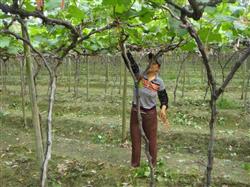
How should grapes be pruned in summer? Here is an introduction to the pruning methods
It is carried out from grape bud break to the inflorescence emergence stage; the earlier the shoots are removed, the less nutrients are consumed. The method is: on the trunk and old canes, remove all sprouting buds, twin buds, thin and weak buds, diseased and pest-damaged buds, overly dense buds, and buds with few fruiting clusters, so that the retained buds are evenly distributed and grow vigorously, promoting fruiting.
Pinching: The timing and number of pinchings should be determined according to the variety, tree vigor and pruning method. Pinching at the flowering stage can stop the growth of new shoots for 10 to 15 days, directing nutrients to the inflorescences, ensuring good pollination and improving the fruit-setting rate. Vigorous fruiting canes should be pinched leaving 4 to 6 leaves above the inflorescence, extension canes should be pinched leaving 12 to 20 leaves, and reserve canes should be pinched leaving 10 to 15 leaves; this helps promote fruit ripening and accelerate cane lignification. When bud-break growth is excessively vigorous, pinch multiple times to control cane growth and reduce nutrient consumption.
Treatment of lateral shoots: Lateral shoots below the fruit cluster should be removed entirely; those above can be pinched leaving 1 to 4 leaves, and any lateral shoots that sprout afterwards should be removed entirely except for the topmost cane. On developing canes, lateral shoots should be pinched leaving 2 to 3 leaves; if later-emerging lateral shoots have flower clusters, they can be retained, otherwise keep only the topmost one and remove all the rest.
Girdling: In the middle of the node below the fruit cluster, use a small knife or girdling shears to remove a ring of bark 3 to 5 mm wide around the cane.
Removing tendrils and tying canes: To save tree nutrients, tendrils should be removed as much as possible. The 2 to 3 young tendrils at the shoot tip are best retained to maintain the growth-point advantage, and the tendrils should be removed once the new shoot has extended forward more than 25 cm. To prevent canes from breaking and to ensure even distribution on the trellis, on a trellis generally tie one at 30 to 40 cm along the cane, and on a pergola generally tie one at 1 m along the cane.
Leaf removal: To improve the light conditions near the fruit clusters, part of the old leaves should be removed to promote fruit coloring. Generally, leaves are removed when the fruit softens.
Click to get more grape growing techniques
Click to get more fruit growing techniques