How to prevent and control grape berry shrivel during summer high temperatures and drought
How to prevent grape berry shrivel during summer high temperatures and drought? Please provide guidance. During summer high temperatures, summer drought often occurs at the same time, which easily causes leaf transpiration to increase rapidly. Leaves not only obtain water from the roots through the stem, but also compete with the fruit for water to supply their transpiration. When the berries lose water and the fruit temperature rises, it will produce...
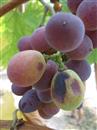
How to prevent grape berry shrivel during summer high temperatures and drought? Please provide guidance.
During summer high temperatures, summer drought often occurs at the same time, which easily causes leaf transpiration to increase rapidly. Leaves not only obtain water from the roots through the stem, but also compete with the fruit for water to supply their transpiration. When the berries lose water and the fruit temperature rises, local scorching will occur, causing grape berry shrivel.
This disease generally begins to occur about 30 days after berry growth starts. On the flesh under the berry skin, brown spots the size of needle tips appear. If the spots develop and expand rapidly, they form lesions. The lesions are nearly round, oval, or elongated oval, varying in size. The diameter of a large lesion can reach 1/3 of the berry surface. The lesions are initially light brown, then quickly turn black and sunken, resembling finger pressure marks. The lesions of this disease feel hard, and the vascular bundles in the flesh under the diseased area become suberized and contract, losing water, with a hollow feeling under the skin, but the berries generally do not drop. In severe cases, several lesions will appear on one berry, and nearly half of the berry is affected, with growth stopping.
The lesions often occur at the base of the berry near the stalk or on the middle and upper part of the berry surface. The location of occurrence is unrelated to direct sunlight. They can occur in shaded areas under the leaf canopy, on the shaded side of the cluster, and on bagged clusters.
This disease occurs sporadically on the cluster, and the lesions on the berry surface are usually not concentrated in continuous patches. When the condition is mild, generally only a few berries on a small number of clusters are affected, and the proportion of diseased clusters will not exceed 10%. However, in some years, some cultivars, especially cultivars of the Kyoho group, can be severely affected, causing huge losses to production.
Starting from the causes, improving orchard management and increasing the vigor of branches and leaves are the fundamental basis for preventing this disease. Prevention and control should be carried out from the following aspects.
1. Lower the groundwater level, improve drainage conditions, deeply plow to improve soil conditions, and increase root activity.
2. Balance soil moisture management, especially avoiding the soil remaining in an excessively wet state throughout the growing season. After the plum rain season, irrigation should be carried out promptly or the soil should be covered with straw.
3. Strictly control nitrogen fertilizer, carry out summer pruning in time, do not allow unchecked growth, and reduce ineffective leaf area.
4. Spray calcium fertilizer on the leaves. Commonly used ones include calcium nitrate and amino acid calcium. The use concentration of calcium nitrate is 0.4-0.5%. Amino acid calcium contains less calcium than calcium nitrate, but has a high utilization rate and is the safest and most effective. Using it in the early and middle stages of the pit-hardening period can promote healthy grape growth and prevent disease.
5. Before the pit-hardening period, applying 2-3 foliar sprays of 0.1-0.15% borax is also beneficial for reducing the occurrence of this disease.
Click to get more grape cultivation techniques
Click to get more fruit cultivation techniques