Sweet Cherry Summer Grafting Methods and Key Technical Points
How to graft sweet cherry in summer? Here is an introduction to the method. For sweet cherry in summer, the following method can be used: The suitable period for bud grafting is, first, early June (before the rainy season arrives); second, late July to late August (late rainy season to before the cambium stops growing). Bud grafting during the dog-day rainy season (early July) makes the graft union prone to gumming...
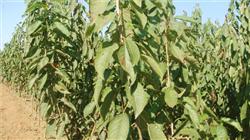
How to graft sweet cherry in summer? Here is an introduction to the method
For sweet cherry in summer, the following method can be used for grafting:
The suitable period for bud grafting is, first, early June (before the rainy season arrives); second, late July to late August (late rainy season to before the cambium stops growing). Bud grafting during the dog-day rainy season (early July) makes the graft union prone to gumming, wound healing difficult, and the survival rate very low.
I. T-shaped bud grafting. Take a plump growing shoot, remove the leaves, and use a grafting knife to make a horizontal cut 2.5 cm below the bud, cutting 1/3 deep into the xylem, then smoothly cut upward to 1 cm above the bud, then make a horizontal cut 0.7 cm above the bud, deep into the xylem, and the roughly rectangular bud piece can then be removed. While cutting the bud piece, at a point 5-10 cm above the ground on the rootstock seedling, select a smooth area and cut a T-shaped notch with the knife, deep into the xylem, its length just enough to accommodate the bud piece. Insert the cut bud piece into the notch on the rootstock seedling so that the bud piece fits closely with the notch. Then use a plastic strip to tie the entire cut tightly from top to bottom, exposing only the axillary bud and leaf petiole.
II. Modified T-shaped bud grafting. The bud piece carries a small amount of xylem, and the joining process is not the healing of the lower part of the bud with the rootstock, but the healing of the edge of the bud with the edge of the cut surface of the rootstock, so the grafted bud will not be damaged and the survival rate is relatively high. The cut bud piece should be large, generally at least 2.5 cm long and 1 cm wide, so that the contact surface is large and survival is easy. About 10 days after the bud graft survives, the tied plastic strip should be removed in time to avoid hindering the growth of callus tissue and the development of the grafted bud. For a surviving grafted bud, the leaf petiole falls off easily, and the graft union heals well with fresh epidermis. For dead buds, if time permits, supplementary grafting can be carried out.
III. Water management. If the weather is continuously dry before bud grafting, the rootstock seedlings should be fully irrigated 2-3 days in advance, so as to make the grafting operation easier and also increase the survival rate. However, within 15-20 days after grafting, irrigation must be avoided, and if rain occurs during this period, drainage and waterlogging prevention should also be done well to avoid gumming and reduce the survival rate.
IV. Pruning the rootstock in spring. Bud-grafted seedlings are generally pruned above the rootstock in early to mid-March of the following year before sap flow, to favor the growth of the grafted bud. After pruning the rootstock, attention should also be paid to removing sprouting rootstock shoots at any time to prevent excessive consumption of nutrients and affect the growth of the grafted bud. For seedlings grafted in early June, the rootstock should be pruned within 10 days after survival, to favor the sprouting and growth of the grafted bud in the same year. After survival, bud-grafted seedlings grow very rapidly, and the new shoots are tender and brittle and easy to break, so supports should be added in time to prevent them from being broken by wind, which is also beneficial to the vertical growth of the seedlings. In order to promote robust and well-developed seedling growth and enhance their overwintering ability, when the seedlings are 40-50 cm tall, the new shoots of the seedlings should be pinched off.
Click to get more cherry tree planting techniques
Click to get more fruit planting techniques