Can foliar fertilizer be applied when growing dragon fruit?
Can foliar fertilizer be applied when growing dragon fruit? Please give a detailed introduction
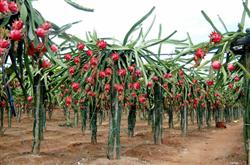
Dragon fruit can be applied with foliar fertilizer.First, you need to understand the surface characteristics of the dragon fruit plant. It originated in the arid regions of South America and belongs to the Cactaceae family as a perennial climbing vine plant, with the physiological and ecological characteristics of drought-adapted plants. As shown in the figure on the right, its stems and leaves have undergone variation, presenting triangular-column-shaped succulent green branches, while the leaves have degenerated into needle-like points distributed along the edges of the triangular columns. On the surface of the branches there are large numbers of brown aerial roots, and together these two constitute the entire nutrient organ through which dragon fruit receives foliar fertilizer. Foliar fertilizer is sprayed onto the surface of the triangular-column branches. To improve fertilizer efficiency, when spraying foliar fertilizer on dragon fruit you must go around the triangular column and spray all three sides.
Requirements of the dragon fruit branch surface characteristics for the formulation of foliar fertilizer components: The efficiency of foliar fertilizer is closely related to leaf surface traits and structure. The epidermal cuticle is a barrier to mineral nutrients entering the plant body. Leaves with a thick waxy layer on the surface do not easily allow fertilizer droplets to penetrate, and after spraying, the liquid fertilizer droplets will slide off the surface, causing nutrient loss with no absorption or fertilizer effect. The surface of the dragon fruit triangular column has a thick, hard, hydrophobic waxy layer, which places special requirements on the formulation and application technology of foliar fertilizer. To ensure effectiveness, excellent adjuvants must be added during the formulation of foliar fertilizer. Adjuvants are auxiliary components of foliar fertilizer, referring to additives other than the nutrient elements in foliar fertilizer. The adjuvant system of foliar fertilizer is relatively complex and important, and it plays a decisive role in maintaining the excellent physical and chemical properties of foliar fertilizer and ensuring product quality. The main components of adjuvants are surface-active substances, which have a series of functions such as wetting, penetration, emulsification, dispersion, solubilization and moisture retention. Generally, adding a very small amount of surfactant can significantly reduce the surface tension of the fertilizer solution. Adjuvants are especially important for the fertilizer efficiency of foliar fertilizer specially used for dragon fruit. This is because the hydrophobic waxy layer on the surface of dragon fruit triangular-column branches is thick and hard, and ordinary water-soluble foliar fertilizers are not easily able to wet and penetrate it, which directly affects the absorption effect of nutrients. Only by adding adjuvants with excellent performance can the foliar fertilizer adhere to and spread on the surface of the triangular column, prolong the wetting time, and achieve the purpose of nutrient absorption. Although there are many types of surfactants on the market, experimental studies at home and abroad show that adjuvants such as organic fertilizers and betaine have better effects. These are also suitable for foliar fertilizer specially used for dragon fruit.
Second, the selection of nutritional components in foliar fertilizer should mainly supplement medium and trace nutrient elements, while combining them with major nutrient elements. During the long production period from April to November each year, in the early fruiting stage the main supply should be magnesium, boron and nitrogen, and in the middle and late fruiting stages more attention should be paid to the successive supplementation of potassium, nitrogen, magnesium, calcium, iron and boron. They are all beneficial for improving the stress resistance and quality of dragon fruit. In addition, to make foliar fertilization more targeted, you should also refer to the types of limiting nutrients in the local soil. It is best not to choose an all-purpose tonic liquid, which is expensive, not targeted, and may not necessarily have a good effect.
You should also pay attention to the requirements of the photosynthetic metabolic characteristics of dragon fruit for foliar fertilizer application technology. Dragon fruit, which originated in arid regions and has succulent characteristics, belongs to the Crassulacean acid metabolism type of plant. Their stomata are open at night and closed during the day. This opening and closing pattern of the stomata is opposite to that of other C4 plants. Since the main pathways for foliar fertilizer nutrients to enter the plant body are through stomata and cracks in epidermal tissue, the best time to spray foliar fertilizer on dragon fruit is after 5-6 p.m.; spraying fertilizer when the sun sets is conducive to nutrient absorption. In addition, regarding the nutrient concentration of foliar fertilizer, according to the characteristics of dragon fruit it can be appropriately increased by 10%-20%, giving a better effect.
In short, the effect of foliar spraying is faster than root fertilization, and it can directly and quickly reach the dragon fruit nutrient body, avoiding the fixation of fertilizer nutrients in the soil. However, the disadvantage is that the amount of fertilizer applied is limited and the effect is relatively short-lived. Therefore, foliar fertilization is an auxiliary method of fertilizing dragon fruit. It may as well be applied in coordination with root fertilization to increase yield.
Click to get more dragon fruit cultivation techniques
Click to get more fruit cultivation techniques