What is the correct way to fertilize dragon fruit?
How do you fertilize dragon fruit properly? Please explain the methods. The following fertilization methods for dragon fruit are for reference: (1) Ring fertilization, also called circular fertilization. It involves digging a ring-shaped trench slightly away from the outer edge of the canopy and applying fertilizer there. This method has the advantages of being simple to carry out and economical with fertilizer. However, digging the trench easily cuts horizontal roots, and the fertilization area is relatively small...
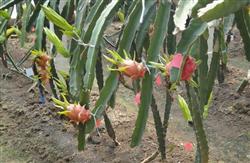
How do you fertilize dragon fruit properly? Please explain the methods
The following fertilization methods for dragon fruit are for reference:
(1) Ring fertilization, also called circular fertilization. It involves digging a ring-shaped trench slightly away from the outer edge of the canopy and applying fertilizer there. This method has the advantages of being simple to carry out and economical with fertilizer. However, digging the trench easily cuts horizontal roots, and the fertilization area is relatively small, so it is generally used mostly for fertilizing young trees.
(2) Semi-ring fertilization. This fertilization method is similar to ring fertilization, but the ring is broken into 3 to 4 pig-trough-style fertilization trenches. Therefore, it is also called pig-trough-style fertilization. This method damages fewer roots than ring fertilization, and by changing the fertilization position each time, the fertilized area can be expanded. It is suitable for both flat land and sloping land, and is a commonly used fertilization method in orchards on hilly and mountainous land. On sloping land, the fertilization trenches should be dug above and on both sides of the tree.
(3) Radial fertilization. Starting about 1 m from the trunk beneath the canopy, with the trunk as the center, dig 4 to 6 trenches outward in a radial pattern. The trenches are generally 30 cm deep, and the fertilizer is applied into them. This method generally damages fewer roots than ring fertilization, but large roots should also be avoided when digging the trenches. The positions of the radial trenches can be changed every other year or every other time to expand the fertilized area and promote root absorption.
(4) Whole-orchard fertilization. This method is mostly used for mature fruit trees or densely planted orchards when the root system has already spread throughout the entire orchard. Fertilizer is spread evenly throughout the orchard and then plowed into the soil to a depth of about 20 cm. The advantage is that the fertilized area in the whole orchard is large, and the root system can absorb nutrients evenly. However, because it is applied shallowly, it often causes the roots to grow upward, reducing the roots' stress resistance. If this method is alternated with radial-trench fertilization every other year, the two can make up for each other's shortcomings and bring out the greatest effect of the fertilizer.
(5) Irrigation fertilization. That is, combining fertilization with irrigation. In recent years, with the gradual promotion of drip irrigation technology in our country, this method has also been gradually applied. Whether irrigation fertilization is combined with sprinkler irrigation or drip irrigation, because fertilizer is supplied promptly and distributed evenly, it does not continuously damage the root system, protects the soil structure of the tillage layer, saves labor, and results in a high fertilizer utilization rate. It can increase yield and quality, while also lowering costs and improving economic returns.
(6) Foliar topdressing, also called leaf spraying. The advantages of this fertilization method are fast absorption, obvious results, fertilizer savings, and freedom from the influence of the nutrient distribution center. It can promptly meet the urgent needs of fruit trees and can avoid the chemical or biological fixation of some elements in the soil. Foliar topdressing is especially good for supplementing trace element fertilizers. However, foliar topdressing can only be a beneficial supplement to soil fertilization and cannot replace soil fertilization.
Each of the above fertilization methods has its own characteristics, and they should be used in rotation according to actual conditions, making up for one another's shortcomings, so as to achieve the greatest fertilization effect and avoid relying on a single method. Dragon fruit is a special emerging fruit tree. Its root system differs from that of other fruit trees: it has no taproot, its roots are very shallow and basically distributed in the surface layer of the soil, and it also has strong aerial roots. Therefore, when fertilizing, special care should be taken not to damage the root system.
Click to get more dragon fruit cultivation techniques
Click to get more fruit cultivation techniques