Walnut Management and Pest and Disease Control Techniques for July and August
How should walnuts be managed in July and August? Which pests and diseases need to be controlled? Please give an introduction. For walnuts in July and August, the following methods can be used for management: 1. Water and fertilizer management. For trees that have already set fruit, by July the fruit size has basically become fixed, and they enter the shell-hardening stage. During this period, no artificial watering is needed. Soil moisture that is too...
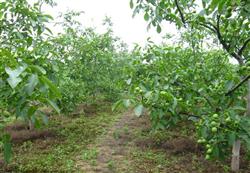
How should walnuts be managed in July and August? Which pests and diseases need to be controlled? Please give an introduction.
For walnuts in July and August, the following methods can be used for management:
I. Water and fertilizer management
Water: For trees that have already set fruit, by July the fruit size has basically become fixed, and they enter the shell-hardening stage. During this period, no artificial watering is needed. Too much soil moisture will cause the fruit shell to become streaked with white and the fruit tip to turn white, affecting the appearance of the fruit surface and making it hard to sell. Therefore, drainage ditches and drainage outlets in the orchard and around the tree basins should be dug as early as possible. For individual trees, when water cannot be drained away and cannot seep down either, you can use burned honeycomb briquettes around the base of the trunk, placing a ring around the tree, paying attention to keeping them above the water surface of the accumulated water; this will play a life-saving role.
For young trees that have not borne fruit, there is also no need to water too much. Because 60% of the terminal buds and flower buds have already differentiated, if there is too much moisture, the autumn shoots will grow a second time, knocking off the female flower buds that have already grown and causing a second fruitless year. In addition, it will also train the trunk into a tall flagpole several meters high. If in an unusual year there is not a drop of rain during the flood season, then in late August, watering can be done appropriately according to the condition of the trees.
Fertilizing: When walnuts enter July and August, their demand for fertilizer is basically not great, and in particular, nitrogen fertilizer should not be applied as a top dressing. Some fruit growers think that since it has finally rained, they should hurry and apply some fertilizer, not realizing that this is the most dangerous move. For a three- or four-year-old grafted tree, just one carry-pole load of manure is enough, and if it clears up after the rain, within five days this tree will be sentenced to death. Moreover, top dressing at this time will cause the hard shell not to harden and to become streaked with white; the green husk grows, but the hard shell does not grow. For young trees, top dressing at this time will cause "runaway shoots," and they will not bear fruit the next year either.
July and August are also the kernel-filling stage and ripening stage of walnuts. Starting in early July, every half month use a sprayer to apply potassium dihydrogen phosphate and thiophanate, and if black spots are found on the trunk and black water flows out when pressed with a finger, spray 0.3% Lundujing (9281) + 0.3% PBO solution, spraying 3 times in succession. The purpose of spraying potassium dihydrogen phosphate and PBO is to speed up the hardness of the shell and the filling of the kernel, increase weight, speed up the differentiation and plumpness of flower buds, and delay the growth of pre-fruiting branches and water sprouts.
II. Prevention and control of pests and diseases
Walnut trees have many pests and diseases. The following are several simple methods for pest and disease control.
Disease control: The disease with a high incidence rate during the hot, humid, and rainy season is walnut bacterial black spot disease. Symptoms: first, small black spots appear on the leaves, and in severe cases the lesions join together to form holes, causing the leaves to drop early; after the fruit is affected, small dark brown spots also appear, which then expand into round shapes and become sunken, and the fruit rots from the outside inward, with severe cases causing the fruit to drop early. Control methods: first, in combination with pruning, remove diseased branches and diseased fruit; second, use 50% thiophanate-methyl or Tuzet wettable powder at 500-800 times dilution, once every half month, spraying 3 times in succession; third, use a knife to make vertical cuts on the trunk at the black spots, and use a brush to brush the diseased area until no foam is produced, with an interval of 10 days, brushing twice in succession.
Walnut powdery mildew mainly harms leaves and young buds, and if management is not timely it can cause leaf drop and even seedling death. Symptoms: there is a layer of white powder on both sides of the leaves, and in the early stage the leaves have yellow patches. Control methods: rational fertilization and irrigation, and timely pruning of diseased leaves. Chemical control can be the same as above, or use 25% triadimefon at 500-800 times dilution, spraying twice in succession, once every 10 days.
Pest control: In July and August, attention should be paid to controlling giant mealybugs, small jewel beetles, and fall webworms, which can be controlled with cypermethrin.
Click to get more hickory planting techniques
Click to get more fruit planting techniques