What causes pomegranate fruit cracking?
Why do pomegranates crack? Please provide an introduction and control methods. Causes of pomegranate fruit cracking: 1. Variety: Pomegranate varieties under different cultivation conditions all show fruit cracking. Generally, mid-season varieties whose ripening period coincides with the rainy season, with large fruit, thin and smooth skin, and red-white skin, are prone to cracking. Such as Yicheng red-skin pomegranate...
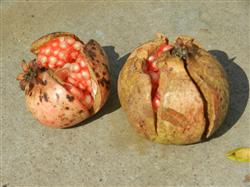
Why do pomegranates crack? Please provide an introduction and control methods
Causes of pomegranate fruit cracking:
1. Variety: Pomegranate varieties under different cultivation conditions all show fruit cracking. Generally, mid-season varieties whose ripening period coincides with the rainy season, with large fruit, thin and smooth skin, and red-white skin, are prone to cracking. Such as Yicheng red-skin pomegranate, and Shaanxi Lintong's Tianhongdan and Pink Sweet pomegranate.
2. Soil and fertilizer: Clay soil, black soil, acid white clay soil, and clay in low-lying areas retain more water and have poor aeration, which not only results in poor fruit quality but also makes fruit prone to cracking. Excessive application of nitrogen fertilizer or inorganic fertilizer, deficiency of trace elements such as Ca, K, B, severe soil erosion, and soil compaction can easily cause fruit cracking.
3. Moisture: Excessive soil humidity or excessive fluctuation in humidity during the ripening period, such as high temperatures, drought, sudden heavy rain or consecutive rainy days, causes the fruit to absorb too much water and crack easily. Excessive air humidity can also cause fruit cracking.
4. Temperature: Temperature and humidity changes are somewhat correlated. Fruit rapidly expands under high temperature and high humidity, and when a sudden temperature drop occurs, cracking is likely.
5. Light: Improper pruning during the growing season, partial exposure of the fruit to the sun, large day-night temperature differences, or rain exposure can easily cause cracking, and the cracks are often on the sun-facing side.
6. Growth period: Cracking generally occurs during the late fruit expansion stage and the ripening stage (color-changing stage). If rainy weather or a temperature drop occurs, cracking is more severe.
7. Harvest: Harvesting in the early morning when temperatures are lower or after rain, harvesting when overripe, and collisions during harvesting and transport can all easily cause fruit cracking. Pomegranate fruit cracking is often caused by a combination of various factors, especially during the mid-to-late expansion stage, when material accumulation and transformation are taking place, the seeds expand rapidly, the seed pulp cell vacuoles are relatively large, the structure is loose, water absorption is strong, and the expansion rate is high, while the skin gradually becomes thinner, and the skin cells are small and dense; the expansion rate is low, and at this time fibrosis is insufficient, making the texture crisp and tender. If high temperature and drought are suddenly followed by heavy rain, consecutive rainy days, or a temperature drop, cracking occurs. Variety is a genetic factor, and this is the decisive factor in pomegranate fruit cracking. Ripe pomegranates split very easily, and the more cracked the pomegranate, the more delicious the seeds, and various birds compete to peck at them so that the pomegranate's offspring can spread everywhere. This is also the result of natural selection.
Control of pomegranate fruit cracking:
1. Variety selection: Early-maturing or late-maturing varieties, with medium fruit size, green skin, copper shell, relatively thick skin, and rough skin with rusty color, are less prone to cracking. Such as Zaozhuang Yicheng's Daqingpi and Qingpicao. In addition, Dahongpao is also less prone to cracking because its skin is relatively thick. Others such as Anhui Huaiyuan's Qingpi pomegranate are also excellent varieties with relatively little cracking.
2. Soil: Yicheng pomegranates are best planted on mid-to-high terrain, on the middle and lower slopes of sunny mountain sides, in deep yellow loam soil with slight clay content. This kind of soil has good water and air permeability and rich mineral content, and the fruit produced is of top quality and not prone to cracking. Other relatively suitable soil types include oil sandy soil and calcareous loam.
3. Fertilizer: Increase the application of organic fertilizer, such as farmyard manure including pig manure, chicken and duck manure, green manure, etc. For inorganic fertilizer, use formula fertilization, and apply less or no nitrogen fertilizer. During the fruit expansion stage, regularly spraying 2000ppm CaCL2 solution and applying an appropriate amount of P, K, and B elements helps improve fruit quality and prevent cracking.
4. Pruning: Prune reasonably during the growing season to ensure ventilation and light penetration and a strong tree vigor. The area of light spots under the canopy generally accounts for 10%-15% of the canopy projection area, and the light penetration is uniform.
5. Hormone treatment: During the color-changing period of pomegranate, spraying 2-3 times of gibberellin (GA3) 50mg/L at 10-15 day intervals can reduce the cracking rate.
6. Irrigation and drainage: During the pomegranate ripening period, heavy irrigation should be prohibited, and drainage should be carried out promptly on rainy days to prevent excessively high soil moisture.
7. Mulching: Ground mulching helps prevent drought and preserve temperature. It can prevent excessive soil temperature changes, reduce temperature differences, prevent soil erosion, reduce the loss of trace elements, maintain microbial activity, increase organic matter, and make fruit cells grow evenly, thereby preventing cracking. Mulching materials include grass mats, wheat straw, green manure, etc.
8. Bagging: Bagging is one of the most effective methods to prevent cracking. Bagging can protect the fruit from sun and rain and from sudden cold and heat changes, has a certain buffering effect on temperature and humidity, protects the fruit, and prevents cracking; bagging can also improve fruit quality, making the flesh tender, improving coloring, and preventing infection by diseases and pests. Bagging is generally carried out during the young fruit stage. The materials used can be waste newspaper, kraft paper, or parchment paper bags, or specialized fruit bags can be purchased directly. In addition, attention should also be paid to controlling fruit-boring pests. For example, to control peach fruit borer, spray 2-3 times of 20% fenvalerate EC 2000-fold solution during the flowering and fruiting stage, or use a cotton ball dipped in 80% dichlorvos EC and insert it into the pomegranate calyx tube.
Click to get more pomegranate tree cultivation techniques
Click to get more fruit cultivation techniques