How to prune a pomegranate tree correctly in summer?
How should a pomegranate tree be pruned in summer? An introduction: Summer pruning of pomegranate trees can be based on the growth characteristics of pomegranate branches. For young trees, during shaping, excessively vigorous new shoots growing from the main branches should be promptly bent, pinched, and removed to maintain the absolute dominance of the main branches' growth. For trees in the fruiting stage, excessive buds should be promptly removed, and suckers should be thinned out. In particular, suckers near pruning and saw cuts and at underground root crowns should be repeatedly removed multiple times. When removing underground suckers, be careful not to damage the bark. Vigorously growing new shoots should be promptly pulled down to adjust their angle or heavily pinched to develop fruiting branch groups. Pomegranates often have many secondary, tertiary, and even quaternary branches, so pinching should be repeated to control excessive growth. For young, vigorous trees with low fruit set rates, ringing can be done on vigorous branches during the flowering period, preferably with two ring cuts spaced 10 cm apart.
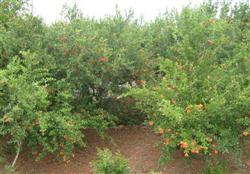
How should a pomegranate tree be pruned in summer? An introduction
Summer pruning of pomegranate trees can be based on the growth characteristics of pomegranate branches. For young trees, during shaping, excessively vigorous new shoots growing from the main branches should be promptly bent, pinched, and removed to maintain the absolute dominance of the main branches' growth. For trees in the fruiting stage, excessive buds should be promptly removed, and suckers should be thinned out. In particular, suckers near pruning and saw cuts and at underground root crowns should be repeatedly removed multiple times. When removing underground suckers, be careful not to damage the bark. Vigorously growing new shoots should be promptly pulled down to adjust their angle or heavily pinched to develop fruiting branch groups. Pomegranates often have many secondary, tertiary, and even quaternary branches, so pinching should be repeated to control excessive growth. For young, vigorous trees with low fruit set rates, ringing can be done on vigorous branches during the flowering period, preferably with two ring cuts spaced 10 cm apart.
Click for morePomegranate tree cultivation techniques
Click for moreFruit cultivation techniques