A Detailed Explanation of Blueberry Growth, Flowering and Fruiting Habits
What are the growth, flowering and fruiting habits of blueberries? Please give an introduction. Blueberries can grow multiple times within a single growing season, with double growth being the most common. In southern China, blueberries have two growth peaks per year, the first from May to June, and the second from mid-July to mid-August. After seedlings are planted...
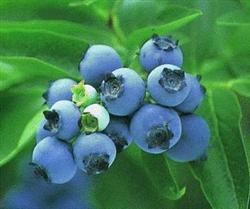
What are the growth, flowering and fruiting habits of blueberries? Please give an introduction.
Blueberries can grow multiple times within a single growing season, with double growth being the most common. In southern China, blueberries have two growth peaks per year, the first from May to June, and the second from mid-July to mid-August. After seedlings are planted, growth speeds up noticeably in the third year, with many new shoots sprouting and growing vigorously, and annual growth can reach more than 1 m.
The tips of current-year shoots mostly form flower buds, and flower buds differentiate from the tip downward. The number of flower buds that can differentiate on each branch is related to the cultivar and branch thickness: highbush blueberry generally has 4-7, and rabbiteye blueberry 3-6; flower buds are mainly solitary at the nodes. The flower bud differentiation period differs among blueberry types: lowbush blueberry and highbush blueberry begin differentiation in July-August, while rabbiteye blueberry begins in mid-June; by late September to early October, blueberry flower bud differentiation is already complete. Morphologically, blueberry flower buds are plump, oval or nearly spherical. Below the flower buds are some narrow, pointed vegetative buds and dormant buds.
Blueberry flowering time differs noticeably with climate and cultivar. In a normal year, blueberries in southern China flower in early to mid-March, and in the north from April to May; the flowering period is generally 15-20 days, and at most 40 days. The flowers are borne on an elongated axis, forming a raceme. While the flowers bloom, vegetative buds begin to develop into vegetative shoots. After growing to a certain extent (length varies), the vegetative shoot stops growing, and the last small pointed young leaf at the tip turns black to form a "black tip". The "black tip" falls off after about 2 weeks, and after 2-4 weeks, the vegetative bud located below the black tip grows a new shoot and has apical dominance, that is, the axis-turning growth of the branch is achieved; this axis-turning growth occurs 3-5 times a year in the south. On the last new shoot of summer, a bud primordium adjacent to the "black dot" gradually enlarges and develops into a flower bud, occupying the terminal position. From the terminal flower bud downward, multiple flower buds can still form, which flower and bear fruit the following spring. The vegetative buds below them develop into vegetative shoots, while the short, small branches that have borne fruit gradually dry up and fall off after autumn.
Blueberries are mostly cross-pollinated plants. Highbush blueberry is self-fertile, but the degree of fertility differs noticeably among cultivars; rabbiteye blueberry and lowbush blueberry are generally self-incompatible, so in production, multiple cultivars must be considered when establishing an orchard to increase yield. After blueberry flowers are fertilized, the ovary rapidly expands, and after about one month the increase tends to stop; afterward the berry remains green and its volume only slightly increases. When the berry enters the color-change and coloring stages, the berry expands rapidly, and the fruit diameter can increase by 50%. After coloring, the berry can still grow another 20%, and the sweetness and flavor become moderate. Fruits on the same fruit cluster do not ripen at the same time; the fruits at the top and middle of the cluster ripen first, generally from June to August. For the same cultivar and the same tree, the fruit ripening period is generally about 30 days; in Majiang, Guizhou and Nanjing, Jiangsu, early-maturing rabbiteye blueberry cultivars begin to ripen in mid-June, and late-maturing cultivars begin to ripen in early to mid-July.
Click to get more strawberry growing techniques
Click to get more fruit growing techniques