Citrus Summer Pruning and Pest and Disease Control Methods
How should citrus be pruned in summer and how are pests and diseases controlled? Please give a detailed introduction. For summer pruning and pest and disease control of citrus, you can refer to the following methods: The main summer pruning methods are: first, for branches extending beyond the canopy, cut them back to 2-year-old branches 0.5 cm--1 cm from the branch group; second, for vigorous upright spring shoots, leave...
How should citrus be pruned in summer and how are pests and diseases controlled? Please give a detailed introduction.
For summer pruning and pest and disease control of citrus, you can refer to the following methods:
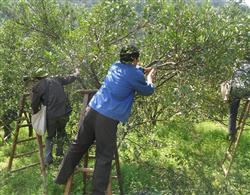
The main summer pruning methods are: first, for branches extending beyond the canopy, cut them back to 2-year-old branches 0.5 cm--1 cm from the branch group; second, for vigorous upright spring shoots, leave 3--5 leaves and cut them back; third, for single terminal fruit on vigorous fruiting branches, cut back and thin the fruit; fourth, for branches that dropped flowers and fruit, cut them back to last year's spring shoot section; fifth, for fruiting mother branches that bear fruit on the rear section, cut them back to 1--2 nodes before the fruiting position.
The intensity of summer pruning depends on the size of the canopy, the age of the tree, and the number of fruit set. Normally there are 100--150 pruning cuts. The cuts should be evenly distributed over the canopy.
July--September is the peak period of damage by scale insects, rust mites and leafminers. You can use 90% trichlorfon 500x--1000x solution or 40% isocarbophos 800x--1000x solution to control scale insects; use 20% dicofol 800x--1000x solution plus 25% chlordimeform 500x solution to control rust mites; use 25% bisultap 500x solution or 50% dichlorvos 1000x--1500x solution to control leafminers.
The black spiny whitefly is one of the main pests of citrus and often causes localized disasters. It mainly gathers as larvae on the underside of leaves to suck sap, and can also damage the upper surface of leaves and the fruit peel, forming yellow spots, while also inducing sooty mold, affecting photosynthesis, weakening tree vigor, and in severe cases causing leaf and fruit drop.
The black spiny whitefly has four generations a year, and the peak hatching periods of each generation occur in the following ranges: first generation May 30--June 13; second generation July 12--July 26; third generation August 28--September 15; fourth generation October 23--November 9.
To control the black spiny whitefly, appropriately prune out pest-damaged branches and weak branches, cultivate and weed frequently, and strengthen cultivation management, so that the citrus orchard has good ventilation and light penetration and the tree vigor is enhanced. Pay attention to protecting and using natural enemies. In citrus orchards with few parasitic natural enemies, timely spray 1--2 times at the peak hatching period of each generation to effectively control its damage. For chemical control, you can use 80% dichlorvos emulsion 500x solution, 40% dimethoate or omethoate emulsion 800x solution, 40% methidathion emulsion 700x solution, 25% rosin-soda mixture 18x--25x solution; in citrus orchards where parasitic natural enemies occur in large numbers, it is advisable to use dichlorvos, dimethoate and other pesticides for control during the pupal stage of the black spiny whitefly.
Click to get more citrus planting techniques
Click to get more fruit planting techniques