What is the citrus red mite? Get to know this pest
What is the citrus red mite? How is it controlled? An introduction to the citrus red mite [Panonychus citri (McGregor)], also known as the citrus red spider mite, belongs to the class Arachnida, subclass Acari, order Prostigmata, family Tetranychidae, and is an extremely serious pest mite on citrus. In China it is distributed across Jiangsu, Jiangxi, Fujian, Zhejiang, Guang...
What is the citrus red mite? How is it controlled? An introduction
The citrus red mite [Panonychus citri (McGregor)], also known as the citrus red spider mite, belongs to the class Arachnida, subclass Acari, order Prostigmata, family Tetranychidae, and is an extremely serious pest mite on citrus. In China it is distributed throughout the vast citrus-growing regions of Jiangsu, Jiangxi, Fujian, Zhejiang, Guangdong, Taiwan, China, Hubei, Sichuan, Yunnan, Guizhou and elsewhere. Besides citrus species, its host plants include more than 40 species in 30 families of perennial and annual plants, such as mulberry, pear, peach, cherry, grape and loquat.
I. Morphological characteristics
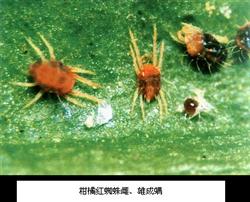
Adult mite: The female adult is 0.4 mm long, oval, bright red, with wart-like protrusions on the back bearing white setae, and 4 pairs of legs. The male adult is 0.3 mm long, slightly pointed at the rear and wedge-shaped, bright red, with 4 pairs of relatively long legs.
Egg: About 0.13 mm in diameter, slightly oblate, red and glossy. There is 1 vertical egg stalk at the top. The end of the stalk bears 10-12 accessory filaments radiating outward, attaching the egg to leaves, branches and fruit.
Larva: The larva is 0.2 mm long, pale red, with 3 pairs of legs.
Nymph: Smaller in size, with shape and color close to the adult. It has 4 pairs of legs.
II. Damage symptoms
Adults, nymphs and larvae gather in groups on citrus leaves, young shoots and fruit, piercing and sucking the sap; citrus seedlings and young trees suffer the most severe damage. Infested leaves show many small grayish-white spots, and in severe cases the entire leaf turns grayish-white, causing heavy leaf drop and dead shoot tips, affecting tree vigor and yield. When outbreaks occur, the fruit surface becomes covered with grayish-white chlorotic spots and the whole fruit turns pale, affecting yield.
III. Occurrence patterns
The citrus red mite generally occurs most severely in spring and autumn of the year. That is, damage and reproduction begin in March. Because the temperature is suitable during April-May and it is also the period when spring shoot leaves unfold and change color, with abundant nutrition, red mite damage is generally severe. After June, temperature is high and humidity is high, and storms are frequent; field weeds and green manure crops grow, various predatory natural enemies appear in large numbers; at the same time, spring shoot leaves tend to mature and the nutritional level declines. These factors all cause the red mite population to decline and mite numbers to drop rapidly. Later, as the temperature becomes suitable again, especially when long-term drought occurs, together with autumn shoot growth and abundant nutritional conditions, mite numbers surge and damage becomes severe. The red mite causes the most severe damage in April-May and September-November.
IV. Life habits
Its life cycle goes through four stages: egg, larva, nymph and adult. Most overwinter as eggs or adults in cracks of branches and on old leaves. Female adults can mate after emerging and may mate multiple times in their lifetime. Each female mite can lay an average of 31.7-62.9 eggs in her lifetime. Egg production is greatest in spring, less in autumn and lowest in summer. Eggs are mostly laid on leaves, fruit and young shoots, but most abundantly on both sides of the midrib on the underside of leaves. Larvae begin feeding and causing damage immediately after hatching. Adults are distributed on both sides of leaves, and population density on the outer layer of the leaf canopy is greater than on the inner layer.
Within the range of 20-25°C, the developmental duration of each mite stage shortens as temperature rises. The relatively suitable temperature for development and reproduction is 20-28°C. At an air temperature of 25°C and relative humidity of 85%, the egg stage is 6.5 d, larval stage 2.5 d, protonymph 2.5 d, deutonymph 3 d, adult pre-oviposition period 1.5 d, and the immature stage lasts about 16 d. At an air temperature of 30°C and relative humidity of 85%, the egg stage is 5 d, larval stage 2.5 d, protonymph 2 d, deutonymph 2 d, adult pre-oviposition period 1.5 d, and the immature stage lasts about 13-14 d. The lifespan of female adults is 14-25 d at a daily average temperature of 16-19°C, 15 d at 23°C, and 12-16 d at 24-29°C.
V. Relationship between occurrence and the environment
The annual number of generations of the citrus red mite is mainly influenced by air temperature. Usually, when the annual average temperature is around 15-17°C, 12-15 generations occur per year; when the annual average temperature is around 18°C, 16-17 generations occur per year; and when the annual average temperature is around 20°C, about 20 generations can occur per year.
VI. Factors related to occurrence
The main factors affecting red mite population density include temperature, humidity, food, natural enemies and human factors.
Generally, air temperatures of 12-26°C favor red mite occurrence, with around 20°C being most suitable. Mainly due to the influence of temperature, red mite occurrence has 2 peak periods, usually appearing in April-June and September-November in normal years.
The relative humidity most suitable for red mite occurrence is around 70%, and rainy conditions are unfavorable for occurrence.
As for food, young and tender citrus tissues are preferred. There are many kinds of natural enemies of the citrus red mite, with nearly 100 species discovered, among which those that can significantly control red mite occurrence include Amblyseius nicholsi, Amblyseius eharai, Amblyseius longispinosus, Agistemus exsertus, Anystis baccarum, Erigonidium graminicolum, Theridion octomaculatum, Chrysopa jinensis, Chrysopa sinica, Scolothrips takahashii, Stethorus punctillum, Stethorus siphonulus, entomogenous algae fungi, Cladosporium and non-occluded viruses. In orchards rich in natural enemies, red mites can be naturally controlled, especially in the middle and late parts of the growing season.
The most important way humans affect red mites is through pesticide use in orchards. Proper pesticide use can achieve better red mite control, while unreasonable and frequent pesticide use kills large numbers of natural enemies, making red mite occurrence more rampant and showing multiple peaks.
VII. Pest survey methods
Starting in mid-January, select 3-5 citrus orchards of different types. In each orchard, fix 3-5 representative trees. Survey once every 10-15 d, and once every 7-10 d in March-April and September-October. From each tree canopy, take 4 leaves each from the east, south, west, north and center, for a total of 20 leaves. Use a 10-20x handheld magnifier to examine the number of mites, eggs and natural enemies on spring and autumn shoot leaves. If more than 100 mites per 100 leaves are found while fewer than 10 natural enemies are present, a forecast should be issued promptly. In years with dry winter and spring and relatively high temperatures, when the ten-day average maximum temperature in March reaches 20-25°C and the ten-day rainfall is below 10 mm, large numbers of winter eggs hatch at this time, which also coincides with citrus bud break and shoot growth and abundant nutrition, shortening the developmental duration of each mite stage and accelerating reproduction, which will lead to rampant occurrence of the citrus red spider mite that year and requires timely control. If the overwintering base is fewer than 50 mites per 100 leaves, natural enemies are more than 10-20, and in the 4 months from December to March the monthly average maximum temperature is relatively low, totaling below 60°C, with total rainfall above 100 mm, occurrence is generally low and damage light.
VIII. Control methods
Control of citrus mites should consider the citrus orchard ecosystem as a whole and implement the policy of "prevention first, integrated control." Use pesticides rationally, protect and utilize natural enemies, fully realize the natural control role of the ecosystem, and keep pest mite damage below the economically allowable level.
1. Agricultural control:
Strengthen water and fertilizer management in citrus orchards. Timely irrigation during dry winter and spring can promote spring shoot growth and favor the occurrence and spread of parasitic fungi and predatory mites, creating an ecological environment unfavorable to pest mites. In winter, combined with pruning, cut out overly dense branches, damaged branches, and diseased or insect-rolled leaves and galls to reduce overwintering mite sources and lower the occurrence base. Planting Ageratum conyzoides, rapeseed, purple alfalfa, perilla, legumes and other plants in citrus orchards can not only improve the orchard microclimate but also favor the reproduction of predatory mites and other natural enemies and supplement their food, enhancing the natural control of pest mites by natural enemies.
2. Quarantine measures:
The citrus bud mite is a domestic quarantine target and can spread with the transport of nursery stock or scions. Quarantine should focus on the place of production. It is prohibited to transport nursery stock, scions or fruit from infested areas to avoid spread and expansion.
3. Biological control:
The citrus red mite has many natural enemies, such as Amblyseius mites, Agistemus mites, mite-eating ladybirds, and six-spotted thrips. If they can be protected and utilized, they can effectively control the occurrence of the citrus red mite. Using methods to rear, protect and utilize Amblyseius (a type of predatory mite) to control the citrus red mite has relatively good control effects.
Keep or artificially plant Ageratum conyzoides (white grass flower) in citrus orchards to cover the bed surface, using its pollen to provide good food for Amblyseius mites as well as places for habitation, egg laying and reproduction. It can also regulate the orchard microclimate and soil temperature and humidity, creating a good ecological environment for the growth and development of citrus roots and the reproduction of Amblyseius mites. In addition, after harvesting, Ageratum conyzoides can be used as green manure for the orchard. According to surveys, each adult Amblyseius mite can prey on more than 10 citrus red mite eggs per day, and more than 10 larvae. If there is an average of 0.1 Amblyseius mite per leaf, spraying can be omitted.
From March-May and September-October, on citrus trees with an average of fewer than 2 pest mites per leaf, release 200-400 predatory mites such as Amblyseius per tree. One and a half months after release, leaf mite damage can be controlled. After natural enemies are released, spraying highly toxic pesticides is strictly prohibited. Hirsutella is an important factor in controlling the citrus rust mite. Therefore, during rainy seasons when Hirsutella is prevalent, copper fungicides such as Bordeaux mixture should not be used in citrus orchards for disease control. In addition, predatory ladybirds, thrips, lacewings and other natural enemies can be introduced to control pest mite damage.
4. Chemical control:
Grasp the key periods, reduce the early-season mite population base, and control later outbreaks. For the citrus red spider mite, apply the first spray when spring shoots have buds 2-3 cm long, at the peak of winter egg hatching, before mites move onto new shoot leaves to cause damage. The citrus yellow mite occurs in spring more than half a month earlier than the citrus red spider mite. Spraying should be timed when spring buds are 1 cm long. When pest mites are found on 20% of leaves and fruit, or when observation with a 10x handheld magnifier shows an average of 5 mites per leaf, spraying should be organized immediately. For the citrus rust mite, when spraying, first spray the inner canopy, then the outer canopy, with special attention to the underside of leaves and the shaded sides of fruit. For the citrus bud mite, spray the canopy in spring when overwintering adults leave and old galls damage new shoots, applying 2-3 times from the early stage of new shoot emergence until flowering.
Choose pesticides that are relatively safe for natural enemies and have good acaricidal effects. Because the citrus red mite very easily develops resistance, and acquired resistance may be inherited, chemical agents should be rationally alternated and rotated; never continuously use the same agent for a long time, so as to prevent or delay the development of resistance in red mites. At the same time, use spot treatment as much as possible so that natural enemies of red mites have room to recover.
Be careful to prevent phytotoxicity: avoid spraying during the midday period as much as possible, prepare pesticides according to the recommended concentration, and try not to use organotin (azocyclotin, tricyclotin, fenbutatin oxide) or propargite acaricides during the young fruit stage and high-temperature period.
Commonly used pesticides:
Spirodiclofen, propargite, hexythiazox, pyridaben, fenbutatin oxide, azocyclotin (do not use from spring bud stage to before petal fall), amitraz, diafenthiuron, pyridaben, profenofos, abamectin, bifenthrin, fenpropathrin, bromopropylate, fenpyroximate.
Click to get more citrus cultivation techniques
Click to get more fruit cultivation techniques