What are the citrus fertilization methods? A must-read for growers
What fertilization methods are there for growing citrus? Please explain. You can refer to the following fertilization methods for growing citrus: (1) Root application: Most citrus roots are distributed in the soil layer at the drip line along the outer edge of the canopy. When applying fertilizer to the roots, the fertilizer should be placed in the soil within the drip line around the outer edge of the canopy. The fertilization depth is generally best at 20-40 cm...
What fertilization methods are there for growing citrus? Please explain.
You can refer to the following fertilization methods for growing citrus:
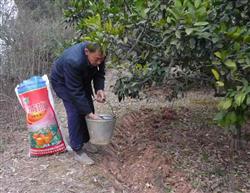
(1) Root application: Most citrus roots are distributed in the soil layer at the drip line along the outer edge of the canopy. When applying fertilizer to the roots, the fertilizer should be placed in the soil within the drip line around the outer edge of the canopy. The fertilization depth is generally best at 20-40 cm. However, the depth varies with terrain and fertilizer type. For example, on sloping land, deeper application is preferable; in low-lying citrus orchards, shallower application is preferable because the groundwater level is higher. For farmyard manure, green manure, and stable manure, a depth of 30-40 cm is best, while for chemical fertilizers, a depth of 20 cm is appropriate. When the soil moisture in a citrus orchard is relatively high, chemical fertilizers can be broadcast and then turned into the soil. In low-lying citrus orchards with a high groundwater level, if the fertilization depth exceeds 60 cm, not only will the roots be unable to absorb the fertilizer, but root rot may sometimes also occur. Root fertilization methods include ring trench application, strip trench application, radial trench application, hole application, whole-orchard application, and auger-hole fertilization.
Ring trench application: Dig a ring-shaped trench 20-40 cm wide and 15-45 cm deep around the outer edge of the canopy, then mix topsoil and base fertilizer and apply it into the trench. This method is suitable for young citrus orchards.
Strip trench application: Dig 1-2 long strip trenches 50 cm wide and 40-50 cm deep between the rows of a citrus orchard, then apply fertilizer and cover with soil. This method is suitable for mature citrus orchards planted in rectangular arrangements. You can also dig several strip trenches between rows or between plants that are about 20 cm wide, 15-30 cm deep, and slightly longer than the canopy spread, and apply fertilizer there.
Radial trench application: At a position 1 m away from the trunk, dig 5-6 radial trenches 30-50 cm wide and 15-40 cm deep, with the length reaching the outer edge of the canopy. Apply fertilizer into the trenches and cover with soil. This method is suitable for mature citrus orchards, especially for fertilizing citrus orchards with narrower terrace surfaces.
Hole application: Under the canopy at least 1 m away from the trunk, evenly dig 10-20 conical holes 40-50 cm deep, with a top diameter of 25-30 cm and a bottom diameter of 5-10 cm. Stuff dry grass and other material into the holes, cover the openings with plastic film, and carry out topdressing and irrigation entirely within the holes. This method is suitable for sandy-soil citrus orchards with poor fertilizer and water retention.
Auger-hole fertilization: That is, use a soil auger to drill holes in the soil under the canopy, pour diluted fertilizer into the holes, and let the fertilizer solution seep in slowly. This method is used in densely planted citrus orchards and mature citrus orchards in areas with relatively little rainfall.
Whole-orchard application: Evenly broadcast fertilizer over the entire orchard, then plow so the fertilizer enters the soil. A depth of about 20 cm is appropriate. This method is suitable for mature citrus orchards or densely planted orchards whose roots are distributed throughout the entire orchard.
(2) Foliar spraying
The number of sprays depends on tree vigor and nutrient deficiency conditions. Young trees, vigorous trees, or trees with few fruits can be sprayed less, while weak trees or trees with many flowers and fruits should be sprayed more. Spraying is more effective on cloudy days or in the early morning and evening. Do not spray under the scorching midday sun or on rainy days.
If citrus crops show the following conditions, foliar spraying should be carried out promptly:
(1) When deficiency symptoms appear in the leaves. Targeted foliar fertilizer spraying can promptly alleviate deficiency symptoms, with better results and higher utilization than soil topdressing.
(2) When the nutrient uptake capacity of citrus roots declines. In the late growth stage, the roots often show reduced vigor and lower fertilizer uptake capacity. At this time, foliar fertilizer spraying should be chosen. For example, spraying phosphorus- and potassium-containing foliar fertilizer in the late growth stage can increase yield. For citrus trees deficient in calcium in the later stage, it is advisable to begin spraying calcium-containing foliar fertilizer 8 weeks before fruit harvest, at intervals of one week, for a total of 4 consecutive sprays.
(3) When citrus growth is affected by an adverse environment. When the environment is unfavorable for citrus growth, such as when there is too much or too little water, drought, or soil that is too acidic or too alkaline, the roots' absorption of nutrients is hindered. In order to restore growth quickly, if root application cannot meet the crop's needs in time, only foliar fertilizer spraying can quickly supplement nutrients and meet the needs of citrus growth and development.
(4) When soil fertilization is difficult to carry out. When the base fertilizer application rate is insufficient and soil topdressing is difficult to carry out, foliar fertilizer spraying should be chosen to supplement nutrient needs.
Click to get more citrus growing techniques
Click to get more fruit growing techniques