What are the methods for controlling summer mites on apple trees?
How to control mites on apple trees in summer? Please learn about the damage caused by summer mites on apple trees: I. Damage symptoms 1. Hawthorn spider mite. Also known as the hawthorn red spider, it mainly damages the leaves, tender buds and young fruit of apple trees. When leaves are damaged, the red spiders gather on the underside of the leaves, spin silk and form webs, with fine soil particles and eggs sticking to the webs, and many pale white spots appear on the upper surface of the leaves. When the damage is severe, rust-colored symptoms appear on the underside of the leaves, followed by dehydration and hardening, and the whole leaf turns yellow-brown and scorched, resembling being burned by fire. In severely affected orchards, most leaves may drop between June and July, causing a second round of flowering and budding, and severely damaged buds cannot continue to grow and die.
How to control mites on apple trees in summer? Please learn about
The damage caused by summer mites on apple trees:
I. Damage symptoms
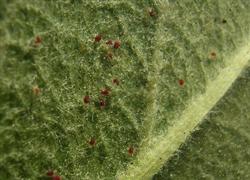
1. Hawthorn spider mite. Also known as the hawthorn red spider, it mainly damages the leaves, tender buds and young fruit of apple trees. When leaves are damaged, the red spiders gather on the underside of the leaves, spin silk and form webs, with fine soil particles and eggs sticking to the webs, and many pale white spots appear on the upper surface of the leaves. When the damage is severe, rust-colored symptoms appear on the underside of the leaves, followed by dehydration and hardening, and the whole leaf turns yellow-brown and scorched, resembling being burned by fire. In severely affected orchards, most leaves may drop between June and July, causing a second round of flowering and budding, and severely damaged buds cannot continue to grow and die.
2. Fruit stem mite. The fruit stem mite, also known as the apple long-legged red spider or alfalfa red spider, mainly feeds on the upper surface of host leaves, can form relatively large chlorotic spots, and there is no rust color on the underside of the leaves. This kind of red spider does not spin silk or form webs, and large amounts of white mite skins attach to damaged leaf stalks, branches and other parts, which can cause leaves to scorch and drop early.
3. Apple panonychus mite. Also known as the apple red spider, when tender buds are damaged they often cannot unfold leaves or bloom normally, and even the entire bud dies; the upper surface of damaged leaves is covered with yellow-white spots, and eventually the whole leaf turns withered yellow; it generally does not cause early leaf drop, nor does it spin silk or form webs.
II. Occurrence patterns
1. Hawthorn spider mite. It occurs 6 to 10 generations a year, overwintering as fertilized female mites in bark crevices, under rough bark and in soil cracks on the ground. Damage is generally light before June. After mid-to-late June, under high-temperature and dry climatic conditions, it reproduces very quickly, and July enters the stage of severe damage, which can cause a large amount of leaf drop. From late July to early August, with the arrival of the rainy season and an increase in natural enemies, the population density gradually declines. By mid-August most female mites have entered overwintering sites, and some may continue to overwinter until September to October.
2. Fruit stem mite. It occurs 3 to 7 generations a year, overwintering as eggs on the shaded side of main branches and lateral branches and on fruit stems and other places. It begins to hatch in April of the following year when apple trees sprout. Damage is most severe from mid-June to early July, and eggs generally appear in early August.
3. Apple panonychus mite. It occurs 6 to 9 generations a year, overwintering as eggs on fruit stems, fruit scars and two-year-old twigs. High temperature and dryness favor the reproduction and damage of the apple panonychus mite.
III. Control measures
To control mite pests, in addition to doing well in dormant-period control and pest monitoring, based on the occurrence patterns of red spiders, seize the 3 key periods before and after apple flowering and before wheat harvest, spray pesticides at the appropriate time, and at the same time pay attention to late-stage control to reduce the overwintering population, so that the damage of red spiders can be effectively controlled. At present, this is the high-incidence period before wheat harvest, so 25% saomanding 600 to 800 times dilution and 20% miexiaoli emulsifiable concentrate 3000 times dilution should be used for control. In addition, the 3 kinds of red spiders have many natural enemies, commonly including natural enemy insects, predatory mites and pathogenic microorganisms, and attention should be paid to protecting and utilizing them in production.
Click to get more apple tree planting techniques
Click to get more fruit planting techniques