How should cherry tomatoes be managed at each stage of cultivation?
How do you manage small tomatoes at each stage of cultivation? Please give a detailed introduction. For managing small tomatoes at each stage of cultivation, you can refer to the following methods: seed soaking, germination, sowing: soak the seeds in clean water for 4-6 hours, then disinfect with 800-fold chlorothalonil for 10-15 minutes (stirring constantly), then rinse with clean water, put them into a sand cloth bag...
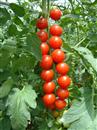
How do you manage small tomatoes at each stage of cultivation? Please give a detailed introduction
For managing small tomatoes at each stage of cultivation, you can refer to the following methods:
Seed soaking, germination, sowing: soak the seeds in clean water for 4-6 hours, then disinfect with 800-fold chlorothalonil for 10-15 minutes (stirring constantly), then rinse with clean water, put them into a sand cloth bag and wrap it well, wrap a wet towel around the outside of the sand cloth bag, and then place it in a 25-30°C environment away from light to germinate. Or after rinsing with clean water, mix with fine sand and sow directly for seedling raising.
1. Seedling raising: the seedling age period is generally about 45 days. The suitable daytime temperature for seedling growth is 20-28°C, the nighttime temperature is 10-15°C, and the relative air humidity is 60-70%. When light is insufficient, use incandescent lamps or biological-effect supplemental lighting and other measures to supplement light. For humidity management in early spring cultivation, the principle is to water early and not water late, and to water when dry and stop when wet. 7-10 days before planting, gradually harden the seedlings by controlling water and lowering temperature, to reduce the occurrence of dwarf-flower plants. The 1000-seed weight of small tomato seeds is 1.4-1.8 grams. Excellent seedlings have a decisive influence on early yield, because during the seedling period, flower bud differentiation of the first to third trusses has already begun. If the seedlings suffer from disease or nutritional imbalance, their development will be affected. At present, the focus of seedling raising is the prevention and control of tomato leaf curl virus. During the seedling period, insect-proof nets or yellow sticky boards should be used to isolate and eliminate the invasion of aphids and whiteflies, so as to completely prevent them from spreading the virus. When the seedlings grow to four leaves and two days before transplanting, foliar fertilizer (Yelüjing) should be used. The appropriate planting seedling age is about four to six leaves.
2. Planting: the planting density of small tomatoes varies according to the planting period, planting region and pruning method. Two crops per year: the autumn crop is sown from late June to mid-July (seedling age about 30 days). The spring crop is sown from late October to mid-November (seedling age about 45 days; when temperatures are low, the seedling raising time will be extended). One crop per year: sown from mid-August to early September (seedling age about 30 days). Plant spacing and row spacing are 30cm-35cm x (double rows) 140cm-160cm.
3. Pruning methods: for indeterminate varieties: double-stem pruning is often the main method, and all other side buds are removed. After the lower fruits mature and are harvested, when the main vine approaches the top of the greenhouse, the lower old leaves and diseased leaves should be removed, and the vines should be lowered in time, so as not to affect plant growth and cause reduced yield.
4. Water and fertilizer management. Tomato is a crop with relatively deep roots among Solanaceae crops, and its roots can reach 120-150CM deep, while the roots of eggplant and sweet pepper only reach about 120CM. Its ideal soil is deep, well-drained sandy soil. Tomato is not suitable for continuous cropping and can be rotated with rice, legumes, corn, etc. Special attention is needed especially in land where tomato bacterial wilt has occurred and in strongly acidic land. In protected areas, the soil should be fully disinfected to prevent severe disease occurrence. Land preparation requires deep ploughing of 20-30CM, careful breaking up of the soil, and depending on the soil pH, 50-100 kg of lime may be added. In areas prone to boron deficiency, a certain amount of borax should also be applied appropriately, and the application rate per mu should preferably not exceed 1.5 kg. Long-term cultivation of fruit vegetables requires large amounts of organic fertilizer. The application of base fertilizer is 10000-15000 kg/mu, compound fertilizer 30-40 kg/mu, and phosphate and potassium fertilizer 15-25 kg/mu. The method of applying base fertilizer is: before fertilizing, first dig a deep furrow in the center of the bed surface, then apply it evenly into the furrow, and then level the bed surface. Or spread it evenly and then combine with deep ploughing. The use of topdressing is very important. Within one month after planting, the accumulation of dry matter in tomato is quite slow, so the first topdressing is generally applied 20-30 days after planting. Topdressing is mainly compound fertilizer, combined with irrigation. Water one day before fertilizing to facilitate dissolution and absorption of the fertilizer after application, and the application amount can be smaller. Subsequent topdressing should maintain a fixed amount, applied once every three weeks. However, in some areas, each fruit harvest is followed by one watering and one topdressing. Tomato is extremely sensitive to boron and calcium deficiency. Boron is a trace element, and excessive use can cause toxic effects. At present, it is recommended to apply about 1 kg of borax per mu as base fertilizer by broadcasting. The absorption of calcium fertilizer is affected by the root system and other nutrient elements. For example, excessive nitrogen fertilizer often causes calcium deficiency fruit top rot. If tomato plants are submerged in water for more than 24 hours, root damage will also affect the absorption of calcium fertilizer. If symptoms of calcium deficiency or boron deficiency appear in the fruit during the cultivation period, they can be supplemented by foliar fertilization, using a concentration of 0.5% calcium chloride or borax aqueous solution.
5. Rainproof cultivation: the main limiting factor for summer small-fruit tomato production can be said to be rain damage. Sudden rainfall will cause fruit cracking and loss of commercial value. Therefore, a simple net house should be used as the production method for summer small-fruit tomatoes. The main advantage of net house cultivation is that the fruit can be harvested and marketed after fully reddening, and the fruit sugar content is naturally 1-2 degrees higher than that of open-field cultivation. Because cultivation in a net house in summer is more likely to produce high-temperature disorders, after the tomato plants enter the flowering stage, the screen nets on both sides of the net house can be rolled open to increase ventilation. Some farmers use shade nets to reduce light during midday (10 a.m. to 3 p.m.) to achieve the purpose of cooling. If continuous cloudy and rainy days occur, the relative humidity inside the facility can reach above 90%, which easily triggers leaf mold and blossom-end rot. Therefore, calcium fertilizer should be sprayed on the leaves to reduce the occurrence of blossom-end rot. Strictly pay attention to disease prevention.
6. Fruit setting treatment: the fruit setting rate of tomato will decline significantly when the nighttime temperature exceeds 21°C. Small tomatoes have relatively high heat tolerance, but in summer cultivation, the nighttime temperature often exceeds 24°C, and the daytime temperature is higher than 32°C. In winter-spring cultivation, when the nighttime temperature is lower than 8°C, the fruit setting rate is reduced.
Therefore, during these periods unfavorable to fruit setting, some drugs should be used for treatment, such as tomato fruit-setting hormone, to promote fruit setting. When applying, pay attention to temperature. The higher the temperature, the lower the concentration that must be used. The application period is when a truss already has 2-3 small flowers in full bloom, spray the truss once, avoiding spraying the terminal bud, which would cause the terminal bud to shrink and the leaves to become narrow and small. The symptoms of phytotoxicity are similar to infection with cucumber virus. Too high a concentration easily causes hollow fruit. At this time, plant auxin can be used at 5-10ppm to spray the leaves.
7. Pest and disease control: the main diseases of small-fruit tomato in spring and summer are seedling blight, bacterial angular leaf spot and bacterial wilt. In recent years, due to the damage caused by whiteflies and aphids, tomato viral disease has become an important disease. Yellow sticky boards can be used for trapping and killing. The symptoms and control methods of various pests and diseases are introduced below.
Click to get more cherry tomato cultivation techniques
Click to get more fruit cultivation techniques