What are the key technical points for summer management of a peach orchard?
How should a peach orchard be managed in summer? Please give an introduction. Summer management of a peach orchard can refer to the following methods: 1. Fertilize according to the tree: in late May, apply a topdressing once to peach trees that bear more fruit this year and have weaker tree vigor. Conversely, do not fertilize peach trees that bear little fruit and have stronger tree vigor. When fertilizing, at the drip line of the canopy, ...
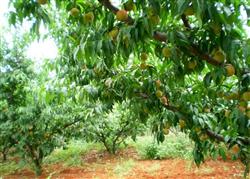
How should a peach orchard be managed in summer? Please give an introduction.
Summer management of a peach orchard can refer to the following methods:
1. Fertilize according to the tree: in late May, apply a topdressing once to peach trees that bear more fruit this year and have weaker tree vigor. Conversely, do not fertilize peach trees that bear little fruit and have stronger tree vigor. When fertilizing, at the drip line of the canopy, dig a ring-shaped fertilization trench about 1 m long and 0.25 m deep and 0.25 m wide. For adult fruiting trees, apply 40-50 kg of decomposed human, livestock and poultry manure water per tree, plus 0.3-0.4 kg of ammonium phosphate (or 0.25 kg of urea, 0.5-0.8 kg of superphosphate), then backfill soil to cover the pit after fertilizing. For small trees, apply half the amount. At the same time, carry out foliar topdressing on the peach trees, spraying the leaves with 0.1% Greenfenwei No. 1 foliar fertilizer (or a mixed fertilizer solution of 0.2% potassium dihydrogen phosphate and 0.3% urea), once every 15-20 days, for 4-5 consecutive times.
2. Drainage and waterlogging prevention: peach trees are afraid of waterlogging. June-July is the rainy season, so the main ditch, back ditch, sediment pits, etc. should be frequently dredged and cleared. Do a good job of drainage in the peach orchard, especially in low-lying peach orchards. Dig the main ditch and back ditch to a depth and width of 0.5 m and 0.3 m respectively, so as to lower the groundwater level and benefit peach tree growth.
3. Summer pruning: carry out summer pruning on peach trees in May-June. (1) Remove buds and pinch tips: remove the water sprout buds in the inner canopy and the competing buds and twin buds below the pruning cuts, and pinch the tips when the new shoots grow to 50-60 cm. (2) Bend branches and twist shoots: for upright peach trees with stronger growth, use branch bending, branch hanging and branch propping to increase the angle of the main branches and moderate tree vigor. At the same time, twist upright water sprouts and other excessively vigorous shoots 180 degrees, but do not twist them off, so that they change from upward growth to horizontal growth, prompting the water sprouts to turn into fruiting branches. (3) Spray hormones: when the secondary branches of the peach tree grow to about 60 cm, spray once with a 500-fold dilution of 15% paclobutrazol wettable powder, which can effectively control their growth and promote flower bud differentiation.
4. Prevent and control diseases and pests: in May-June, use 80% anthracnose fumate or 75% chlorothalonil 800-fold, or carbendazim 800-1000-fold, and continuously spray the canopy 3 times to prevent and control gummosis, anthracnose, etc. For trees that already have gummosis, first scrape off the diseased spots, then apply thiophanate-methyl wettable powder mixed with edible vinegar liquid or 402 fungicide 100-fold liquid to the affected area. At the same time, spray the canopy 2-3 times with mixed pesticide liquids such as 50% decis 1500-fold, 20% pirimicarb or buprofezin 1200-fold, etc., to prevent and control peach fruit borer, aphids, peach fruit moth (or lesser peach fruit moth), etc.
5. Cultivation and weeding: on sunny days in summer, for peach orchards without intercropping crops, use manual weeding, and bury the weeds in pits at the drip line of the canopy, or cover the peach trees with the weeds. Herbicide mixed liquids of glyphosate (Roundup) and paraquat can also be sprayed in the peach orchard. After the weeds die, they play a mulching role, which helps retain moisture and resist drought, and in autumn they are turned into the soil to increase soil organic matter.
Click to get more peach tree planting techniques
Click to get more fruit planting techniques