Key Technical Points for Kiwifruit Planting and Management in June
How to manage kiwifruit in June? Here is an introduction to the methods. June is the fruit swelling period for kiwifruit, and also the second peak period of fertilizer demand and the period when pests and diseases are most severe. Making the most of management during this month is crucial. 1. Continue four-season pruning: for the fruiting trees positioned and pruned in May, thin out overly dense branches and overlapping branches, diseased and pest-damaged branches, and thin weak branches. Pinching of fruiting branches: when two fruiting branches are side by side, for one of them leave only one leaf above the foremost fruit and pinch; when the other fruiting branch is being trained as next year's fruiting mother branch, leave 3-4 leaves above the foremost fruit and pinch, with a leaf-to-fruit ratio of 6-8:1. For vegetative branches that are good fruiting mother branches for next year, those already pinched should continue to be trained; those not yet pinched should be pinched after leaving 10-12 leaves. For water sprouts, leave 3-4 leaves and pinch; those with no space should be thinned from the base. They must not be left to grow freely, otherwise useless water sprouts will form.
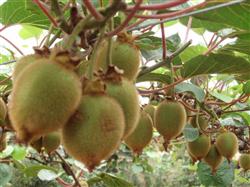
How to manage kiwifruit in June? Here is an introduction to the methods.
June is the fruit swelling period for kiwifruit, and also the second peak period of fertilizer demand and the period when pests and diseases are most severe. Making the most of management during this month is crucial.
1. Continue four-season pruning: for the fruiting trees positioned and pruned in May, thin out overly dense branches and overlapping branches, diseased and pest-damaged branches, and thin weak branches. Pinching of fruiting branches: when two fruiting branches are side by side, for one of them leave only one leaf above the foremost fruit and pinch; when the other fruiting branch is being trained as next year's fruiting mother branch, leave 3-4 leaves above the foremost fruit and pinch, with a leaf-to-fruit ratio of 6-8:1. For vegetative branches that are good fruiting mother branches for next year, those already pinched should continue to be trained; those not yet pinched should be pinched after leaving 10-12 leaves. For water sprouts, leave 3-4 leaves and pinch; those with no space should be thinned from the base. They must not be left to grow freely, otherwise useless water sprouts will form.
2. Grasping pest and disease control is key: pay attention to controlling spotted lanternfly, Oriental small auger beetle, stink bugs, red spider mites, aphids and brown spot disease, branch blight, gray mold, etc. You can choose 2.5% Chongsaisi 2000 times or Alituo 2000-3000 times + 25% Jinlishi 6000-7500 times + Roushuitong 4000 times, or Awei chlorpyrifos 3000-4000 times + Namixin 1500 times + Roushuitong 4000 times. At the same time, add foliar fertilizer Guoyou amino acid 600 times or fulvic acid Kanghanlong 500-600 times and an appropriate amount of rooting agent for root drenching to prevent root rot.
3. Topdressing: the fruit is in the swelling period and has a high fertilizer demand, so topdressing must be done in time. Choose soil application, foliar spraying and trunk coating to advance on three fronts together, meeting the maximum nutritional demand of fruiting trees during this period.
Topdressing: for trees with a medium fruit load, apply per tree Longfei Dasanyuan 1.5-2 kg + Wotianjia 1-1.5 kg; for trees in the early fruiting stage, apply per tree Longfei Dasanyuan 1-1.5 kg + Wotianjia 0.5-1 kg. Broadcast or apply in open radial trenches, first mixing the fertilizer with soil and then covering with topsoil. After application, water thoroughly. For foliar spraying, choose Guoyou amino acid 600 times or Shuofeng "481" 600 times and spray on the leaves, once every 10 days, for 2-3 consecutive sprays. For yellowing trees, add Sidekaopu 6000 times as a soil application, and add it to the foliar spray for one combined application to reduce costs. When yellowing is severe, spraying Dinglv times solution on the leaves twice in succession has an obvious effect. You can also choose fulvic acid Kanghanlong 400-500 times or Guoyou amino acid 200 times + Sidekaopu 5000 times for root drenching, which has an obvious effect.
4. Training high-grafted young trees onto the trellis: the new shoots sent out by high-grafted varieties have already reached the trellis at this time. Keep two vegetative branches and separate them in a "Y" shape from the middle wire on the trellis, inducing them to extend in two directions. After new shoots emerge, keep one branch every 20-25 cm, extending in two opposite directions, and train them into next year's fruiting mother branches. For new buds emerging below the trellis, all new shoots should be thinned out, using a single main vine to reach the trellis.
For new shoots sent out by low grafting, a plastic string can be used to guide them onto the trellis, keeping only a single main vine and wiping out the rest.
5. Management of seedling trees: for seedling trees planted in the current year, the main focus is survival. There must be no water shortage, and weeds must be cleared. Small weeds can be retained to cool temperatures and provide shade; large weeds must be removed so they do not affect young seedling growth.
6. Orchard shading and grass planting: use corn stalks, wheat straw and cut weeds for shading to lower soil temperature and preserve moisture.
7. Irrigation and drainage: under conventional kiwifruit management, when soil moisture content drops to 50-60%, irrigation is needed. Generally, the irrigation amount is 60 cubic meters per mu. Do not use large-volume seepage irrigation; irrigate with a small amount of water. In low-lying areas, drain during rainy periods; do not allow water to accumulate. After water accumulates for a long time, root rot occurs.
Special reminder: for trees newly planted in the current year, summer harvest is a critical hurdle. Before summer harvest, irrigate to preserve moisture and provide shade to keep seedlings alive. Most people neglect management and protection once summer harvest begins, and large numbers of seedlings die. Young trees planted especially in wheat fields should receive extra care and heavier management to keep the young trees alive. Otherwise, a moment of negligence wastes effort and money, and you must wait another year to replant.
Click to get more kiwifruit planting techniques
Click to get more fruit planting techniques