How to prevent and control kiwifruit chlorosis? These cultivation techniques you need to master
How to prevent and control kiwifruit chlorosis? Please introduce the prevention and control methods. Kiwifruit chlorosis can be prevented and controlled by referring to the following methods: Build the orchard in a suitable location and choose a good site. The soil pH of a production orchard should be between 5.5 and 7.5. The soil should preferably be light loam, medium loam, or well-aerated sandy loam, with organic matter content in the topsoil above 1.5%, and the groundwater level below 1 m. Avoid establishing an orchard on replanted land where perennial trees such as apple, pear, and peach have already been grown, or on heavy clay soil. It should also not be established in areas with a high groundwater level that are prone to waterlogging.
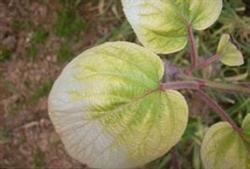
How to prevent and control kiwifruit chlorosis? Please introduce the prevention and control methods
Kiwifruit chlorosis can be prevented and controlled by referring to the following methods:
Building the orchard in a suitable location Choose a good site. The soil pH of a production orchard should be between 5.5 and 7.5. The soil should preferably be light loam, medium loam, or well-aerated sandy loam, with organic matter content in the topsoil above 1.5%, and the groundwater level below 1 m. Avoid establishing an orchard on replanted land where perennial trees such as apple, pear, and peach have already been grown, or on heavy clay soil. It should also not be established in areas with a high groundwater level that are prone to waterlogging.
Variety selection Choose wild delicious-series kiwifruit with relatively strong resistance to chlorosis as rootstock, and select varieties with strong resistance to chlorosis.
High-ridge, shallow-furrow planting Build ridges 30 cm high along the tree rows. Seepage irrigation is best, as it helps preserve soil moisture, protect the trunks, prevent soil compaction, facilitate drainage during waterlogging, avoid standing water, and provide good soil aeration.
Interplanting green manure between rows in the kiwifruit orchard During dry seasons, cover the tree discs with green manure and other crop straw to preserve moisture, thereby increasing soil humus and improving soil structure.
Improving the soil and deep plowing for maturation Combine this with the application of organic fertilizer to increase soil organic matter content and improve soil structure and physical and chemical properties.
Rational topdressing and promotion of balanced fertilization techniques In the early growth stage each year, chemical fertilizer application should mainly be ammonium nitrogen fertilizers such as ammonium sulfate or urea, with less use of nitrate nitrogen fertilizers and ammonium bicarbonate. When applying iron fertilizer to the soil, it should be mixed with decomposed organic fertilizer or humic fertilizer. Ensure combined application of nitrogen, phosphorus, and potassium, and combined application of major elements and trace elements.
Controlling yield and improving vigor For trees in full fruit-bearing stage, the yield per mu should preferably be 2000-2500 kg. Strictly prevent excessive load to maintain vigorous tree growth.
Timely irrigation Change flood irrigation to small-plot separate irrigation, avoid excessive irrigation, and be careful to prevent standing water. Where conditions permit, seepage irrigation or drip irrigation techniques can be adopted.
Regulating soil pH In alkaline soil with a pH above 7.5, it is recommended to apply 1 kg of sulfur powder or 8% acetic acid solution per plant to appropriately lower the pH of the rhizosphere.
Chemical control
① For chlorotic trees with physiological nutrient deficiency induced by pathological factors in the root system, root diseases should be treated as soon as possible. On the basis of pruning out diseased roots and scraping off diseased bark, use equal-amount Bordeaux mixture to irrigate the roots alternately 2-3 times.
② For nutrient-deficient chlorotic trees induced by root-knot nematode disease, spray the rhizosphere soil to kill root-knot nematodes, and combine this with pruning out diseased fibrous roots to restore the physiological function of the root system as soon as possible.
③ For plants that have already developed chlorosis, hanging drip infusion can be used. Trunk and branch infusion for preventing and controlling kiwifruit chlorosis is simple, quick, practical, saves labor and time, and has remarkable effects. The method is to drill a hole at the base of the main trunk of the diseased tree until reaching the pith (that is, at 1/2 of the trunk diameter). The amount of nutrient solution used depends on the thickness and diameter of the trunk.
Click to get more kiwifruit cultivation techniques
Click to get more fruit cultivation techniques