Kiwifruit Cultivation Techniques: How to Manage Kiwifruit in Summer?
How to manage kiwifruit in summer? Please provide guidance on management methods. The main summer management practices for kiwifruit are as follows: 1. Bud removal and pinching. Based on the principle of "early bud removal, timely pinching, and shortening of long branches," combined with the tree's vigor, kiwifruit should be pruned multiple times during the growing season to achieve high and stable yields...
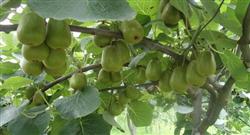
How to manage kiwifruit in summer? Please provide guidance on management methods
The main summer management practices for kiwifruit are as follows:
1. Bud removal and pinching
Based on the principle of "early bud removal, timely pinching, and shortening of long branches," combined with the tree's vigor, kiwifruit should be pruned multiple times during the growing season to achieve high and stable yields. During the bud break period, buds that are poorly positioned or too dense can be removed early; for vigorous fruiting branches in mature orchards, pinch the tips leaving 8-10 leaves above the fruiting position; for secondary shoots that sprout after the first pinching, pinch leaving 3-4 leaves; for tertiary shoots that sprout, pinch leaving 2-3 leaves; for water sprouts or vegetative branches that can be trained, pinch leaving 10-15 leaves; diseased, pest-damaged, and weak slender branches are generally removed from the base. Hongyang kiwifruit has thinner and larger leaves than other varieties, with poorer stress resistance, and its shoots are slender and easily broken. In strong wind weather, pay constant attention to tying branches and guiding vines. Those most easily broken by wind are usually the good fruiting canes of the second year. If dry hot winds occur, where conditions permit, water can be sprayed on the leaves to prevent the dry hot wind from scorching them. Gradually improve the microclimate so that kiwifruit is kept in a warm and humid climate environment.
2. Pollination during flowering
Kiwifruit's early flowering period is in late April, full bloom in early May, and late flowering in late May. If continuous rainy weather occurs during the flowering period, pollination will be poor, and artificial pollination is necessary. The specific method is: before the flowering period, collect male flower buds in advance, remove the pollen sacs and place them at a room temperature of 25°C; after a full day and night, the pollen sacs open and the pollen can be collected. Pollinate in two batches during the female flowering period; pollinating with flowers that open on the same day gives good results. The number of seeds in kiwifruit is directly proportional to fruit size; for a fruit weighing 130 grams, the number of seeds per fruit is 800-1,200. Conventional manual spot pollination requires repeated pollination many times to meet the requirement, whereas liquid pollination has the characteristics of fast pollination speed, concentrated and accurate spraying, extended pollination period, and pollen savings.
3. Timely fruit thinning
Strictly thin fruit, ensure a reasonable load, and do not use fruit-sizing hormones. In principle, keep a single fruit per inflorescence and remove the top and tail fruits on the same branch. Fruit thinning should be carried out 10-15 days after flowering, following the principle of "keep the good and remove the poor, keep the large and remove the small, keep the sparse and remove the dense, keep the middle and remove the base," removing deformed fruits, small and weak fruits, overlapping fruits, and diseased and pest-damaged fruits. Generally, short fruiting branches keep 1-2 fruits, medium fruiting branches keep 3-5 fruits, and long fruiting branches keep 4-6 fruits. To grow higher-quality fresh fruit, where conditions permit, bagging techniques give even better results. 15 days after pollination, spray the second foliar fertilizer, still mainly with 0.3% urea and monopotassium phosphate, combined with Meilin high-efficiency calcium, etc. After that, spray once every 15 days for 5 consecutive sprays. After the young fruit's first growth stop, apply a fruit-strengthening fertilizer mainly with potassium and nitrogen.
4. Soil management
Soil is the foundation for good kiwifruit growth. Kiwifruit roots are fleshy roots, and 70% of the roots grow horizontally. In terms of management, young trees should have a 1 m tree disc, and large trees should have a 2 m tree disc, with no intercropping of other crops. No tall-stalk crops should be intercropped throughout the orchard. In the tree disc, weeds should be hoed frequently and the soil loosened to maintain soil aeration. Fertilization and weeding should be as shallow as possible to avoid damaging the main roots. Where conditions permit, high-quality green manure can be planted in the tree disc or throughout the orchard, and no-till methods can be adopted. For summer fertilization, "eat small meals more often" should be followed; in principle, avoid applying high-concentration chemical fertilizers. Spray foliar fertilizer, spraying fully water-soluble Meilin high-efficiency calcium. If high temperature and drought occur, irrigate before 11:00 a.m. or after 4:00 p.m. when the ground temperature is lower; combined with irrigation, use rice straw, wheat straw, weeds, etc. as mulch to achieve the purpose of drought resistance and moisture retention.
5. Pest and disease control
Flower bud maggots mostly occur from April to May and can cause a large amount of flower and fruit drop, so they must be controlled promptly. From June to September, control diseases such as soft rot and brown spot disease.
Click to get more kiwifruit cultivation techniques
Click to get more fruit cultivation techniques