Papaya planting techniques: How do you plant and manage Xuan papaya (Chinese flowering quince)?
How do you plant and manage Xuan papaya (Chinese flowering quince)? Please provide guidance. For the planting and management of Xuan papaya (Chinese flowering quince), you can refer to the following: I. Land preparation and planting. 1. Site selection and land preparation. For the cutting seedbed, it is best to choose flat, sunny, fertile, loose, well-drained sandy soil, where cuttings root easily after insertion. There should be a water source near the seedbed for irrigation...
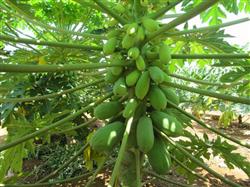
How do you plant and manage Xuan papaya (Chinese flowering quince)? Please provide guidance.
For the planting and management of Xuan papaya (Chinese flowering quince), you can refer to the following:
I. Land preparation and planting
1. Site selection and land preparation. For the cutting seedbed, it is best to choose flat, sunny, fertile, loose, well-drained sandy soil, where cuttings root easily after insertion. There should be a water source near the seedbed for irrigation. For the planting site, it is best to choose a wind-sheltered, sunny location with moderate fertility on a gentle slope in a low mountain area or hilly land. You can also choose flat land, the foot of a hill, field edges, ditch sides, or gaps in courtyards for scattered planting. Windy sections facing north are not suitable for planting.
2. Field planting. This can be done from after leaf fall in winter to before bud break in early spring. When planting, dig planting holes at a row spacing and plant spacing of 2 x 2 m (165 plants/mu). The hole diameter and depth are each 50 cm. First loosen the subsoil at the bottom and level it, then apply decomposed barnyard manure, compost, cake fertilizer, burnt soil ash, and other fertilizers mixed evenly with the subsoil as a base fertilizer, applying 510 kg per hole, and cover with fine soil about 10 cm thick. Then, plant 1 strong seedling or 2 small seedlings per hole, so that the root system spreads out in the hole, and fill and firm the soil in layers. After planting, water once thoroughly, and cover with soil 1020 cm above the ground, shaping it like a turtle shell, which helps with heat preservation and freeze prevention and favors survival.
II. Field management
1. Cultivation, weeding, and fertilization. In the first two years after field planting, short-stem crops can be intercropped between the rows. Each year in spring, summer, and autumn, carry out cultivation, weeding, and fertilization once each in combination with the intercrops. Apply 1020 kg per plant of a compound fertilizer made by mixing and composting barnyard manure, compost, superphosphate, burnt soil ash, and other materials. Open a ring-shaped ditch below the outer edge of the canopy and apply it, then cover with soil after application. Stop cultivation and weeding after the plants close their rows.
2. Pruning and trimming. After field planting, select 5-6 strong main trunks from the plant cluster and train them into plants with a natural open-center shape. Carry out pruning and trimming every winter, cutting off dead branches, thin and weak branches, aged branches, excessive vegetative branches, diseased and pest-damaged branches, and overly dense branches. Xuan papaya (Chinese flowering quince) mostly bears fruit on 2-year-old branches, so after fruit harvest each autumn, heading-back pruning should be carried out, that is, keeping branch length at about 30 cm and cutting off the top shoots, to encourage more branching and more flowering and fruiting. Through several years of pruning and trimming, form a high-yielding tree shape that is round outside and open inside, ventilated and light-transmitting, with sparse, strong branches, and capable of bearing fruit both inside and out.
3. Drainage and irrigation. After field planting, if the weather is dry, pay attention to watering to protect the seedlings. In the rainy season, dredge ditches and drain water promptly to prevent waterlogging and root rot.
Click to get more papaya planting techniques
Click to get more fruit planting techniques