How to prune Fujiminori grapes in summer? Key points of grape growing techniques
How should Fujiminori grapes be pruned in summer? Please explain the methods. Summer pruning of Fujiminori grapes can be carried out by referring to the following methods: 1. Bud removal and shoot thinning. Bud removal is done after spring bud break, removing weak buds and useless latent buds or twin buds and triple buds. To avoid wasting nutrients, bud removal should be done as early as possible. When new shoots grow 1...
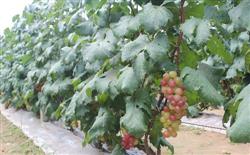
How should Fujiminori grapes be pruned in summer? Please explain the methods.
Summer pruning of Fujiminori grapes can be carried out by referring to the following methods:
1 Bud removal and shoot thinning
Bud removal is done after spring bud break, removing weak buds and useless latent buds or twin buds and triple buds. To avoid wasting nutrients, bud removal should be done as early as possible. When new shoots reach 10-15 cm, shoot thinning can be carried out. When new shoots grow to more than 10 cm, removing excess young branches is called branch thinning. From bud removal to shoot thinning, bud removal needs to be done 2-3 times.
The number and degree of shoot thinning should be determined according to tree age, tree vigor, cultivation and management conditions, and the number of buds retained during winter pruning. Buds on the trunk or main vine within 40 cm from the ground should all be removed at once as early as possible at the initial stage of bud break. For buds on the remaining mother branches, when 2 sprouts appear at one bud eye or the buds are too dense, remove them about 10 d after leaf unfolding. In principle, remove vegetative branches and keep fruiting branches, remove weak branches and keep strong branches, remove injured and diseased branches and keep normal branches, and remove upward-pulled branches and keep lower-position branches.
2 Pinching and treatment of secondary shoots
Pinching is the removal of the tender tips of 3-5 new shoots. Its purpose is to inhibit vine growth, save nutrients, promote flower bud differentiation and vine maturity, and improve the yield and quality of Fujiminori grapes. Pinching is carried out from before flowering until the new shoots stop growing. Pinching of fruiting branches is generally carried out 3-7 d before flowering or at the beginning of flowering. It is suitable to leave 5-7 leaves above the inflorescence before pinching. For fruiting branches with fewer leaves and overly weak growth, pinching may be temporarily omitted. For vegetative branches, it is suitable to leave 10-15 leaves, generally later than pinching of fruiting branches; extension branches may be pinched after leaving 12-20 leaves, at an even later time. For strong secondary shoots above the inflorescence, pinch after leaving 4-5 leaves; for weaker secondary shoots, pinch after leaving 1-2 leaves. After secondary shoots are pinched, they will continuously sprout again repeatedly throughout the entire growth period and must be repeatedly removed, generally once every 10-15 d, about 4-6 times per year, stopping secondary shoot pinching when the fruit begins to color.
3 Flower cluster thinning, tipping of flower clusters and cluster shape management
Flower cluster thinning and tipping of flower clusters should be carried out 2 weeks before flowering. Generally, strong branches retain 2 flower clusters, and weak branches retain 1 flower cluster. Tipping the flower cluster means pinching off about 1/3 of the end of the flower cluster and pinching off secondary clusters. When fruiting branches are thin and weak or fertilizer and water are insufficient, thin more heavily and remove more flower clusters. One week after flowering, thin the fruit and manage the cluster shape, removing small berries, leaving 25-30 berries per cluster.
4 Removing tendrils and tying new shoots
Tendrils both waste nutrients and tend to entangle fruit clusters and vines, affecting the normal growth and development of fruit clusters and vines, so they should be removed in time. When new shoots reach 20-40 cm in length, the work of tying new shoots should be done well. Tying of new shoots can be divided into horizontal tying, vertical tying, inclined tying and bow-shaped tying. Horizontal tying and bow-shaped tying can inhibit excessive growth of new shoots and make the basal bud eyes plump, and are mostly used for fruiting branches and developmental branches; vertical tying and inclined tying are mostly used for extension branches and weaker-growing branches. Main vines in trellis fan-shaped training may be tied vertically or at an incline; those in single-arm horizontal training may be tied horizontally. When tying new shoots, be careful not to bind the vine too tightly, and leave a certain amount of room to facilitate thickening growth.
5 Leaf removal
In the late stage of fruit cluster ripening, properly removing some old leaves that have lost their function can improve light and ventilation conditions for the plant, help fruit cluster coloring, increase fruit value, and cut off the overly long autumn shoot tips by 20-30 cm.
Summer pruning measures for Fujiminori grapes must be closely coordinated with variety characteristics and cultivation management techniques in order to achieve good results. Emphasizing only a single technique makes it difficult to achieve the expected results.
Click to get more grape growing techniques
Click to get more fruit growing techniques