Grape Growing Video: Courtyard Grape Cultivation Techniques and Pictures
Using courtyards and the vacant land in front of and behind houses to cultivate grapes not only increases economic returns, but also relieves heat, provides shade and coolness, greens the courtyard, and beautifies the environment. Therefore, whether in urban or rural homes, factories, schools, or institutions, grapes can be planted in courtyards. It is a developmental form of production with very broad prospects...
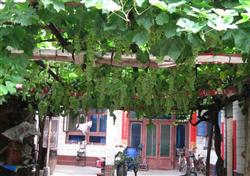
Using courtyards and the vacant land in front of and behind houses to cultivate grapes not only increases economic returns, but also relieves heat, provides shade and coolness, greens the courtyard, and beautifies the environment. Therefore, whether in urban or rural homes, factories, schools, or institutions, grapes can be planted in courtyards. It is a developmental form of production with very broad prospects.
I. Characteristics of Courtyard Grape Cultivation
1. Easy management:
Because grapes are climbing fruit trees, they can extend and bear fruit with the help of trellises, making full use of space. Therefore, in courtyards, grapes are very suitable for planting. Since they are planted in the yard, family members, young and old, can use their leisure time to tie vines, pinch tips, prevent and control diseases and pests, fertilize, and water in a timely manner, which is very convenient.
2. Early fruiting:
Because the courtyard is warm and prone to forming a microclimate, it is favorable for grape growth and extends the growing period compared with open fields. Due to sufficient fertilizer and water and careful management, grapes sprout early, grow quickly, have deep roots and lush leaves, strong photosynthesis, bear fruit early, produce stable yields, ripen early, and have excellent quality.
3. Beautifying the environment:
Planting grapes in the courtyard not only brings considerable income, but also provides people with a good place to escape the heat, cool off, and rest in the hot summer. When the fruit ripens, its color and fragrance are intoxicating, making people feel relaxed and refreshed.
II. Cultivation Trellis Styles
1. Sloping large shed trellis
In open areas of the courtyard and in front of and behind houses, this trellis style can be used for cultivation, guiding the branches and vines toward the roof space. The work does not affect the grapes' requirements for wind and light conditions or people's free movement under the trellis, and it also provides summer shade. A sloping large shed trellis generally has a length of 8-20 m, and the height varies greatly. For a trellis led above a building, the root end height is 1.5-2 m and the tip end height is 3-4.5 m. The supports are mostly cement posts or bamboo poles, etc. Wire or other substitutes are laid on top.
2. Small shed trellis
Suitable for smaller courtyards. Grapes easily cover the trellis surface, which is favorable for early high yield. Generally, the trellis length is 4-6 m, the root end height is 1.3-1.5 m, and the tip end height is 1.8-2.2 m or more. Plant spacing is about 0.5-2 m.
3. Single-plant tall-trunk arbor trellis style
In a quiet part of the courtyard, build a 2 m high square or round flat-topped arbor trellis, and plant one grapevine in the middle using a tall trunk and multi-main-vine training method. Its branches and vines are evenly distributed on the trellis surface, forming a flat-topped arbor covered with green leaves. Place a stone table and small stools underneath, where people can play chess and rest in the cool shade, giving a distinctive flavor.
4. Potted form
If it is inconvenient to obtain soil in the courtyard or the ground is entirely concrete, the potted form can be used, that is, potted grapes can be neatly placed along both sides of walkways and other places, and they can still play the role of courtyard grapes.
III. Key Cultivation Points
1. Selecting varieties
The varieties planted for courtyard grapes must have strong stress resistance, early fruiting and easy high yield, large berries, high quality, easy management, and suitability for trellis cultivation. Excellent table varieties are best, such as Kyoho, Zana, Red Fuji, Shengli, Italia, and other varieties.
2. Planting strong seedlings
The quality of grape seedlings directly affects the survival and growth and development of young plants after courtyard grape planting. Therefore, seedlings with well-developed root systems, thick branches and vines, plump buds, and no pests or diseases must be selected for planting. When planting, in addition to disinfecting the seedlings with 3-degree lime sulfur mixture, the roots also need to be trimmed, that is, excessively long roots and rotten roots should be cut off. This helps the growth and development of new roots after planting and prevents the occurrence of diseases.
3. Improving soil and applying sufficient base fertilizer
Grapes are suitable for sandy loam soil, and the soil layer should be deep. In many courtyards, the soil contains broken bricks, tiles, crushed stones, lime residue, and other debris. This debris should be completely and cleanly removed while turning the soil and digging planting holes. If the soil quality is really poor, soil replacement cultivation should also be carried out. Before planting, sufficient base fertilizer should be applied, mainly organic fertilizer, such as chicken manure, sheep manure, pigpen manure, and human feces and urine. About 100 jin per plant. When fertilizing, mix the fertilizer and topsoil evenly and first fill it into the bottom layer of the planting hole, which helps the root system grow downward.
During the grape growth and fruiting period, in order not to affect the environmental sanitation of the courtyard, the fertilizer types are best chicken manure or fully decomposed cake fertilizer. The fertilization method and timing are basically the same as in open fields.
4. Reasonable watering
For courtyard grape cultivation, avoid watering whenever there is water, and do not often splash washbasin water under the vines. This is unscientific: it not only causes high soil moisture and breeding of diseases, but the soap contained in washbasin water also affects root growth, which is extremely unfavorable to grapes. Watering courtyard grapes should be flexibly controlled by observing the sky, the soil, and the growth performance of the grape plants. However, at least 3 waterings must be guaranteed throughout the year, namely before budding, during the young fruit enlargement growth period, and before overwintering.
5. Trellis training
The parallel main-vine form on a trellis is mostly used. In the same year or the second year after planting, select 3-4 vigorous new shoots as main vines, and tie these main vines parallel on the trellis surface at intervals of about 60 cm. During winter pruning, leave them as long as possible. After budding the following spring, use one new shoot at the tip as the extension vine of the main vine and still tie it in the parallel direction. According to the needs of the trellis surface, arrange a fruiting branch group or side vine every 30 cm along the later new shoots until the branches cover the trellis surface. Generally, the branches and vines can cover the trellis surface in 2-3 years.
6. Preventing and controlling pests and diseases
Because courtyard grapes occupy a small area and there are few plants, once an individual plant suffers from pests or diseases, it is easy to detect, and manual control methods such as removing diseased leaves and diseased fruits and catching and killing pests can be adopted in time. When pests and diseases occur seriously, spray control should be carried out in time. The specific methods and types of pesticides applied can be the same as those for general open-field cultivation.
Click to get more grape cultivation techniques
Click to get more fruit cultivation techniques