How should pear trees be pruned in summer for the best results?
How is summer pruning of pear trees done well? Who can explain the method? For pruning pear trees in summer, you can refer to the following method: I. Characteristics of pear tree branch growth. 1. The new shoot growth period of pear trees is short and has obvious stages. Long shoots stop growing before early to mid-July, while medium and short shoots stop growing before early to mid-May....
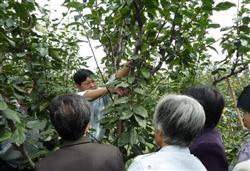 How is summer pruning of pear trees done well? Who can explain the method?
For pruning pear trees in summer, you can refer to the following method:
I. Characteristics of pear tree branch growth
1. The new shoot growth period of pear trees is short and has obvious stages. Long shoots stop growing before early to mid-July, while medium and short shoots stop growing before early to mid-May.
2. Pear tree leaves grow quickly, and leaf area forms early. The leaves of medium and short shoots stop growing in early to mid-May, and the total leaf area accounts for more than about 85% of the whole tree. After late May, the increase in leaf area mainly depends on the leaves on long shoots.
3. Pear tree branches are strongly upright, and the conflict between new shoot growth (including fruit spur secondary shoots) and young fruit growth and development in competing for nutrients in a short period is relatively prominent. At the same time, the new shoots on the back and apical dominance are relatively strong, while the growth vigor at the tip of the branches is relatively weak. In production management, the handling of main branch angles and bearing branch group angles is very sensitive to fruit growth and crown shaping and expansion. Summer pruning can be done well in combination with fruit thinning and bagging.
II. Principles of summer pruning
1. Summer pruning time should not be too early. It is better to carry it out in early to mid-May, when medium and short shoots have basically stopped growing, the tree leaf area has reached more than 85% of the whole tree, and new shoots are at a semi-lignified degree. Supplementary pruning is carried out in June to July.
2. Pruning should be based on maintaining the original crown and the amount of branches and leaves. Under the conditions of stabilizing tree vigor and balanced growth, the purpose is to improve ventilation and light transmission conditions in the orchard. The pruning amount should not exceed 5%-10% of the whole tree's branches and leaves, and a light interception rate of 20%-30% under the crown projection is sufficient.
3. Summer pruning focuses on regulating vegetative growth and reproductive growth. According to the current tree structure and orchard density, the key is to properly handle the balanced relationship between young fruit growth and new shoot growth (including fruit spur secondary shoots).
III. Summer pruning methods
1. Branch thinning. Thin out branches at pruning cuts and saw cuts, as well as vigorously growing new shoots sprouting on the back, at the top, and inside the canopy. Try not to pinch or top the various long, medium, and short new shoots that are growing or have stopped growing. Through branch thinning, the purpose of improving tree ventilation and light transmission and reducing ineffective nutrient consumption is achieved. At the same time, note that to maintain tree balance, the thinning of back branches should not exceed 1/3-1/2.
2. Shoot twisting. This is mainly aimed at upright and vigorously growing fruit spur secondary shoots. Pinching or thinning should not be used. If there is space, twist and release them to promote the secondary shoots to grow horizontally or obliquely downward, improve the growth angle of new shoots, inhibit new shoot growth, increase leaf area, reduce or avoid competition with fruit for nutrients, and help produce fruit with a regular shape. It also increases single fruit weight, raises sugar content, and increases storability.
3. Branch kneading. For long shoots that grow vigorously in the current year and have an upright angle, besides thinning out some of them, soften the rest by branch kneading.
4. Branch bending. For bearing branch groups and flower-bearing branches that are more than one year old, have upright angles, and have space for use, adopt the technique of bending instead of pruning to moderate tree vigor, improve light conditions, and promote good development of fruit and flower buds.
5. Girdling. This is mainly aimed at main branches that have upright angles, grow strongly, and cannot be opened in angle. From May to July, use girdling technology to control tree vigor and new shoot growth and promote fruit development.
Click to get more pear tree planting techniques
Click to get more fruit planting techniques