Which methods cannot be used for summer pruning of pear trees?
Which methods cannot be used for summer pruning of pear trees? Please introduce and guide the cautious use of the following three methods in summer pruning of pear trees: tip pinching, which is pinching off the tender tip at the top of the current year's new shoot that has not yet stopped growing, at the point where 2~3 leaves have unfolded; shoot clipping, which is cutting off the upper part of a new shoot that has not yet stopped growing and has exceeded the length that should be retained and has already become woody, and this method is still in use; shoot twisting, which is done from late May to early July, taking a semi-woody new shoot more than 40 cm long, gently kneading it soft at 8~12 cm from the base, then twisting it 120°~150°, so that the inner wood tears but does not break, and the outer bark bends but does not split, then bending the upper part to change the growth direction of the branch.
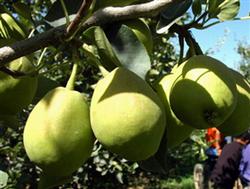 Which methods cannot be used for summer pruning of pear trees? Please introduce and guide
The following three methods should be used with caution in summer pruning of pear trees:
Tip pinching is pinching off the tender tip at the top of the current year's new shoot that has not yet stopped growing, at the point where 2~3 leaves have unfolded; shoot clipping is cutting off the upper part of a new shoot that has not yet stopped growing and has exceeded the length that should be retained and has already become woody, and this method is still in use; shoot twisting is done from late May to early July, taking a semi-woody new shoot more than 40 cm long, gently kneading it soft at 8~12 cm from the base, then twisting it 120°~150°, so that the inner wood tears but does not break, and the outer bark bends but does not split, then bending the upper part to change the growth direction of the branch.
However, none of these three methods can be used on pear trees. This is because most pear varieties have strong sprouting ability, weak branching ability, and new shoots that stop growing early. Except for some varieties in the Sand Pear (Pyrus pyrifolia) system, which can produce autumn shoots in fertile southern orchards and areas with abundant rain, the new shoots of other strain systems grow only once a year, and do not produce autumn shoots or secondary branches. Therefore, whether in nursery seedling production, or for young trees and trees just beginning to bear fruit, these three methods cannot be used in summer pruning.
This is because after using tip pinching or shoot clipping, medium-sized seedlings and moderately vigorous trees mostly do not sprout new shoots again, which shortens the original shoot and reduces the number of leaves, affecting the plant's nutrient production and accumulation, and is not conducive to accelerating seedling formation, tree formation, and early fruiting and high yield; vigorous seedlings and strongly growing trees, after using tip pinching and shoot clipping, can sprout new shoots quickly, but at most can only sprout two branches, and sprouting shoots also consumes a large amount of nutrients from the tree. Most importantly, the sprouted shoots have leaf scars on the 0~12 cm section at the base where no leaves or shoots can emerge, and the middle and upper parts are mostly not fully developed and matured, so they still have to be cut off during winter pruning, completely causing ineffective consumption of nutrients and useless growth of shoots. Therefore, tip pinching and shoot clipping cannot be used in summer pruning of pear trees. Also, because pear shoots are relatively thick and hard-brittle, with wood that is not fine-textured, if shoot twisting is used, it often splits or breaks as soon as it is twisted, so this method likewise cannot be used.
For long, thick, strongly vigorous and upright new shoots of pear trees, only methods such as branch pulling, branch bending, girdling, and scoring can be used during summer pruning.
Click to get more pear tree planting techniques
Click to get more fruit planting techniques