Pear tree cultivation: What methods can make pears larger and increase yield?
What methods can make pears larger and increase yield? Please provide guidance. To make pears larger and increase yield, you can refer to the following methods for planting: 1. Improve the traditional tree shape. Most high-density pear orchards use the inverted herringbone shape or the double-layer open-center shape with a central leader, which is suitable for Dangshan pears. However, because early-maturing series varieties have a low branching rate...
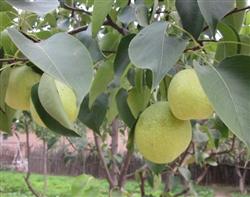 What methods can make pears larger and increase yield? Please provide guidance.
To make pears larger and increase yield, you can refer to the following methods for planting:
1. Improve the traditional tree shape. Most high-density pear orchards use the inverted herringbone shape or the double-layer open-center shape with a central leader, which is suitable for Dangshan pears. However, because early-maturing series varieties have a low branching rate and bear fruit mainly on short fruiting spurs, with few secondary shoots emerging from the fruit spur, there is no problem of canopy shading. In this orchard, early-maturing pears are trained with a central-leader system with multiple scaffold branches. For a 3 m row spacing, more than 12 large branches are retained, with branch height of 1.6-1.8 m; for a 4 m row spacing, tree height is about 2.8 m, and more than 15 large branches are retained. Because there are many large branches, with single fruit spacing of about 25-30 cm, the required number of fruits must still be retained. The load per branch is light, single fruits enlarge very quickly, flower buds form year after year, and the alternate-bearing phenomenon is also overcome.
2. Mulch the ground in early spring. According to different row spacings, choose plastic film with a width of 10.7-1 m, and lay it along both sides of the tree row in the direction of the row, leaving a working path in the middle. This has an extremely obvious effect on raising ground temperature in early spring, conserving water and fertilizer, stabilizing the soil environment, and enlarging fruit size early. The investment in plastic film is 12-15 yuan per mu, which is also economically worthwhile.
3. Thin flowers early and leave fruits sparsely. Flowering wastes a great deal of tree nutrients. Therefore, flower thinning must be carried out as early as possible. Start thinning buds and flowers early when the fruit stalk elongates and flower buds first appear. Leave two flowers per cluster that are horizontal or pointing downward, and do not leave flowers facing upward, to prevent the fruit from rapidly swelling and turning over, breaking the pear stalk, and causing fruit drop. When young fruits are the size of a little thumb, set the fruit at a spacing of 25-30 cm. For trees over 5 years old, leave about 120 fruits, with single fruit weight above 200 g, a load of about 25 kg per tree, and an annual yield stably maintained at 2500-3000 kg per mu.
4. Control water sprouts on the upper side of branches in time. Early-maturing pear trees have strong vigor. After large branches are bent flat, upright vigorous water sprouts easily emerge on the upper side. If these branches are not handled in time, the vigor of the whole tree shifts upward, competing with the fruit for nutrients and affecting fruit enlargement; if all are removed, nutrients are also wasted. They should be pinched back repeatedly 2-3 times at the right time, leaving 3-5 leaves each time. This not only controls their excessive growth but also increases the amount of effective leaves, with a very prominent effect on enlarging fruit size. Moreover, after this treatment, 1-2 flower buds often form at the first pinching point, increasing the fruiting sites for the next year.
5. Girdling vigorous branches to promote fruit enlargement. At the end of May and the beginning of June, make 1-2 girdling cuts at the base of large branches on vigorous trees. The spacing between double girdling cuts should be 10 cm, blocking nutrient flow back to the roots and promoting fruit enlargement, with very significant results.
Click to get more pear tree cultivation techniques
Click to get more fruit cultivation techniques