Complete Collection of Banana Cultivation Technique Videos and Pictures
Bananas favor high temperatures and high humidity, usually growing at temperatures of 20-35°C, with the optimum temperature being 24-32°C. The critical temperatures for various organs are 10-12°C for leaves, 13°C for fruit, and 13-15°C for roots. Areas with an annual average temperature above 21°C are the main distribution zones for bananas, with a few distributed in regions at 20°C and below. Banana plants have a high water content, and their leaves...
 Bananas favor high temperatures and high humidity, usually growing at temperatures of 20-35°C, with the optimum temperature being 24-32°C. The critical temperatures for various organs are 10-12°C for leaves, 13°C for fruit, and 13-15°C for roots. Areas with an annual average temperature above 21°C are the main distribution zones for bananas, with a few distributed in regions at 20°C and below. Banana plants have a high water content, large leaf area, and high transpiration, so their water requirement is also high. The most suitable monthly average water availability for bananas is 200-300 mm, and it should not be less than 50 mm. Bananas require ample sunlight, but not too intense. For detailed banana cultivation techniques, refer to the following methods:
Banana orchard land preparation: Banana orchards are mainly divided into two types: paddy field banana orchards and dryland banana orchards. The following introduces land preparation methods for paddy field banana orchards and dryland banana orchards.
1. Paddy field banana orchards These include old enclosed fields in deltas, newly enclosed fields on tidal flats, and river alluvial fields. Enclosed fields are located in the middle and lower reaches of rivers or along the coast. When establishing an orchard, attention should be paid to building high embankments to prevent sea tides and floods from rushing into the field. Generally, paddy fields have a high groundwater table, so high beds and deep ditches are needed to lower the water level. For orchards of less than 20 ha, two-level drainage and irrigation are used, with an outer perimeter ditch (circumferential ditch) and bed ditches; for orchards larger than 20 ha, three-level drainage and irrigation are used, with bed ditches, intermediate drainage ditches, and main drainage ditches. The banana orchard bed surface width is 4.67-6.0 m, the bed ditch width is 50-100 cm and depth 50-100 cm; the intermediate drainage ditch or circumferential ditch is 100-150 cm wide and 100-130 cm deep; the main drainage ditch is 300-500 cm wide and 150-200 cm deep. Old enclosed fields generally have a relatively shallow plow layer and low organic matter, so more organic fertilizer should be applied; newly enclosed fields have a relatively high salt content, so attention should be paid to flushing saline-alkali soil with irrigation before planting, or first planting salt-alkali-tolerant crops such as lotus root and sugarcane for several years.
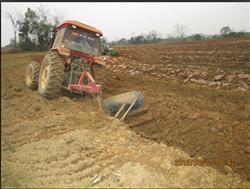
2. Dryland banana orchards These include terrace orchards, slope orchards, and mountain orchards. The key to opening an orchard is good soil and water conservation. For slopes of less than 10 degrees, the trench method is used; for slopes greater than 10 degrees, horizontal terraces are built. For dryland orchards with irrigation conditions, a small drainage and irrigation ditch (20-30 cm and 15-25 cm) is set up every 4-8 rows of bananas; for dryland orchards where irrigation is difficult, ditches should be opened or ridges built between rows, or tree basins 10-20 cm below ground level should be made to intercept rainwater. For dryland with poor, lean soil that tends to harden, deep plowing and increased application of organic fertilizer (farmyard manure, green manure) should be done for soil improvement. The orchard land needs to be deeply plowed 1-2 times 2-4 months before planting, to a depth of 25-40 cm, allowing the soil to fully weather; 10-30 days before planting, break up the soil and level the bed surface.
Banana seedling selection:
Selecting excellent varieties is one of the keys to high quality, high yield, and high efficiency in banana production. Therefore, it is necessary to select varieties that are high quality, high yielding, highly adaptable, and strongly wind-resistant. After several years of planting practice, relatively good varieties include Guangdong Banana No. 2, Brazil No. 3, and others. Bananas use asexual reproduction, and seedlings include sucker seedlings and tissue-cultured seedlings. ① Sucker seedlings come in 3 types: lüyi buds (suckers that emerge before the Start of Winter, covered with scale-like sword leaves, some of which die after winter like tattered clothing, hence the name), red bamboo shoots (suckers that emerge after spring warms, with red leaf sheaths, hence the name), and Geshanfei (suckers drawn from old banana corms long after harvest, also called water buds), with lüyi bud seedlings being superior. ② Tissue-cultured seedlings grow uniformly and are best planted when they have 6-10 leaves. Tissue-cultured seedlings are prone to variation, grow weakly, and have poor stress resistance, so careful management is required in the early growth stage.
Banana planting:
(1) Preparatory work before planting. The procedure for a selected banana orchard is: ① For orchards with relatively steep slopes, build platforms first and then dig holes; the hole size is 60 cm x 60 cm x 50 cm; ② For flat-slope and paddy field banana orchards, deep plow and harrow the land -> break up the soil -> make beds -> dig drainage ditches -> plan the bed surface -> dig holes -> apply base fertilizer -> prepare for planting.
(2) Planting spacing. About 150-160 plants per mu, with a spacing of 200-220 cm x 200 cm.
(3) Planting method. Generally, a rectangular double-row planting per bed is used; in banana orchards with poor drainage, single-row planting is preferable. Planting method: Place the nursery bag seedling into the hole, cover with some soil, use a sharp knife to make two opposing cuts in the plastic bag, pull out the plastic film bag, then cover with soil to 3 cm above the soil block, and water thoroughly to settle the roots. Planting should preferably be done on cloudy and rainy days.
(4) Planting period. Bananas take about 10-12 months from planting to harvest. Choosing the planting period is the main measure for regulating the production period (factors related to the production period are: planting period, fertilizer and water management, cultivated variety, and market demand).
Banana fertilization:
According to research, each Cavendish banana plant requires 150.5 g of nitrogen, 40.7 g of phosphorus, and 561 g of potassium per year. However, the plant can only absorb part of the fertilizer, of which nitrogen accounts for 50% of the applied amount (some say only 1/4), potassium accounts for 50% of the applied amount, and phosphorus accounts for only 20%-30% of the applied amount, meaning that 50%-80% of the applied nitrogen, phosphorus, and potassium fertilizers is lost or fixed by the soil. Therefore, the fertilization amount should include both the amount absorbed by the plant and the amount lost or fixed. To determine the reasonable fertilization amount for a given orchard, local climatic conditions must also be considered. Therefore, banana fertilization needs to be quantified according to the soil conditions, and the following methods can be referenced for fertilization.
1. In winter and spring, organic fertilizer is generally applied. A ditch and holes 20-30 cm deep can be opened about 50 cm from the banana corm, and fertilizer can be applied in the ditch or holes. This shifts the plant from relying on the mother plant for nutrients to absorbing nutrients from the soil. Plant growth during this period is not large.
2. Seedling stage: From the emergence of suckers from the soil to the emergence of large leaves, lasting 2-3 months, the main process is increasing leaf area and forming the corm and root system, transitioning from relying on the mother plant for nutrients to absorbing nutrients from the soil. Plant growth during this period is not large.
3. Vegetative growth stage: From the beginning of large leaf emergence to before flower bud differentiation, lasting about 5-6 months, this is the banana vegetative growth stage, with rapid increases in leaf number and leaf area and massive accumulation of nutrients to lay the foundation for flower bud differentiation. The plant biomass accumulation during this period accounts for about 10%-16% of the total biological yield of the whole growth period.
4. Bud emergence stage: From flower bud differentiation to bunch emergence, lasting about 3-4 months. The petiole thickens, leaf spacing becomes denser, and the pseudostem (banana body) becomes thicker, commonly called "pregnant with fruit." During this period, female flower differentiation is completed, male flower differentiation begins, flowers and young fruit develop simultaneously, and finally new leaf growth enters its final stage, with leaf area decreasing. The plant biological yield during this period accounts for 30%-35% of the total biological yield of the whole growth period. According to surveys, tall bananas emerge their bunch after producing 31-34 leaves, while short-stemmed bananas emerge their bunch after producing 28-30 leaves.
5. Fruit development and ripening stage: From the completion of female and male flower differentiation to full fruit ripening. During this period, the fruit expands rapidly, nutrients in the plant are transferred to the fruit, lower leaves quickly turn yellow and wither, and growth vigor weakens and gradually ages. After fruit harvest, the aboveground part is generally cut off, and suckers drawn from the mother plant's underground stem continue the offspring and begin a new growth cycle.
6. Medium and trace element water-soluble fertilizer: During the banana growth period, various trace elements such as calcium, magnesium, sulfur, boron, zinc, iron, and others can be supplied to banana trees through water-soluble fertilizer.
Banana pest and disease control:
Banana bunchy top disease: Commonly known as "banana male," it is a viral disease. Infected plants generally cannot emerge their bunch, and it is mainly transmitted through seedlings and banana aphids. Control methods: (1) Suckers are easily diseased, so it is not suitable to introduce seedlings from diseased areas; promote the planting of test-tube plantlets; (2) Eliminate the transmission vector: 2000-fold solution of Yajiqing (or 10 g of Yashijing) + 15 mL of Jundushaxing (or Virus K) + 25 g of plant physiological balance agent + one tube of Yunda 120 + 15 kg of water, sprayed once every 5-7 days for 2-3 consecutive times; at the same time, drench the roots of diseased plants twice with 600-fold solution of plant physiological balance agent (once every 5 days). This kills aphids and controls the virus. (3) When diseased plants are found, remove them two days after eliminating aphids, and spread lime in the diseased holes.
Mosaic heart rot disease: This disease is a viral disease. After it occurs, the leaf sheaths collapse and rot, and the heart leaves wither and die. The control methods are the same as for bunchy top disease.
Leaf spot disease: July to October is a period of high temperature and high humidity, with frequent typhoons, making this disease very likely to occur. Control methods: (1) Strengthen cultivation management to improve plant disease resistance; (2) Keep the banana orchard clean, cut off diseased leaves, and burn them; (3) Spray every 2 months: ① 20 mL of Huishuangling + 25 g of plant physiological balance agent + 10 mL of Jiamu Fengshou + one tube of Yunda 120 + 15 kg of water; ② 10 mL of 25% Tilt emulsifiable concentrate + 1 tube of Yemianlong + 25 g of plant physiological balance agent + 15 kg of water, or use chlorothalonil or ridomil for control.
Fusarium wilt: A fungal disease, also known as Panama disease and yellow leaf disease, which once destroyed large areas of banana orchards in the Americas. The pathogen has 4 physiological races. Control should focus on: ① Implementing quarantine and blocking diseased areas; ② Removing diseased plants and planting disease-resistant varieties; in severely affected areas, after removing diseased plants, paddy-upland rotation must be implemented; ③ Cultivating disease-free tissue-cultured plantlets.
Black spot disease: A fungal disease. It is commonly seen on green bananas before harvest and rarely harms ripe fruit. Many small star-like spots are scattered on green fruit, causing loss of commercial value. Although the harm is not serious, it affects appearance and causes the occurrence of anthracnose. Control can be done by bagging the fruit cluster for isolation and protection during the fruit-bearing period after bunch emergence, frequently removing diseased residues, and chemically controlling with a 600-800 fold solution of 75% Shijunqing.
. Banana weevil: Mainly harms the banana pseudostem. For banana orchards where orchard cleaning is not effective, dead leaves and residual stems should be removed promptly, old banana corms dug out, and concentrated for burning or deep burial to eliminate breeding sites. Pay attention to inspecting banana plants. When gum-like substance is seen flowing from the pseudostem, spray or drench the pseudostem with 1000-fold solution of Nongdile or 2000-fold solution of Kung Fu. Sprinkle Mirel or Dixing granules on the banana corm or banana mat, cover with soil after sprinkling, or place 3-6 g of Mirel or Dixing separately at the fork of 3-4 old leaf sheaths of the pseudostem, once every 20 days for 2-3 consecutive times, for poisoning and killing.
Banana aphid and lace bug: Mainly suck leaf sap. At the initial occurrence, use pesticides such as 1500-fold 1.5% Pule or 3000-fold 2.5% Kung Fu for spraying and killing. Spray once every 10 days for 2 consecutive times.
Banana skipper and tobacco cutworm: Mainly harm leaves. Frequently inspect banana plants and promptly remove and burn insect nests or egg masses. When newly hatched larvae are concentrated at leaf edges or on the underside of leaves, use 1500-fold 1.5% Pule solution or 2000-fold 10% alphacypermethrin solution for spraying and killing.
Spider mites: Mainly harm leaves by sucking sap; damaged leaves appear grayish-white and, in severe cases, die. Pay attention to inspection. When mite damage is found at the veins on the underside of leaves, acaricides such as 1000-fold dicofol, 1000-fold pyridaben, or 1500-fold propargite can be used for spraying control. Rotate the chemicals alternately, once every 7-10 days for 2-3 consecutive times.
Banana management:
Hilling soil around banana corms: It can prevent the underground stem of banana plants from being exposed above the ground, and also serves the functions of fertilization and irrigation.
Banana irrigation: Ensure sufficient water supply In the early stage of banana development, a sufficient water supply must be ensured. In addition to keeping the soil moist, the bed ditches should also be filled to two-thirds with water. In the middle and late stages of fruit development, the soil should be kept moist. If the weather is dry and the soil cracks, water should be applied promptly, once every 2-3 days, 50 kg per plant each time, for 3-5 consecutive times; otherwise, water shortage will cause leaves to curl and wilt, affecting banana fruit expansion and ripening.
Bud adjustment: When bananas emerge their bunch, it is necessary to check whether the flower bud is blocked by the petiole or leaf and cannot hang down. Promptly move the flower bud to the left or right side of the petiole or leaf so that the flower bud hangs down naturally.
Bunch cutting and fruit thinning: When the flower bud opens to 1-2 hands of male flowers, the bunch can be cut. If combined with fruit thinning, it can be cut earlier when the last hand of female flowers opens. When there are 9-10 hands of female flowers, remove the last hand of female flowers; when there are 11-12 hands, remove the last two hands; when there are 13-14 hands, remove the last 3 hands; when there are 15 hands or more, remove the last 4 hands, and the final hand removed should retain one finger. Bunch cutting and fruit thinning should be done on sunny afternoons.
Management after bunch cutting: After bunch cutting, spray the fruit with 500-fold Miebingwei or 800-fold chlorothalonil plus 400-fold Banana Fruit Enhancer, then immediately bag the fruit cluster with a blue plastic film bag, with kraft paper or clean banana leaves separating the bag from the fruit cluster to prevent sunburn. The above measures can prevent fruit from being infected by black spot disease, keep the fruit surface clean and attractive, and also promote early fruit ripening, increase finger length, and raise banana yield.
Click to get more banana cultivation techniques
Click to get more fruit cultivation techniques