How do you winter-prune a pomegranate tree when planting? Detailed explanation of winter pruning methods
How do you winter-prune an ordinary pomegranate? Is there a reader who can introduce the method to me? To ensure the yield for the coming year, pomegranate trees must undergo winter pruning when winter arrives; the method can follow the operations below. 1. Train the pomegranate tree shape: because the pomegranate's trunk is not obvious, when planting in a courtyard, to prevent harm from livestock and poultry...
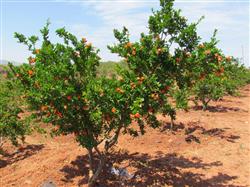 How do you winter-prune an ordinary pomegranate? Is there a reader who can introduce the method to me?
To ensure the yield for the coming year, pomegranate trees must undergo winter pruning when winter arrives; the method can follow the operations below.
1. Train the pomegranate tree shape:
Because the pomegranate's trunk is not obvious, when planting in a courtyard, to prevent harm from livestock and poultry, reduce the footprint and beautify the environment, an open-umbrella shape should be adopted, with branches kept only above 1.2 m on the trunk. For field cultivation, a flat-topped vertical-branch shape should be the main form, to facilitate management and obtain early high yields.
2. Pomegranate trees should be pruned appropriately late:
Pomegranate branches have loose tissue and poor cold resistance; to reduce freeze damage, winter pruning should preferably be delayed until late February.
3. Pomegranate trees should combine winter and summer pruning:
Winter pruning often causes excessive tree vigor, which is not conducive to flower bud formation. Therefore, during the growing period, measures such as bud rubbing, twig twisting, tip pinching and shoot thinning should also be combined to regulate tree vigor.
4. Pruning should be moderate:
Pomegranate is sensitive to pruning and has poor pruning tolerance. A large amount of winter pruning produces excessive spring vigor, increases the number of vegetative branches, and affects its fruit set rate; a large amount of summer pruning in turn weakens tree vigor. Therefore, for pomegranate trees with weak vigor, the amount of winter pruning should be appropriately increased, and for vigorous trees, the amount of summer pruning should be appropriately increased.
5. Pomegranate trees are not suitable for heading back:
Pomegranate pruning should mainly consist of thinning branches and leaving them unpruned, thinning out senescent and dead branches, overly vigorous and dense branches, and upright water sprouts, and leaving flat and slanting branches and diseased and pest-damaged branches unpruned; only very few extension branches should be headed back. Too much heading back easily causes excessive tree vigor, is not conducive to flower formation, and affects the yield per tree.
Click to get more pomegranate tree cultivation techniques
Click to get more fruit cultivation techniques