What are the control methods for grape anthracnose?
What harm does anthracnose do to grapes? How do you control grape anthracnose? We also ask netizens to help introduce it. Zhongdi Network has compiled the harm, causes and control methods of grape anthracnose, listed below for your reference. The harm of anthracnose to grapes: anthracnose mainly damages the fruit, while leaves, new...
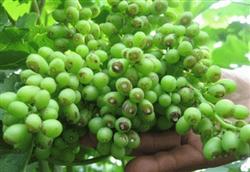 What harm does anthracnose do to grapes? How do you control grape anthracnose? We also ask netizens to help introduce it.
Zhongdi Network has compiled the harm, causes and control methods of grape anthracnose, listed below for your reference.
The harm of anthracnose to grapes:
Anthracnose mainly damages the fruit; leaves, new shoots, rachises and tendrils are affected less often. At the early stage of infection on the berries, black, round, flyspeck-like spots appear on the surface of the young fruit, but because the young fruit is highly acidic and the flesh is firm, which limits the growth of the pathogen, the spots do not expand and no conidia form; the diseased area is confined to the epidermis.
When the berries begin to color, the berries soften, the sugar content rises and the acidity falls, and anthracnose enters its peak period of infection. Grape anthracnose first appears on the surface of diseased fruit as round, slightly sunken, light brown spots, and the surface of the spots is densely covered with small black dots (acervuli). In damp weather, a crimson sticky substance (spore mass) exudes from the acervuli, after which the diseased fruit gradually dries up and finally becomes a mummified fruit. Diseased berries mostly do not drop, and whole clusters of mummified grapes remain hanging on the canes.
On leaves and new shoots, anthracnose spots are rarely seen; mainly elongated, dark brown spots appear on the veins and petioles. In damp weather, crimson conidial masses can be faintly seen on the surface of the spots, but they are less obvious than on the berries.
The time and causes of grape anthracnose infection:
Grape anthracnose generally occurs after May and June, when the temperature rises above 20°C and the bacteria-carrying canes are wetted by rain, forming large numbers of spores. The optimum temperature for forming the grape anthracnose pathogen is 25°C-28°C; below 12°C and above 36°C, no spores form.
Anthracnose pathogen spores spread by wind and rain, germinate and infect; the pathogen enters the epidermal cells of the young fruit through small pores in the skin, and after a latent period of 10-20 days, spots can appear. This is the primary infection. In some varieties, after the pathogen invades the young fruit, symptoms do not appear until the berries begin to ripen.
The anthracnose pathogen can also invade tissues such as leaves, new shoots and tendrils, but does not produce spots and shows no visible abnormality in appearance; this is latent infection, and such bacteria-carrying new shoots will become the infection source for the next year. When grapes are near maturity and encounter rainy weather, they enter the peak period of infection. Diseased fruit can continuously release conidia, repeatedly causing secondary infection and leading to an epidemic of the disease.
The epidemic of anthracnose is closely related to environmental conditions; frequent rain, high humidity and suitable temperatures are the main reasons for the epidemic of this disease. Orchards in low-lying areas, with poor drainage, a shallow groundwater table and heavy clay soil suffer more severe infection.
The disease is also related to cultivation techniques. Orchards with extensive management, incomplete clearing of the orchard and large amounts of diseased debris on the trellis suffer severe infection; orchards with too close row and plant spacing, excessive retained shoots, poor ventilation and light penetration, and high humidity in the field microclimate suffer severe infection. The disease is also related to variety; generally, Vitis vinifera varieties are highly susceptible, while Vitis vinifera x Vitis labrusca hybrids are relatively resistant.
Control methods for grape anthracnose:
1. Eradicate the overwintering sources of disease: prune carefully, cutting off all diseased canes, diseased fruit clusters and tendrils; bury fallen leaves deeply, promptly remove diseased debris and bury it deeply or burn it; when the buds swell, spray carefully with 50Be lime sulfur mixture + 100x sodium pentachlorophenate to eradicate overwintering pathogens.
2. Use drip-free anti-fog film to cover the facility, cover the entire ground area inside the facility with plastic film, and pay attention to ventilation and dehumidification to reduce the air humidity inside the facility, keeping the relative air humidity below 80%, inhibiting spore germination and reducing infection.
3. Deeply plow and improve the soil, deepen the active soil layer and promote root development; increase the application of organic fertilizer, phosphate fertilizer, potash fertilizer and trace element fertilizers; appropriately reduce the amount of quick-acting nitrogen fertilizer to improve the plant's own disease resistance.
4. Rational density, scientific pruning, retaining an appropriate amount of shoots, rational load, maintaining vigorous growth, improving field light conditions and reducing the air humidity of the microclimate.
5. Pay attention to drainage and waterlogging prevention; strictly prohibit water accumulation in the field during the hot season, or waterlogged roots from wet soil, so as to avoid weakening the plants and causing disease occurrence.
6. Bag the fruit clusters to eliminate infection of the clusters by the pathogen
7. In the growing season, focus on spraying for protection. Every 15-20 days, carefully spray 1 application of 240-200x half-strength Bordeaux mixture to protect the tree. And between the two Bordeaux mixture applications, add a spray of a highly effective, low-residue, non-toxic or low-toxicity fungicide.
The following pesticides can be used alternately: 80% Penncozeb wettable powder 800x solution, 70% Kelu wettable powder 700-800x solution, 50% Tuzet wettable powder 600-800x solution, 80% anthracnose thiram wettable powder 600x solution, 20% Yinguo wettable powder 600x solution, etc. To improve the control effect, when spraying non-alkaline solutions, 600x "Tianda-2116" or 1000x Hanlaoshou can be added.
Supplement: 10% difenoconazole water-dispersible granules, active ingredient dosage: 100-167 mg/kg; 50% asomate. zinc. thiram wettable powder, active ingredient dosage: 500-1000x solution.
Click to get the complete guide to grape cultivation techniques
Click to get more fruit cultivation techniques