How is the Hutai No. 8 grape? Learn about its variety characteristics in one article
How is the Hutai No. 8 grape? What kind of locations is the Hutai No. 8 grape suitable for planting in, and how can it be grown well? We hope experienced friends can help introduce it. Zhongdiwang has compiled information and cultivation techniques for the Hutai No. 8 grape, and the following list is provided for netizens' reference. Characteristics of the Hutai No. 8 grape variety: The Hutai No. 8 grape...
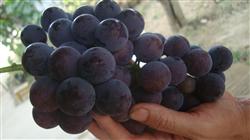 How is the Hutai No. 8 grape? What kind of locations is the Hutai No. 8 grape suitable for planting in, and how can it be grown well? We hope experienced friends can help introduce it
Zhongdiwang has compiled information and cultivation techniques for the Hutai No. 8 grape, and the following list is provided for netizens' reference.
Characteristics of the Hutai No. 8 grape variety:
The Hutai No. 8 grape has a rich aroma and excellent taste. The sugar content of the fruit generally reaches 17-20%, the average berry weight is 12-18 grams, and the cluster weight is 600-800 grams. Its root system is thicker and more developed than that of the common Kyoho grape, and its growth vigor is strong. Although the Hutai No. 8 grape bears fruit multiple times a year, the vine does not decline. When overwintering, the canes remain plump, and the degree of lignification is still higher than that of common varieties. The grape clusters are compact, the skin is relatively thick, and storage and transport performance is excellent. Under high summer temperatures, without chemical refrigeration treatment, the shelf life can reach more than 10 days while still remaining fresh.
Hutai No. 8 has stronger cold resistance than common grape varieties, and has strong resistance to black pox, white rot, and downy mildew.
Yield of the Hutai No. 8 grape:The first crop generally yields about 1,500 kg per mu. The second crop yields 500-600 kg per mu; if the climate is suitable, it can also bear a third crop, and the cluster weight and berry weight of each crop are comparable, with excellent color and aroma, with no difference.
Environmental requirements of the Hutai No. 8 grape:
Introduction to the adaptability and stress resistance of the Hutai No. 8 grape: It is suitable for cultivation in most areas of the country. The best planting areas have an annual accumulated temperature of 3,800 degree-days at >=10°C and a frost-free period of more than 180 days. The plant tolerates high temperatures, and new shoots can still grow when the daily maximum temperature remains 38°C. It shows strong disease resistance to downy mildew, gray mold, and anthracnose.
Cultivation and management methods for the Hutai No. 8 grape:
I. Orchard establishment requirements: spacing between plants and rows of 1.5 x 2.8-3 m, using a tall, wide, drooping T-shaped trellis or a three-wire Y-shaped trellis. In management, promoting early growth and then controlling it later is most suitable. Shaping can generally be completed in two years.
II. Crop load control: This variety has high yield and strong multiple-cropping ability, so the crop load must be strictly controlled. The first crop should retain 750-1,000 kg per mu, and the second crop should preferably be controlled at 1,250-1,750 kg per mu, with an annual yield of more than 2,000 kg per mu.
III. Fertilization and irrigation requirements: The Hutai No. 8 grape requires sufficient base fertilizer and strengthened topdressing. The water control period is from 10 days before flowering of the first crop through the entire flowering period. In addition to water control during the fruit coloring period in late June, irrigation should be applied at appropriate times according to conditions at other times.
IV. Principles of pest and disease control: This variety has strong disease resistance, and after several years of trials, no obvious pests or diseases have been found. In production, according to the occurrence patterns of grape pests and diseases and the characteristics of this variety, early prevention and early treatment should be carried out, combining prevention and treatment with integrated control.
V. Pruning and training methods for the Hutai No. 8 grape:
Winter pruning operations: Leave one fruiting mother cane about every 30-40 cm on the main cane, with fruiting mother canes arranged on both sides of the main cane, leaving a total of 7-8 fruiting mother canes per plant. Use short- and medium-cane pruning, leaving 2-4 buds on each fruiting mother cane. The cut diameter of the fruiting mother cane should be more than 0.9 cm. The length of the extension head should not exceed 1 m.
At present, Hutai No. 8 management mostly adopts a V-shaped trellis, with row spacing of 2-2.5 m and plant spacing varying from 0.8-1 m, with 220-330 plants per mu. This trellis type is convenient for management, simple to operate, and can bear fruit in the second year.
Summer pruning operations:
(1) Bud removal: Remove buds with poor growth position and direction, as well as twin buds and medium-weak buds.
(2) Shoot thinning: Select and retain shoots with good growth and large inflorescences according to the planned yield. Before the vines cover the trellis, fruiting shoots can be retained at the 1st and 2nd wires to ensure early yield. After the vines cover the trellis, do not retain them.
(3) Pinching and removal of secondary shoots: Pinching is generally carried out 1 week before flowering, preferably 2-3 days before flowering, by removing the portion above walnut-sized leaves at the upper part of the shoot. Keep 1-2 secondary shoots at the top of the new shoot, and remove all the rest, or leave 1-2 leaves on secondary shoots below the inflorescence and repeatedly pinch them. For secondary shoots at the top of the new shoot, leave 4-5 leaves and repeatedly pinch them.
Management methods for the Hutai No. 8 grape during the fruiting period:
Cluster thinning operation method: According to high-quality fruit standards, the grape yield per 667 sq m is best controlled at about 1,500-2,000 kg, with each cluster kept at about 750 g, that is, retaining 1,500-2,000 clusters per 667 sq m. If 150 plants are planted per 667 sq m, then on average each main cane retains 5-7 clusters, and each plant has 10-15 clusters; excess clusters can be thinned out.
Remove secondary clusters and pinch the cluster tip. Straighten the clusters caught among the canes so that they hang naturally. The cluster length should be 12-15 cm, with a maximum of no more than 20 cm, so that the whole cluster is tight but not compressed, and loose but not scattered.
Berry thinning operation method: Remove small berries, deformed berries, damaged berries, and berries that are too dense and tightly pressed against each other on the cluster. To save labor, some small clusters on the rachis can also be removed. Keep about 50 berries per cluster, with an average berry weight of 14-15 g, which can ensure about 750 g per cluster.
Bagging: To ensure that the clusters are not contaminated by pesticides and other substances, reduce pest and disease damage and bird damage, prevent the clusters and leaves from rubbing against each other and injuring the fruit surface, avoid sunburn of berries and overly strong or deep coloration, and prevent fruit cracking and hail damage to the fruit surface, the clusters should be bagged in time after berry thinning.
Before bagging, first spray the clusters that have already been thinned once with Bordeaux mixture at 1:0.7:200. After the liquid on the fruit surface has air-dried, put on the paper bag, tie the upper opening of the paper bag tightly and fix it to the old cane, and leave one ventilation opening at each of the two lower corners for air permeability. The paper bag is generally 33 cm long and 30 cm wide, and single-layer paper bags specially used for grapes that have been soaked with fungicide should be selected. The bagging time is around June 20.
Click to get more grape cultivation techniques
Click to get more fruit cultivation techniques