Complete Collection of Cherry Tree Planting and Cultivation Pictures and Videos
Cherries come to market in late spring and early summer, making them the earliest fruit tree to ripen in the Yangtze River basin and the Huaibei region. The fruit has a short growth period, requiring only 40 to 60 days from flowering to harvest, with relatively light field management work and low production costs. Cherry fruits are brightly colored, delicious and tasty, and rich in iron. Besides being eaten fresh, they can be used for...
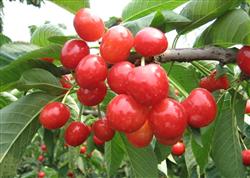 Cherries come to market in late spring and early summer, making them the earliest fruit tree to ripen in the Yangtze River basin and the Huaibei region. The fruit has a short growth period, requiring only 40 to 60 days from flowering to harvest, with relatively light field management work and low production costs.
Cherry fruits are brightly colored, delicious and tasty, and rich in iron. Besides being eaten fresh, they can be used as a garnish for desserts or served at high-end banquets, and can also be processed into products such as syrup canned cherries, candied fruits, preserved fruits, and juice. Sweet cherries in particular have large fruit, thick flesh and firm texture, making them especially suitable for processing; they are in high demand in domestic and international markets and command high prices, yet the current domestic planting area is small, giving them high development value in the Huaibei region. Dwarf cherries and Chinese cherries have smaller plants, bear fruit early and have a long lifespan, and are also suitable for courtyard cultivation and greenhouse cultivation.
Main Types and Varieties of Cherry
Cherry is a plant of the subgenus Cerasus in the genus Prunus of the rose family (Rosaceae). The main types cultivated as fruit trees in production are three: Chinese cherry, European sweet cherry (sweet cherry for short) and European sour cherry (sour cherry for short).
Excellent varieties of Chinese cherry include Jinhong cherry and Dayingzuigan cherry from Taihe, Anhui; Dawolouye from Zaozhuang, Shandong and Dahong cherry from Tengxian; Dongtang cherry from Nanjing, Jiangsu; and Duanbing cherry from Zhuji, Zhejiang.
Excellent varieties of sweet cherry include Dazi, Hongyingtao, Rainier, Sato Nishiki, Napoleon, Hongdeng, Hongyan, Jiahong, Juhong, and Bingku. Sour cherry varieties have a sour and astringent taste and are mainly used for processing; they are tolerant of poor soil and cold, bloom late, and are also good rootstocks for sweet cherry.
Growth and Fruiting Habits of Cherry
Cherry root growth has strict requirements for soil permeability; when the soil is clayey or soil management is poor, the root distribution becomes noticeably shallower and causes premature decline of the aboveground part.
Chinese cherry trees have weaker vigor and are mostly medium or small trees or have a shrub-like canopy. Sweet cherry has strong trunk dominance and vigorous growth, forming a tall tree. Sour cherry trees are shrubs or small trees.
The sprouting rate of Chinese cherry is higher than that of sweet cherry; at budbreak, nearly all the buds of the former can sprout. The number and lifespan of latent buds in sweet cherry are greater and longer than in Chinese cherry, and they are the basis for later renewal of large branches. Branching ability varies by type and variety, and Chinese cherry is generally stronger than sweet cherry.
Branching ability clearly weakens with age. Annual branches can be broadly divided into two types: vegetative branches and fruiting branches. After entering the fruiting stage, branch growth decreases, and branches that were originally vegetative branches (such as the extension branches of scaffold branches at various levels) often form flower buds at the base and leaf buds in the middle and upper parts; some call these mixed branches. Such branches serve three functions: expanding the canopy, forming new fruiting branches, and flowering and bearing fruit.
Other fruiting branches can be divided into 4 types: long fruiting branches, medium fruiting branches, short fruiting branches and flower-bunch fruiting branches. Generally, in types and varieties with strong branching ability, mixed branches and long fruiting branches play an important role in yield formation from the initial fruiting stage to the early full fruiting stage. Conversely, in varieties with weak branching ability, or in large trees in the full fruiting stage, yield is mainly formed by flower-bunch fruiting branches and short fruiting branches.
What makes cherry different from other stone fruit trees is that the flower buds on long fruiting branches are mostly borne singly at the base and lower part of the branch, with very few compound buds present, so after flowering and fruiting this part becomes bare. Short fruiting branches and flower-bunch fruiting branches have strong fruiting capacity and a long lifespan, and can continuously extend along a single axis and bear fruit for many years, making them the main fruiting branch type for most sweet cherry varieties. A single flower bud contains 1 to 5 flowers, in a raceme or clustered form. Most Chinese cherry varieties can set fruit by self-pollination, while the vast majority of sweet cherry varieties set fruit by cross-pollination and require pollinizer varieties to be planted together; sometimes there is also cross-pollination incompatibility. However, in recent years, China has introduced several excellent varieties such as Stella and Lapins that can set fruit by self-pollination and are relatively resistant to fruit cracking.
The fruit development period of cherry is short; like peach, it has two rapid growth phases and one slow growth phase during pit hardening. The flesh can be soft-fleshed or firm-fleshed, and varieties with crisp, firm flesh are generally more tolerant of storage and transport.
Cherry Tree Cultivation Techniques
1. Propagation and Planting of Cherry Trees
Chinese cherry branches have strong rooting ability and are mostly propagated by cuttings, with a survival rate generally reaching 80% to 90%. Cuttings should preferably use one-year-old branches and be taken in spring before sap flow begins. Cuttings are 15 cm to 20 cm long, inserted 2/3 into the soil, then covered with soil level with the upper end of the cutting or 1 cm to 2 cm above it.
When propagating a small number of nursery plants, division or layering can be used. Sweet cherry must be propagated by grafting. The rootstock used is Cao cherry (a type of Chinese cherry, with strong compatibility with sweet cherry); others that can be used include Qingfu cherry, sour cherry and Mahaleb cherry. The latter two rootstocks also have a certain dwarfing effect.
Chinese cherry has strong adaptability and can be planted throughout the Jianghuai region. Sweet cherry has poor adaptability; the area south of the Huai River has high temperature and humidity and is unsuitable for planting, otherwise it easily causes excessive vegetative growth of branches and leaves and poor fruiting, and the fruit ripening period coincides with the plum rain season, which also easily causes fruit cracking and fruit rot. The ideal soil is a loam that is well aerated and drained yet able to retain moisture. The planting site should also be chosen in a place sheltered from frost and wind.
When planting sweet cherry, good pollinizer trees must be selected and planted together. When Napoleon and Bingku are the main cultivars, Yellow Spanish, Dazi and Zaozhi can be planted as pollinizers; when Hongdeng and Dazi are the main cultivars, Napoleon and Yellow Spanish can be planted. However, Napoleon and Bingku show incompatibility when cross-pollinated with each other. Guahong and Juhong can serve as pollinizers for each other.
In addition, Stella and Lapins have abundant pollen and strong compatibility and are good pollinizer varieties that can be selected. Pollinizer trees should generally account for 30% to 40%. Sweet cherries for canning should also choose large-fruited, firm-fleshed yellow varieties, such as Napoleon, Banana and Rainier.
Nursery plants can be planted in autumn or spring. Immediately after planting, water thoroughly once, then mound soil to conserve moisture, or cover the tree basin with plastic film; this helps improve the survival rate of planting and early plant growth. Spacing varies with canopy size. Chinese cherry has a smaller canopy, generally 4 m to 5 m, while sweet cherry has a larger canopy, preferably 4 m to 6 m. In poor soil or when dwarf cultivation is used, spacing can be appropriately reduced.
2. Training and Pruning of Cherry Trees
Chinese cherry has weak trunk dominance but many branches, so a natural clump-shaped tree form is generally used. There is no trunk or the trunk is very short; 4 to 5 slanting main branches are developed from near the ground, and in winter they are appropriately headed back to expand the canopy, while secondary main branches (side branches) are selected and retained. During the growing season, vigorous new shoots can be pinched early (before June) to stimulate secondary shoots and accelerate canopy formation. Training is generally completed within three years.
Sweet cherry has relatively strong trunk dominance; it is generally considered that the natural open-center form or natural clump form takes shape quickly, requires light pruning, bears fruit early, and is suitable for close planting. The training process for the former tree form can refer to that for peach. In addition, varieties with strong trunk dominance and obvious tiering (such as Napoleon) can also use the open-center tiered form.
However, this tree form is tall, inconvenient to manage, and because pruning is relatively heavy, often delays fruiting. If dwarfing rootstocks are used, the tree structure can be simplified, and the free spindle form or central leader form can be used to speed up formation.
In pruning, to encourage young trees to bear fruit early and achieve early high yield, besides heading back scaffold branches according to training requirements, other moderately growing branches should mostly be left unpruned to promote the formation of medium and short fruiting branches and early fruiting. Upright branches and overly dense branches need to be thinned out. Branches with narrow angles should have their branch angles adjusted during the growing season.
During the full fruiting stage, 2- to 3-year-old branches bearing short fruiting branches and flower-bunch fruiting branches should be appropriately retracted to stimulate vegetative growth and the formation of new fruiting branches, delaying the aging of fruiting branch groups and the outward movement of the fruiting zone.
3. Soil, Fertilizer and Water Management, and Controlling Growth to Promote Flowering in Cherry Trees
Cherry roots are distributed relatively shallowly; sweet cherry in particular, as tree age increases, is often susceptible to drought, wind and freezing damage, so after planting the soil must be expanded and deeply turned year by year to deepen root distribution. Based on the characteristic that cherry flowering and fruiting periods are early and short, fertilization should mainly be post-harvest fertilizer and pre-winter base fertilizer, to promote flower bud differentiation and increase the tree's stored nutrients. In addition, appropriate topdressing during flowering and fruit set (mainly quick-acting nitrogen fertilizer) and foliar topdressing (spraying 0.1% to 0.3% urea or 600 times monopotassium phosphate at flowering) have obvious effects on improving fruit set rate and promoting branch and leaf growth.
Soil water shortage often causes cherry fruit drop; if drought occurs from after flowering to before harvest, appropriate irrigation should be applied. The cherry root system has strict requirements for soil aeration, so each irrigation amount should be small, and timely intertillage and loosening of the soil should be done to conserve moisture.
In places without irrigation conditions, grass mulch can be applied over the tree basin to conserve moisture. This has very good effects on improving both cherry fruit set rate and berry quality. After entering the ripening stage, widespread rainfall easily causes fruit cracking.
In addition to selecting crack-resistant varieties and doing good field drainage, spraying the berries with 72% calcium hydroxide or 54% calcium chloride solution 2 to 3 weeks before harvest, and spraying again after 5 to 7 days, can reduce fruit cracking.
In coastal areas with strong winds, to prevent young trees from lodging, soil mounding must also be done well, with the practice of mounding in spring and removing in autumn; soil should not be mounded around the trunk for a long time.
Cherries, especially sweet cherries, tend to grow vigorously as young trees and are difficult to induce to form flower buds, and they develop a large canopy. In addition to measures such as using dwarfing rootstocks to moderate growth vigor, spraying the leaves with paclobutrazol solution at a concentration of 250 ppm to 300 ppm when cherry growth begins (Chinese cherry can also be treated after harvest) has obvious effects in shortening branches, promoting flowering, and achieving early fruiting and high yield.
Main Pests and Diseases of Cherry Trees and Their Control Methods
Many pests and diseases of cherry are the same as those of other stone fruit trees and can be controlled by reference to them. The main diseases damaging cherry are shot hole disease, crown and root collar rot, and gummosis. Crown and root collar rot mostly occurs on trees in the initial fruiting stage, causing decay at the root collar.
Control method: mainly avoid long-term soil mounding around the root collar of the plant, and control underground pests that gnaw the bark. At the same time, inspect frequently; when diseased plants are found, scrape and treat them promptly, and after scraping disinfect with Bordeaux mixture or lime sulfur mixture. In severe cases of root collar rot, bridge grafting in spring can also restore aboveground growth.
The insect pests damaging cherry mainly include red-necked longhorn beetle, golden buprestid beetle, small clearwing moth, globose scale, and phalera caterpillar. The small clearwing moth has 1 generation per year, and its larvae damage the cortex of large branches.
Control measures mainly include spraying during the peak emergence period of adults, whitewashing the branches and trunk to prevent egg laying, and promptly killing with chemicals or digging out larvae when their frass is found in the field.
Click to get more cherry tree planting techniques
Click to get more fruit planting techniques