Detailed Explanation of Key Techniques for Autumn Management of Peach Trees
How should peach trees be managed in autumn? Please introduce the autumn management methods for peach trees. Autumn management of peach trees mainly includes pruning, pest and disease control, and water and fertilizer management. The following detailed operating methods are provided for reference: 1. Timely pruning. The high altitude and strong sunlight of the peach's place of origin gave the peach its particularly light-loving characteristics...
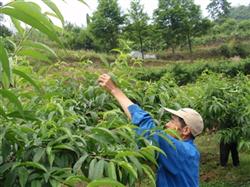 How should peach trees be managed in autumn? Please introduce the autumn management methods for peach trees
Autumn management of peach trees mainly includes pruning, pest and disease control, and water and fertilizer management. The following detailed operating methods are provided for reference:
1. Timely pruning
The high altitude and strong sunlight of the peach's place of origin gave the peach its particularly light-loving characteristics. In addition, peach branches have multiple extended growth peaks and multiple secondary shoots, so timely pruning in autumn to create good ventilation and light conditions is even more important than for other tree species.
(1) Thinning branches. Timely remove overly dense, thin and weak, diseased and pest-infested, upright useless branches, and excessively long leafless branches.
(2) Bending branches. For vigorously growing upright peach trees, use methods such as bending, hanging, and propping branches to increase the angle of the main branches and moderate the tree vigor.
(3) Twisting shoots. For competing branches and upright branches retained where there is space, twisting and pressing down can be carried out. For strong vigorous branches (groups) on the upper part of the canopy, after removing the strong tips, twist or press down from the base to control their growth, promote further flower bud differentiation, and use them for fruiting. Care should be taken when twisting; they can be twisted 180 degrees, but must not be broken off.
(4) Retraction. Overlapping branches, crossing branches, and old and weak branch groups within the canopy can be retracted. For medium and long branches that have already fruited at the tip, retract them in time, leaving 2-3 reserve branches at the base to promote their growth.
Pinching. For some late-autumn shoots that are excessively vegetative and leggy, pinch the tips or take other measures to control growth, so as to promote branch maturity.
2. Drought prevention and drainage
Although peach is a drought-tolerant tree species, in order to achieve high yield, high quality, and stable production, water supply must be ensured in a timely manner during each growth period. Especially in the dry and rain-scarce north, if drought persists in autumn, water supplementation should be arranged, which is particularly important for late-maturing varieties.
Peach trees are drought-tolerant and intolerant of waterlogging, so special attention must be paid to drainage in rainy autumns. During the rainy season, in combination with intertillage and weeding, shape the tree basin so it is higher inside and lower outside, to prevent water accumulation at the root crown and avoid crown root rot. The practice summarized by fruit growers in northern fruit regions of shallow hoeing after light rain and deep hoeing after heavy rain is very effective for drought prevention and drainage and should be promoted.
3. Pest and disease control
Protecting peach leaves and branches from pest and disease damage in autumn can improve the tree's photosynthetic efficiency and increase stored nutrients, and has a considerable impact on the yield and quality of late-maturing fruit in the current year and on fruiting in the following year. For autumn pesticide use on peach trees, options include imidacloprid and chlorbenzuron No. 3; fungicide options include polyoxin and mancozeb. For trees with gummosis, first scrape off the gummosis lesions and loose bark, then apply quicklime to the gummosis sites.
4. Autumn application of base fertilizer
Practice shows that applying base fertilizer in autumn results in earlier flowering and more and larger flowers and a higher fruit set rate than applying base fertilizer in spring. Autumn base fertilizer should be mainly organic fertilizer with an appropriate amount of chemical fertilizer added; mainly nitrogen, phosphorus, and potassium, with an appropriate amount of medium and trace elements mixed in. The fertilization amount should account for 60-70% of the annual fertilization amount. For mature trees, fertilization should be based on yield and growth vigor, calculated as 200-300 kg of organic fertilizer, 0.7 kg of available nitrogen, 0.5 kg of available phosphorus, and 1.0 kg of available potassium for every 100 kg of peach fruit produced. For newly planted young trees, organic fertilizer should be the main input, with no or little nitrogen fertilizer applied. As for varieties, early-maturing varieties and strongly upright varieties can appropriately receive less nitrogen; old trees and weak trees should appropriately increase nitrogen application. The best time for autumn base fertilization is around September, and it can also be carried out before and after leaf fall in combination with autumn plowing. The fertilization method is the same as for other fruit trees. In recent years, some fruit growers have achieved very good results on heavily fruiting trees by spraying 0.3-0.5% monopotassium phosphate on the leaves 2-3 times after fruit harvest, with an interval of about 15 days between foliar sprays.
5. Proper winter irrigation
In order to ensure water supply for peach trees during the overwintering period, it is necessary to irrigate once with freezing water in early winter from late October to mid-to-late November after autumn base fertilization, and the irrigation should wet through the dry soil layer. If there is a lot of autumn rain, the soil moisture is good, and the soil is relatively clayey, light irrigation or no irrigation may be used.
Click to get more peach tree planting techniques
Click to get more fruit planting techniques