What are the key technical points for managing walnut trees in autumn and winter?
How should walnut trees be managed well in autumn and winter? Please give guidance. Autumn and winter management of walnut trees mainly includes soil, fertilizer and water management, as well as pruning and freeze protection. For detailed operations, you can refer to the following methods: Soil, fertilizer and water management for walnut trees in autumn and winter: For non-bearing trees, after leaf fall and before the soil freezes, deep-till the soil and build tree basins, generally to a depth of 20-25 cm. The base fertilizer should mainly be decomposed organic fertilizer, with an application rate of 25-50 kg per tree, and 2-5 kg of superphosphate can also be added. When fertilizing, the ring trench method can be used, that is, dig a ring-shaped trench 20-40 cm wide and about 30 cm deep around the outer edge of the canopy, placing topsoil and subsoil separately. After digging, put the fertilizer in, then fill in topsoil and mix evenly, and finally fill in an appropriate amount of subsoil to level with the original ground surface.
 How should walnut trees be managed well in autumn and winter? Please give guidance.
Autumn and winter management of walnut trees mainly includes soil, fertilizer and water management, as well as pruning and freeze protection. For detailed operations, you can refer to the following methods:
Soil, fertilizer and water management for walnut trees in autumn and winter:
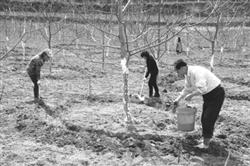
For non-bearing trees, after leaf fall and before the soil freezes, deep-till the soil and build tree basins, generally to a depth of 20-25 cm. The base fertilizer should mainly be decomposed organic fertilizer, with an application rate of 25-50 kg per tree, and 2-5 kg of superphosphate can also be added. When fertilizing, the ring trench method can be used, that is, dig a ring-shaped trench 20-40 cm wide and about 30 cm deep around the outer edge of the canopy, placing topsoil and subsoil separately. After digging, put the fertilizer in, then fill in topsoil and mix evenly, and finally fill in an appropriate amount of subsoil to level with the original ground surface.
For trees that have just begun bearing fruit, after leaf fall and before the soil freezes, deep-till the soil and build tree basins in the same way as for young trees. Apply 30-50 kg of decomposed organic fertilizer per tree as base fertilizer, and add 2-5 kg of superphosphate. When fertilizing, the strip trench method can be used. Between rows or between trees of walnut trees, along two opposite sides of the canopy edge, dig parallel fertilization trenches separately, 20-40 cm wide and about 30 cm deep, with the length determined according to the size of the canopy. After mixing the fertilizer with topsoil, finally fill with subsoil to level with the original ground surface. Note that the trench positions should be changed once a year.
For trees in full bearing period, after leaf fall and before the soil freezes, the management method is the same as for young trees. The base fertilizer should mainly be organic fertilizer, applying 50-80 kg per tree, combined with 2-5 kg of superphosphate. When fertilizing, the radial trench fertilization method can be used. At a certain distance from the trunk, dig 3-6 trenches from the inside outward, 20-40 cm wide and about 30 cm deep, gradually deepening from the inside outward. After digging, mix the fertilizer with topsoil and fill it in, and finally fill with subsoil to level with the original ground surface. Note that the trench positions should be changed every year.
After fertilizing, water should be applied to help the absorption of fertilizer.
Pruning, shaping and rejuvenation of walnut trees in autumn and winter:
Pruning of young trees is mainly to cultivate a good tree framework, lay a solid foundation, rapidly expand the canopy, promote early fruiting and early high yield. The commonly used tree shape is the small-crown delayed-open central leader form. This tree shape has an obvious central leader, with the trunk set at 80 cm, and 6-8 main branches arranged in 3 layers alternately up and down on the central leader. The spacing between the first and second layers is 80 cm, and between the second and third layers is 70 cm. The main branches in the first and second layers each retain 2 side branches, and the main branches in the third layer each retain 1-2 side branches.
Pruning of trees that have just begun bearing fruit: walnut trees enter the initial fruiting stage 2-3 years or 5-6 years after planting. The main task of pruning at this stage is to continue cultivating main and side branches according to the tree shape requirements, so that the framework is firm, the growth vigor is balanced, and bearing branch groups are systematically arranged. At this stage, walnut trees should strictly control backward branches, and retain as many auxiliary branches as possible to fill space and increase early yield. For the pruning of auxiliary branches, remove strong ones and keep weak ones, or first leave them and then shorten them, combining leaving and shortening, so that they bear more fruit.
Pruning of trees in full bearing period: For trees in full bearing period, the main purpose is to regulate the relationship between vegetative growth and reproductive growth, and improve ventilation and light conditions in the tree canopy. When cultivating branch groups, the pruning methods of "first leave, then shorten" and "remove upward-growing branches, keep slanting branches" can be used. In addition, at this stage, water sprouts can be properly cultivated into fruiting branch groups to prolong the full bearing period. At this stage of pruning, special attention should be paid to preventing the fruiting parts from moving outward, which causes the inner canopy to become bare. Therefore, when main branches do not need to extend, the heads can be repeatedly changed to prevent outward expansion. Fruiting branch groups should be arranged with a combination of large, medium and small ones and evenly distributed, so that large fruiting branch groups are distributed on the inner side and small ones are near the outside, with more under the tree and fewer on the tree, and the outer part of the canopy not dense while the inner part not empty. Medium and long fruiting branch groups have strong continuous fruiting ability and should not be headed back.
Renewal and rejuvenation of trees in the aging stage: At this stage, the small branches of walnut trees dry up severely, the growth of peripheral branches weakens obviously and droops, the canopy shrinks, there is a large amount of "tip scorch" phenomenon, and yield drops significantly, even to total crop failure. At this stage, renewal and rejuvenation should be carried out promptly.
During renewal and rejuvenation, healthy main branches can be selected, retaining 50-100 cm, and the rest can be sawed off. After branches sprout, on each main branch select 2-3 healthy branches in suitable positions and cultivate them into first-level side branches. Branch group renewal can also be carried out: for weak large and medium fruiting branch groups, heavily cut back to healthy branching points to promote new branches; for small branch groups, remove weak ones and keep strong ones, and newly grown healthy branches and water sprouts in the canopy should be retained as much as possible and cultivated into various branch groups. Side branch renewal can also be carried out: on each main branch to be retained, select 2-3 side branches in suitable positions, and cut each side branch at the front end or upper part of the middle-lower part where strong vigorous branches grow.
Cold protection for young walnut trees in autumn and winter:
Because walnut branches have a large pith, high water content and poor cold resistance, they are prone to freeze damage in the relatively cold and dry areas of the north, causing branches to dry up. Therefore, in order to ensure the normal growth of young trees and prevent freeze damage, winter cold protection work should be strengthened to reduce the harm. After leaf fall of 1-2 year old walnut trees (generally from mid-November to early December), cold protection measures can be taken. The most commonly used and most effective method is soil mounding for cold protection, that is, bend the entire tree body to the side opposite the graft union, cover with 30 cm of soil, and remove the covering soil after the soil thaws the next year and before sprouting.
Some cold-intolerant varieties may still suffer freeze damage when the tree is relatively large. At this time, soil mounding for cold protection is no longer suitable, and the method of applying polyvinyl alcohol to side branches or new branches can be used. Generally, polyvinyl alcohol and water are boiled at a ratio of 1:15-20. First heat the water to about 50°C, then add polyvinyl alcohol (do not add it after the water has boiled, otherwise the polyvinyl alcohol cannot dissolve completely and the solution will not be uniform). Stir while adding until boiling, then simmer over low heat for 20-30 minutes. Use it after the temperature drops to not too hot to touch.
In addition, in early winter, branches and trunks can be wrapped and bound with 10 cm wide plastic strips, or soil ridges can be built before the soil freezes for cold protection.
Click to get more hickory planting techniques
Click to get more fruit planting techniques