What are the key points of autumn management techniques for walnut trees?
How should walnut trees be managed in autumn? What should be noted about walnut trees in autumn? Please introduce them one by one. In autumn, during the fruiting period, walnut trees consume a large amount of tree nutrients due to the needs of the fruit, and the trees mostly show weakened vigor and a marked increase in pests and diseases; even the structure of the tree has changed. Therefore, after the walnuts...
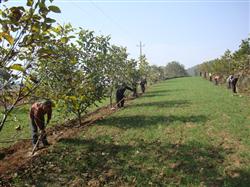 How should walnut trees be managed in autumn? What should be noted about walnut trees in autumn? Please introduce them one by one
In autumn, during the fruiting period, walnut trees consume a large amount of tree nutrients due to the needs of the fruit, and the trees mostly show weakened vigor and a marked increase in pests and diseases; even the structure of the tree has changed. Therefore, after the fruit of walnut trees is harvested, reasonable and effective management must be carried out. This not only ensures a faster recovery of tree vigor, but also plays an important role in preventing the occurrence of pests and diseases. Refer to the detailed management methods as follows:
After harvesting the fruit, the soil should be deeply turned:
The roots of walnut trees generally penetrate deep into the soil, and whether the soil has good aeration directly affects root growth. Therefore, after the fruit is harvested, the orchard soil should be deeply turned. Liu Chaobin suggests that a suitable time should be chosen for deep turning. Generally, from after fruit harvest to before leaf fall, orchard debris should be cleared and the soil deeply turned, with the deep turning controlled at 25-40 cm. "At this time the temperature is relatively high, and it is also the second growth peak of the root system. Many damaged roots heal easily and new roots form, and soil nutrients transform quickly, which is conducive to the accumulation of nutrients in the tree." Liu Chaobin said.
Fertilize reasonably according to actual conditions:
At the same time, during the process of deeply turning the soil, fertilization should be carried out reasonably according to the actual conditions of the orchard. Liu Chaobin said that the fertilization period should be controlled from early September to late October, that is, after the walnut harvest. To ensure tree growth and next year's fruiting, fertilizer must be supplemented in time to supply sufficient nutrients. In this regard, Liu Chaobin suggests that fertilization can mainly use organic fertilizer and biological bacterial fertilizer suitable for walnut tree growth, to improve the soil, prevent compaction, and promote aeration. At the same time, an appropriate amount of nitrogen, phosphorus, potassium and other medium and trace element fertilizers can be added.
"For walnut trees bearing fruit for the first time, use 30 jin of high-quality organic fertilizer, 0.3 jin of biological bacterial fertilizer, 2 jin of nitrogen-phosphorus-potassium fertilizer, and 200 g/mu of Ciba boron-zinc trace element fertilizer; for trees in full fruit period, apply 50 jin of high-quality organic fertilizer, 0.5 jin of biological bacterial fertilizer, 4 jin of nitrogen-phosphorus-potassium fertilizer, and 300 g/mu of Ciba boron-zinc trace element fertilizer per tree." Liu Chaobin said that when fertilizing, for 2- to 4-year-old trees bearing fruit for the first time, fertilizer should be broadcast under the canopy; for large trees 5 years old and above, fertilizer can be applied in trenches along the rows, mixing fertilizer and soil evenly and then filling them back into the trench. Alternatively, trenching and broadcasting followed by turning the tree basin can be alternated every other year.
In addition, watering should be coordinated well. Generally, after deep turning or trench fertilization, irrigation should be timely and sufficient. In dry years, another irrigation can be given before the soil freezes.
Pruning requires grasping the timing and method:
When pruning walnut trees, a suitable time must be grasped. Generally, pruning during the dormant period is prone to bleeding and weakens tree vigor, and may even cause local branches to die. Therefore, the pruning time is best controlled before leaf fall in autumn or after bud break in spring, which is most suitable. "Pruning from the Autumn Equinox to Cold Dew is best, as this time is conducive to the wound healing as early as possible within the same year." Liu Chaobin said that if the pruning workload is relatively large, pruning can also be carried out in winter from 30 days after leaf fall to 25 days before bud break, which can reduce the adverse effects of bleeding on the tree.
On the basis of grasping the suitable pruning time, the pruning method must also be appropriate. Liu Chaobin said that in the young tree stage, walnut trees have vigorous nutrition, shoots grow rapidly, and the canopy expands year by year. At this time, pruning should focus on training the trunk, keeping good main branches, retaining auxiliary nurturing branches, and promptly thinning dense branches, water sprouts, and weak slender branches. More fruiting branches should be kept inside the canopy. Pruning is best combined with branch bending; for densely planted trees, branch bending should be the main practice and pruning supplementary. Liu Chaobin stated that pruning in this way not only ensures uniform distribution and balanced growth of the main branches, but also makes the canopy hierarchy clear, open, and not lopsided, ensuring balanced development of tree vigor and gradually cultivating a full-shaped tree with a large fruiting volume.
Click to get more pecan planting techniques
Click to get more fruit planting techniques