What are the control methods for watermelon anthracnose?
How do you control watermelon anthracnose? What harm does watermelon anthracnose cause? Is there any fellow grower who can help explain? Anthracnose is a common disease of watermelon. Zhongdi Network has compiled the harm and control methods of watermelon anthracnose, listed below for fellow growers' reference. Harm of watermelon anthracnose: Anthracnose from water...
 How do you control watermelon anthracnose? What harm does watermelon anthracnose cause? Is there any fellow grower who can help explain?
Anthracnose is a common disease of watermelon. Zhongdi Network has compiled the harm and control methods of watermelon anthracnose, listed below for fellow growers' reference.
Harm of watermelon anthracnose:
Anthracnose occurs on the leaves, vines and fruits of watermelon from the seedling stage to maturity.
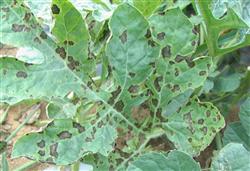
When seedlings develop the disease, the stem vine near the ground turns dark brown, constricts and causes damping-off. When leaves are affected, small yellow water-soaked round spots appear first, then expand and turn brown. The lesions are surrounded by a purple-black ring, on which small black dots or pink sticky matter grow. The lesions gradually expand and merge into patches, breaking apart when dry and causing the leaves to die. On the petioles and stem vines, narrow brown sunken lesions appear; as the lesions spread, the stem vines gradually die.
When the watermelon stalk is infected, young fruits become dark in color and gradually shrivel and die. When mature watermelons develop the disease, the diseased part first appears as water-soaked rings, then becomes sunken round spots bearing many small dots arranged in rings; when humid, the diseased part is covered with pink sticky masses of conidia. After young fruits are infected, they become deformed; in severe cases the lesions merge into patches and the watermelon rots.
Control methods for watermelon anthracnose:
1. Do a good job of pruning, pressing vines and removing side shoots, maintain a good ventilated and light-transmitting environment in the field, and strictly prohibit flood irrigation.
2. Use 45% chlorothalonil smoke agent at 250 grams per mu each time, once every 9-11 days.
3. Spray pesticide promptly at the early stage of the disease to achieve better control results. You can choose 25% bromothalonil wettable powder at 500 times dilution, or 25% prochloraz emulsifiable concentrate at 1000 times dilution, or 80% carbendazim-thiram at 800 times dilution, or 10% difenoconazole water-dispersible granules at 1000 times dilution. Spray once every 7 days, for 3 to 4 consecutive sprays, alternating the pesticides in turn; the control effect is relatively good.
Click to get more watermelon cultivation techniques
Click to get more fruit cultivation techniques