Control Methods for Root-Knot Nematode Disease in Cantaloupe Cultivation
What harm does root-knot nematode disease cause to cantaloupe? How do you control root-knot nematode disease when growing cantaloupe? Please provide control methods. Zhongdiwang has compiled the harm and control methods of cantaloupe root-knot nematode disease, listed below for netizens' reference. Harm of cantaloupe root-knot nematode disease: Root-knot nematode disease is a...
 What harm does root-knot nematode disease cause to cantaloupe? How do you control root-knot nematode disease when growing cantaloupe? Please provide control methods.
Zhongdiwang has compiled the harm and control methods of cantaloupe root-knot nematode disease, listed below for netizens' reference.
Harm of cantaloupe root-knot nematode disease:
Root-knot nematode disease is an important disease of cantaloupe, occurring and distributed in some areas. It can occur in protected cultivation and open fields, with more severe incidence in autumn. Infection at the seedling stage has a great impact on production, and after onset the diseased plant rate often reaches more than 60%, significantly affecting cantaloupe production.
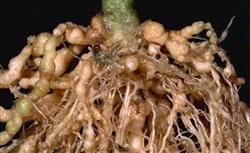
Root-knot nematode disease mainly damages the root system, producing many milky-white root knots of varying sizes on the main root and lateral roots. Cutting open a root knot reveals white, semi-transparent pear-shaped nematodes. In the later stage of the disease, the diseased roots darken in color and eventually rot. The aboveground part of the plant or seedling gradually fades in leaf color as the disease progresses, wilting from bottom to top until completely dead.
Causes of cantaloupe root-knot nematode disease:
Root-knot nematodes are mainly spread through diseased soil, diseased seedlings, irrigation water and farm tools. At a soil temperature of 20-30°C and humidity of 40%-70%, nematodes reproduce very quickly and easily accumulate in large numbers in the soil. Generally, plots or greenhouses with high, dry terrain, loose soil, and lack of water and fertilizer have more severe incidence. Usually greenhouses are more severely affected than plastic tunnels, and plastic tunnels more severely than open fields. In addition, continuous cropping leads to more severe incidence.
Control methods for cantaloupe root-knot nematode disease:
Method 1:Use disease-free soil for raising seedlings. In areas where the disease occurs frequently, use nematode-free soil or field soil for raising seedlings, apply organic fertilizer that does not contain diseased residues or is fully decomposed, or use substrate for raising seedlings, while also paying attention to preventing human-mediated spread.
Method 2:Before planting, deep plow the soil 30-50cm. Solar high-temperature disinfection to kill pests can be carried out in late spring and early summer. After pulling up the previous crop, apply quicklime and chopped rice straw at 4.5-7.5t/hm2 respectively, plow and mix evenly, then dig trenches and form ridges or beds, fill with water, cover with plastic film and press it down firmly, then seal the greenhouse for 10-15 days, which can kill all nematodes, pathogens and weeds in the soil. After treatment, pay attention to applying additional biological bacterial fertilizer.
Method 3:At sowing or transplanting, use fenamiphos applied with the seeds into the seedbed, using 2000 kg of 10% granules per mu.
Method 4:Apply ethoprophos evenly by broadcasting or by furrow application into the top 20cm of soil. After application, immediately cover with soil, sprinkle water to seal or cover with film for 7-12 days, then loosen the soil to release gas for 3-10 days before sowing or transplanting.
Click to get more cantaloupe cultivation techniques
Click to get more fruit cultivation techniques