What are the control methods for powdery mildew on cantaloupe?
How do you control powdery mildew when growing cantaloupe? What harm does powdery mildew do to cantaloupe? Experienced growers are asked to help explain. Powdery mildew is a major disease in cantaloupe cultivation, widely distributed and commonly occurring, in both protected and open-field cultivation, seriously affecting cantaloupe yield and quality. Therefore, Zhongdiwang has compiled the cantaloupe...
 How do you control powdery mildew when growing cantaloupe? What harm does powdery mildew do to cantaloupe? Experienced growers are asked to help explain.
Powdery mildew is a major disease in cantaloupe cultivation, widely distributed and commonly occurring, in both protected and open-field cultivation, seriously affecting cantaloupe yield and quality. Therefore, Zhongdiwang has compiled the harm and control methods of powdery mildew during cantaloupe cultivation, listed in detail below for growers' reference.
Harm of powdery mildew to cantaloupe:
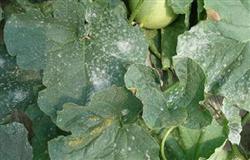
Powdery mildew can occur throughout the entire growth period of cantaloupe and can infect leaves, leaf stalks and stems. In the early stage of powdery mildew, small white powdery spots form on the leaf surface; multiple lesions merge into large irregular patches, after which the leaf surface becomes covered with white powder, namely the pathogen's conidiophores and conidia.
Powdery mildew causes diseased cantaloupe leaves to gradually age and die, and sometimes black dots, namely the pathogen's ascocarps, form on necrotic lesions. When leaf stalks and stems are infected, white powdery mold spots also appear on the surface; in severe cases the lesions are densely distributed, and the tissues age prematurely and die.
The powdery mildew pathogen prefers warm, humid conditions and tolerates dryness; alternating high temperature and dryness with humidity favors disease occurrence and development. The pathogen grows at 10-30°C, with an optimum temperature of 20-25°C; conidia can germinate at a relative humidity of 25%~85%, with high humidity being favorable for disease development. In the middle and late growth stages, plants grow weak and the disease is severe.
Methods for controlling powdery mildew in cantaloupe cultivation:
Method 1: Select varieties suitable for the local area and disease-resistant varieties.
Method 2: Use high-ridge planting, rational close planting, and pay attention to ventilation and air permeability; fertilize scientifically, apply sufficient base fertilizer at planting, increase phosphorus and potassium fertilizer, avoid fertilizer deficiency in the later stage, and cultivate strong seedlings; irrigate at the right time, pay attention to combining drainage and irrigation, and prevent excessive humidity in the field; prune and remove branches in time, and promptly pull out diseased plants when found.
Method 3: A sulfur fumigator can be used for regular fumigation as prevention.
Method 4: In the early stage of disease, choose 2% Nongkang 120 aqueous solution, or 2% Wuyi mycin aqueous solution at 200-300 times dilution, or 43% Junlike suspension concentrate at 8000 times dilution, or 10% Shigao water-dispersible granules at 8000 times dilution, or 40% Fuxing emulsifiable concentrate at 8000 times dilution, or 25% Bailitong wettable powder at 2500 times dilution, or 30% Tefuling wettable powder at 4000 times dilution, or 25% Fenxiuning wettable powder at 1000-1500 times dilution for spraying. For protected cultivation in the early stage of disease, choose 5% chlorothalonil dust or 5% Jiareinong dust, or dust formulations of the above spray agents at 15kg/hm2 for dusting; the control effect is ideal.
Control methods for cantaloupe fruit cracking
Control methods for cantaloupe root-knot nematode