What are the key points for summer management of greenhouse cherries?
What should be paid attention to in summer when growing cherries in greenhouses? Experienced netizens are also asked to give a detailed introduction. Generally, by summer the harvest of greenhouse cherries is basically complete, and at the same time they enter a blind period of cherry management. Therefore, Zhongdi Network has compiled the key points for summer management of greenhouse cherries, listed in detail below for netizens' reference. Key point one, ...
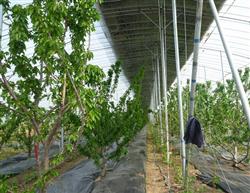 What should be paid attention to in summer when growing cherries in greenhouses? Experienced netizens are also asked to give a detailed introduction
Generally, by summer the harvest of greenhouse cherries is basically complete, and at the same time they enter a blind period of cherry management. Therefore, Zhongdi Network has compiled the key points for summer management of greenhouse cherries, listed in detail below for netizens' reference.
Key point one, summer pruning of cherries:
Summer pruning of greenhouse cherries is generally carried out when the film is removed, mainly to retract the cherry tree canopy and carry out heavy pruning.
1. Retraction method: This method can reduce the overall height of each cherry tree canopy by 50-80 cm respectively, preventing the tree from growing taller and taller and affecting the ventilation and light transmission conditions inside the greenhouse.
2. Cutting back and thinning method: This method mainly heavily cuts back strong main branches and moderately cuts back medium main branches, letting them retract to the middle or rear fork points, and cultivating and developing them again into main branches.
3. Detailed branch group pruning method: This mainly involves carefully pruning the various branch groups and branches growing on the main branches and trunk, thinning out densely growing chicken-claw branches, upright branches, overlapping branches, and peripheral competitive branches, heavily short-cutting medium and long branches, and retaining flat, slanting, and medium branch groups.
4. Strengthen the cultivation of new fruiting branches: After heavy pruning, the tree body will stimulate numerous new buds and new branches. For those in suitable positions, attention should be paid to cultivating them into new main branches or fruiting branch groups; for those in unsuitable positions, sprouts must be removed promptly and the layers cleaned up.
Key point two, fertilizer and water management:
1. Topdressing and watering: After removing the film, fertilize promptly. Between every two plants in each row, dig a fertilization ditch 30 cm deep, 30 cm wide north-south, and 100 cm long east-west. In each ditch, broadcast 250-300 g of nitrogen, phosphorus, and potassium compound fertilizer. After covering with soil, restore it into a high-ridge bed again, cover with plastic film, spread soil on the film and seal it tightly. Combine this with opening the ditch to cut off the roots exposed after digging, renew and retract the root system, so as to reduce root volume and control tree expansion. When digging the ditch, be careful not to damage the agricultural film at the bottom of the ditch. Water once while fertilizing. The second fertilization is carried out in mid-to-late September, and a fertilization ditch should be dug on the other side of the planting row. Thereafter, alternate the operation every year.
2. Foliar spraying: After removing the film and retracting and pruning, combine with disease prevention and pest control, and spray once every 7-15 days with 1000-times liquid fruit-tree-specific "Tianda-2116" + 0.7% brown sugar + 0.3% urea solution, for 3-4 consecutive times. After the end of June, switch to 0.4% potassium dihydrogen phosphate solution + 0.7% brown sugar solution + 0.3% urea solution and use it alternately, spraying once every 7-10 days, for 3-4 consecutive sprays.
Key point three, spraying paclobutrazol on cherry trees:
In summer, cherry trees can be sprayed once every 10-15 days starting from early July with 200-300 times 15% paclobutrazol solution, for 1-3 consecutive sprays, to inhibit excessive growth of new shoots and promote flower bud differentiation.
Key point four, timely drainage and waterlogging prevention:
Cherry trees are afraid of waterlogging. Once there is standing water in the field for about 24 hours, the tree body will die from flooding. Therefore, after removing the film, high ridges should still be made, and the ridge surface should be covered with plastic film to prevent waterlogging. When it rains, attention should also be paid to timely drainage, and water accumulation between rows in the greenhouse is strictly prohibited.
Cherry tree planting video
The growing environment of cherries