How do you identify and control common pests and diseases of the loquat tree?
What pests and diseases affect loquat trees? How should they be controlled? Experienced gardeners, please help explain. Loquat tastes sweet and is highly nutritious, containing various fruit sugars, glucose, potassium, phosphorus, iron, calcium, and vitamins A, B, C, and more. Its carotene content ranks third among all fruits. Moreover, loquat leaves are also a kind of traditional Chinese medicine...
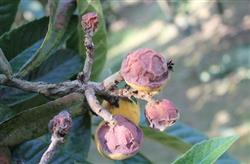 What pests and diseases affect loquat trees? How should they be controlled? Experienced gardeners, please help explain.
Loquat tastes sweet and is highly nutritious, containing various fruit sugars, glucose, potassium, phosphorus, iron, calcium, and vitamins A, B, C, and more. Its carotene content ranks third among all fruits. Moreover, loquat leaves are also a kind of traditional Chinese medicine; large loquat leaves are dried and used as medicine, with the functions of clearing lung and stomach heat and descending qi to resolve phlegm. Therefore, Zhongdiwang has compiled the damage caused by common pests and diseases of loquat trees and their control methods, listed in detail below for gardeners' reference.
I. Loquat tree anthracnose:
Damage of anthracnose to loquat trees: It mainly damages the fruit. In the early stage of the fruit, the lesions appear as small light brown round spots, water-soaked, later gradually becoming elliptical, dark brown, with sunken lesions, densely covered with small light red dots, which later become small black dots arranged in concentric rings, until the fruit rots. The pathogen overwinters as mycelium on diseased fruit, and produces spores in the spring of the following year, spreading by wind and rain. When the fruit ripening period encounters high temperature and heavy rain, the damage is severe.
Control methods for loquat tree anthracnose: Combine with strengthened cultivation management, and remove diseased fruit during pruning and burn them in a centralized manner. In the early stage of the disease, spray 1:1:200 Bordeaux mixture, or 80% Daconil wettable powder 400-600 times solution, or 70% mancozeb powder 500 times solution, once every 10-15 days, for more than 2 consecutive sprays.
II. Loquat tree leaf spot disease:
Damage of loquat tree gray leaf spot: It occurs on leaves. In the early stage, the lesions are light brown, round, later turning grayish white, with a clear boundary between diseased and healthy parts, and a relatively narrow dark brown ring, with the center grayish white to grayish yellow. After the fruit is affected, obvious sunken round purplish brown lesions appear, scattered with small black dots. The lesions attacking leaves have two types, acute and slow; the acute type often causes leaf scorch and defoliation. The lesions attacking branches and trunks are similar to branch and trunk rot, with two types, gummosis type and dry type. Gray leaf spot can also damage fruit.
Damage of loquat tree angular leaf spot: It occurs on leaves. In the early stage, small brown spots appear, later becoming polygonal, surrounded by a yellow halo. The lesions are bounded by leaf veins and often merge into large lesions, on which black mold-like small dots grow, namely the pathogen's conidiophores and conidia.
Damage of loquat tree spot disease: It occurs on leaves. In the early stage, reddish brown small spots appear, later gradually expanding to form round lesions with a grayish yellow center and reddish brown outer edge; in the later stage, small black dots grow on the lesions, namely pycnidia, sometimes arranged in concentric rings, and most lesions merge into irregular shapes.
The above 3 leaf diseases occur throughout the year. The pathogen overwinters on infected leaves and spreads by wind and rain in the spring of the following year. Angular leaf spot and gray leaf spot are severe under drought conditions, while spot disease becomes epidemic in rainy seasons.
Control methods for loquat tree leaf spot disease: Clean the orchard in winter to eliminate the source of inoculum, increase potassium fertilizer application, and improve stress resistance. Do well in cultivation management such as ditching and drainage, and drought resistance. In the early stage of the disease, spray 1:1:200 Bordeaux mixture or 65% zineb wettable powder 600 times solution, or 70% thiophanate wettable powder 600-800 times solution, or 50% carbendazim wettable powder 800-1000 times solution, every 10-15 days, for 2-3 consecutive sprays.
III. Loquat tree sooty leaf disease:
Damage of loquat tree sooty leaf disease: It mostly occurs on the underside of leaves. In the early stage, dark brown round or irregular spots appear, and later smoky mold-like growth appears, finally the whole leaf becomes soot-like. It often becomes severe after rainy or stormy weather.
Control methods for loquat tree sooty leaf disease: First, strengthen tree vigor, apply more phosphorus and potassium fertilizers, and promptly remove diseased leaves in the field to reduce the source of inoculum. In the early stage of the disease and during the new shoot sprouting period, spray 65% zineb wettable powder 600 times solution or 50% carbendazim wettable powder 800-1000 times solution, every 10-15 days, for 2-3 consecutive sprays.
IV. Yellow hairy caterpillar:
Damage of yellow hairy caterpillar to loquat trees: The yellow hairy caterpillar is the main pest of loquat. Its larvae damage tender leaves and tender buds, and when outbreaks are heavy, they can also eat old leaves, tender stems, epidermis, flowers, and fruit. After leaves are damaged, they become notched. In severe cases, all leaves on the whole plant are eaten bare, leaving only leaf veins. The larvae are pale yellow to orange-yellow, with hair tufts on the dorsal line and both sides of the spiracles of each segment, bearing stinging hairs. On the back of the sixth segment there is a pair of obvious dark brown hair tufts, which are venomous. It has more than 3 generations a year: the 1st generation occurs in May-June, the 2nd generation in July-August, and the 3rd generation in September-October. It overwinters as pupae in cocoons in gaps in branches and bark or on the underside of leaves.
Control methods for loquat tree yellow hairy caterpillar: In addition to capturing and killing larvae, pruning in winter, and picking off cocoons, protecting and utilizing natural enemies and parasitic wasps, it is necessary during the spring, summer, and autumn shoot periods to spray chemicals when the larvae have just hatched. You can use 20% fenvalerate emulsifiable concentrate 3000-4000 times solution, 2.5% deltamethrin 4000-5000 times solution, 90% trichlorfon crystal 1000-1500 times solution, or 50% fenitrothion emulsifiable concentrate 800 times solution to kill the larvae.
Fertilizer requirements of loquat trees
Methods to make loquat trees bear more fruit