How to prune an apple tree? Video explanation of 12 pruning methods
Zhongdi Network has compiled 12 methods for pruning apple trees. They are listed in detail below for the reference of gardeners. Pruning method 1: When an apple tree grows too vigorously, branch growth dominates, which is not conducive to flower bud formation. When pruning, the main approach should be "slowing" the tree: increase the branching angle of the main limbs, thin out water sprout groups on the upper side of the branch, keep more...
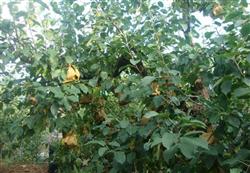 Zhongdi Network has compiled 12 methods for pruning apple trees. They are listed in detail below for the reference of gardeners.
Pruning method 1:When an apple tree grows too vigorously, branch growth dominates, which is not conducive to flower bud formation. When pruning, the main approach should be "slowing" the tree: increase the branching angle of the main limbs, thin out water sprout groups on the upper side of the branch, keep more lateral and lower branch groups, leave extension shoots unpruned, and use measures such as ringing on the scaffold limbs to control the transport of nutrients and promote flower formation.
Pruning method 2:If an apple tree grows too weakly, heavy pruning can be carried out on the basis of fertilizer and water management to stimulate vigorous growth. Extension shoots should be cut at a plump bud in the middle section, with a strong shoot leading, gradually raising the extension angle, keeping few branch groups on the underside of the branch and more branch groups on the upper side and both sides.
Pruning method 3:If an apple tree has large branches on one side and small branches on the other, showing lopsided crown growth, first, thin branches at the lower part of the branch and thin flowers at the upper part of the small branches; second, widen the angle of the large branches and raise the angle of the small branches; third, leave more fruit on the large branches and less fruit on the small branches; fourth, apply less fertilizer on the side of the large branches and more fertilizer on the side of the small branches. Never use drastic cutting and sawing to reshape the tree.
Pruning method 4:Some branches of an apple tree are not pruned for years and often extend on a single axis, rarely producing branches, forming long bare sections. Such branches have poor flower-forming ability and produce poor fruit growth and development. When pruning, if there is space, ring them to stimulate bud sprouting; or cut them back in time to stimulate branching and develop good branch groups. If there is no space, remove them immediately to improve ventilation and light penetration in the tree.
Pruning method 5:For apple trees that are strong at the top and weak at the bottom, a competing branch from the lower part of the canopy can be used to lead the extension, keeping the extension at a small angle to promote growth of the lower branches. For the middle and upper branches, increase the extension angle and select a branch on the underside of the branch as the extension shoot to balance tree vigor.
Pruning method 6:For apple trees that are weak at the top and strong at the bottom, the lower branches can be extended at a wide angle, with a branch from the back side leading, to weaken growth vigor; the upper branches can be extended at a narrow angle, with a branch on the upper side leading, to promote vigorous growth.
Pruning method 7:For young apple trees and trees bearing fruit for the first time, pruning should use a weak branch to lead, so as to control vegetative growth of the tree, increase nutrient accumulation in the tree, and promote flower formation. Ringing and other flow-blocking measures can also be carried out on auxiliary branches to promote flowering.
Pruning method 8:After an apple tree enters the full fruit-bearing stage, tree vigor is very easily weakened due to heavy fruiting. When pruning, heading back and cutting back should be used more often to strengthen vegetative growth and prevent decline in tree vigor. Leaving an appropriate amount of flowers can also be used to enhance tree vigor.
Pruning method 9:For crossing branches within the apple tree canopy, cut one back and leave one unpruned; when rows cross each other, both rows should be cut back so as to leave working aisles and improve ventilation and light penetration.
Pruning method 10:For young apple trees and apple trees bearing fruit for the first time, bending and training should be used as much as possible to increase the number of branches in the tree; for trees that have entered the full fruit-bearing stage, when there is no space, thin one branch and leave one branch unpruned to improve ventilation and light penetration in the tree.
Pruning method 11:In the early stage of apple tree growth, bending and pressing should be used to promote flowering and increase the fruit load of the tree. After fruiting, cut back immediately to avoid bare sections at the rear.
Pruning method 12: Apple trees need to have overly dense and tangled branches thinned out, and overly tall and weak drooping branches cut back, so that branch groups are evenly and compactly distributed. One- and two-year-old auxiliary branches that block light can be thinned out. For a single upright water sprout, if there is space, it can be trained by bending, pulling and twisting the branch. This eases decline and reduces apical dominance; if there is no space, it can be removed from the base.
For drooping branches of ordinary growth, a small amount of "live cap" cutting can be used to concentrate nutrients. For sprouts at pruning and saw cuts, if there is space, remove the upright ones and keep the slanting ones; if there is no space, all can be thinned out.
Temperature requirements for apple tree growth
Apple tree fertilization and watering methods
Click to get more apple tree planting techniques